
A budget gaming mouse sits in an awkward middle ground. You need tracking reliable enough to flick between targets without drift or spin-out, a shape that won’t cause wrist fatigue during a long session, and buttons placed where a thumb can find them without hunting. Below a certain price, any one of those requirements tends to fall apart — the sensor loses track at high DPI, the shell creaks after a few months, or the software is either missing entirely or so bloated it defeats the purpose of having a simple peripheral.
The eight best budget gaming mice on this list each solve that problem differently. Some lean on brand-name sensor technology at a lower price point, others pack surprising programmability into a shell that costs less than a lunch out. What separates the worthwhile picks from the disposable ones comes down to whether the manufacturer held firm on core hardware — sensor quality, switch longevity, ergonomic geometry — or quietly cut corners somewhere you notice only after a week of use.
As an Amazon Associate we earn from qualifying purchases at no extra cost to you. Product prices and availability are accurate as of the date shown and are subject to change.




![Redragon M602 Gaming Mouse, Ergonomic RGB Gaming Mouse Wired with 7200 Adjustable DPI, 9 Programmable Buttons, Professional Software for Gamer Office [Black]](https://m.media-amazon.com/images/I/4189L2UBl9L._SL160_.jpg)
Top 3 picks at a glance
Quick Picks
| Product | Best For | Price |
|---|---|---|
| Redragon M612 | Maximum DPI on a shoestring | $16.99 |
| Logitech G305 (Black) | Wireless freedom under $30 | $29.99 |
| Razer Basilisk V3 | Ergonomic comfort for long sessions | $34.98 |
| Razer DeathAdder Essential | A classic shape at the lowest entry price | $20.98 |
| Logitech G203 | Compact hands and fast swipes | $25.99 |
| Logitech G502 Hero | Power users who want every button | $37.99 |
| Logitech G305 (Blue) | Wireless with a bolder colorway | $34.99 |
| Redragon M602 | Nine programmable buttons on a budget | $16.99 |
How We Picked
We evaluated each mouse against four criteria that matter most in this category: sensor reliability at the DPI range an actual gamer uses (not the inflated headline number), physical comfort over extended play, software that adds functionality without slowing down your system, and build quality that survives repeated clicking without double-fault switches. Price is the baseline gate; everything else is about whether the manufacturer used that budget wisely or padded a spec sheet.
The 8 Best Budget Gaming Mice in 2026
Redragon M612
If you want the highest listed DPI in this group without spending more than the price of a coffee and a pastry, the M612 delivers an 8000 DPI optical sensor at $16.99. The RGB lighting adds visual appeal to a desk that otherwise looks like an office, and the remappable keys let you bind macros without expensive software suites.
- Pro: 8000 DPI covers even the highest sensitivity needs on a 4K monitor.
- Pro: Remapping keys without installing a heavy application.
- Con: Build materials feel plasticky and the cable is thin enough to feel fragile.
Skip it if you need wireless or if your grip style demands a contoured shell; this mouse is flatter and more ambidextrous-friendly than palm-grip-oriented.
Logitech G305 Lightspeed (Black)
The G305 Black is the cheapest credible wireless gaming mouse that Logitech will sell you, and at $29.99 it undercuts most wired competitors on brand-name sensor technology. Lightspeed keeps input latency competitive with cables, which matters in tactical shooters where a few milliseconds decide a duel.
- Pro: Wireless freedom without noticeable lag in competitive play.
- Pro: Proven Logitech sensor with stable tracking across common DPI ranges.
- Con: A single AA battery, so you swap rather than recharge.
Skip it if you dislike battery maintenance or need more than six buttons; the shape is minimal and the button count reflects that.
Razer Basilisk V3
At $34.98 the Basilisk V3 is the most feature-complete mouse in this roundup for someone who sits at their desk for hours. The ergonomic sculpting supports the palm and thumb naturally, RGB zones are customizable per profile, and the wheel has a tilt-click function that adds two bindings without extra physical buttons.
- Pro: Ergonomic shape designed for extended sessions without wrist strain.
- Pro: Rich customization through Razer Synapse with per-app profiles.
- Con: Synapse is resource-heavy and some users prefer a lighter driver experience.
Skip it if you have small hands or a claw grip — the Basilisk is a palm mouse and feels oversized otherwise.
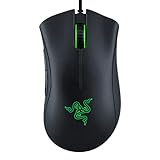
Razer DeathAdder Essential
The DeathAdder Essential takes one of the most recognized mouse silhouettes in gaming history and sells it at $20.98. It is wired, simple, and immediately familiar to anyone who played first-person shooters on a LAN in the 2010s. The ergonomic right-handed shape fits medium to large hands comfortably.
- Pro: Time-tested shape that needs no adaptation period.
- Pro: The lowest entry price in this list for a major brand name.
- Con: Limited button count and no RGB, so it looks plain beside the M612.
Skip it if you need high DPI or multiple programmable side buttons; this is a two-button-plus-wheel mouse at heart.
Logitech G203
The G203 at $25.99 is Logitech’s answer to “I want a good sensor and I do not care about wireless.” It uses the same tracking philosophy as pricier Logitech mice in a compact, lightweight shell. Small-hand users and claw-grip players benefit most because the narrower body reduces reach to the buttons.
- Pro: Compact form factor suits small hands and fast horizontal flicks.
- Pro: Reliable sensor with consistent tracking at moderate DPI settings.
- Con: Only six programmable buttons total, which limits MMO utility.
Skip it if you have larger hands or want a wireless setup; the shape can feel cramped for palm grip.
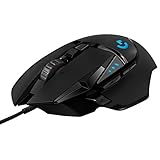
Logitech G502 Hero
At $37.99 the G502 Hero is the most expensive pick here and the one that justifies its price with sheer input density. Eleven programmable buttons, adjustable weight system, and a free-spin wheel mode make it the Swiss army knife for players who want one mouse for FPS, MMO, and desktop work without switching peripherals.
- Pro: Eleven buttons plus a tilt wheel give it the most inputs in this group.
- Pro: Adjustable weights let you tune balance without buying a different mouse.
- Con: At full weight it feels slow in competitive FPS compared to lighter rivals.
Skip it if you prioritize speed over versatility; the extra weight and button clutter work against fast flick shots.
Logitech G305 Lightspeed (Blue)
The Blue G305 is functionally identical to the Black version above, but Logitech prices it at $34.99 — a $5 premium for a different shell color. Under the hood you get the same Lightspeed wireless system and sensor. It is worth mentioning for buyers who specifically want blue and have no problem paying slightly more.
- Pro: Same reliable wireless performance as the Black variant.
- Pro: Distinctive color that stands out on a dark desk mat.
- Con: Costs more than the identical Black model for cosmetic difference alone.
Skip it if the $5 premium for a colorway bothers you; buy the Black and save the difference for a pad.
Redragon M602
The M602 packs nine programmable buttons and a 7200 DPI adjustable sensor into a $16.99 shell, making it the most input-dense budget mouse in this list. The ergonomic shape is wider than the M612, giving palm-grip users something more substantial to hold. Included software handles all button remapping without extra cost.
- Pro: Nine programmable buttons rival mice that cost twice as much.
- Pro: Free professional software covers macro and DPI switching.
- Con: Switch quality is the consistent complaint in owner feedback after heavy use.
Skip it if you play in a tournament where switch reliability matters more than button count; budget switches eventually double-register.
Buying Guide
Sensor DPI: Why the Headline Number Is Almost Never the Real Story
A mouse that advertises 8000 DPI will not make you aim better than one rated to 4000 DPI unless you actually run it above 4000. Most competitive players use between 400 and 3200 effective DPI on their mousepad surface. What matters more than the ceiling number is whether the sensor tracks consistently at your working range without smoothing, acceleration, or jitter. Check owner reviews for complaints about spin-out at your specific sensitivity rather than trusting the packaging.
Shape and Grip: The Spec You Cannot Return After a Tournament
Palm grip, claw grip, and fingertip grip each favor different mouse geometries. A tall, contoured body like the Basilisk V3 or G502 supports the full palm but fights claw grip players who need their arch free. A shorter, flatter shell like the G203 suits small hands and fingertip control but causes fatigue for larger palms. If you have not identified your grip style yet, a moderate ergonomic shape like the DeathAdder Essential gives you the most room to adapt without discomfort.
Wired Versus Wireless: The Budget Trade-Off Is Almost Gone
Wireless gaming mice once added latency that mattered in tactical shooters. Modern budget wireless options like the G305 close that gap enough that casual and semi-competitive players will not notice a difference. The real trade-off is battery maintenance and price. If you are fine swapping a single AA cell every few weeks, wireless at $29.99 removes cable drag from your mousepad and simplifies your setup. If you would rather never think about power, a wired mouse at $16.99 saves money and eliminates a moving part.
Our Verdict
The top pick for most buyers is the Logitech G305 Black at $29.99. It balances a reliable sensor, genuine wireless freedom, and a shape that works for multiple grip styles. The budget pick is the Redragon M612 at $16.99 for anyone who needs high DPI and basic RGB without spending more. If you have large hands and play marathon sessions, the Razer Basilisk V3 is worth the extra five dollars over the G305 because its ergonomic sculpting reduces wrist fatigue over hours of continuous use.
FAQ
Is a higher DPI always better for gaming?
No. Higher DPI means the cursor moves more pixels per inch of physical mouse travel, so you move your hand less. Most players find accuracy improves at moderate settings between 400 and 1600 DPI combined with lower in-game sensitivity. A very high DPI number is a marketing ceiling, not a performance requirement.
Do budget gaming mice last as long as expensive ones?
Typically not. Switch quality is the first component to degrade at lower price points, with double-registering clicks appearing after several months of heavy use. Sensor lifespan is less of a concern since optical sensors have no moving parts, but physical switches and cable strain relief are where manufacturers save cost.
Is wireless worth it for competitive gaming?
With modern low-latency wireless protocols like Logitech Lightspeed, the difference between a $30 wireless mouse and a $30 wired mouse is negligible for all but the most sensitive professional players. Cable drag can actually slow your flicks, so wireless often feels more responsive despite theoretical latency.
How many programmable buttons do I actually need?
Two to four side buttons cover most FPS and hero-shooter needs, such as crouch, push-to-talk, and reload. If you also play MMOs or want one mouse for Photoshop shortcuts and media controls, six or more becomes genuinely useful. The G502 Hero and Redragon M602 serve that expanded role without requiring a second device.


