
The best single tower CPU coolers for a gaming PC are the Thermalright Assassin X 120 Refined SE for tight budgets, the DeepCool AK400 for mainstream builds, and the Noctua NH-U12A or NH-U12S for quiet systems and premium builds; they suit builders with mid-range processors who want a cooler that clears RAM and side panels in a standard mid-tower. This guide compares what makers list, explains what a single tower can and cannot do and gives fit checks.
As an Amazon Associate we earn from qualifying purchases at no extra cost to you.

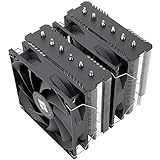


Top 3 picks at a glance
At a glance
| Cooler | Best for | Key stated specs | Limits |
|---|---|---|---|
| Thermalright Assassin X 120 Refined SE | Budget builds | Single tower; 148mm tall; one TL-C12C 120mm PWM ARGB fan; four 6mm heatpipes; 630g heatsink plus 120g fan; Intel 115x, 1200, 1700, 1851 and AMD AM4, AM5 | Entry-to-mid class, suited to mainstream CPUs |
| DeepCool AK400 | Mainstream gaming builds | Single tower, 120mm fan, direct-touch heatpipes as the maker describes; broad socket support | Read the maker’s TDP rating against your CPU |
| Noctua NH-U12A | Premium quiet cooling | Single tower with two 120mm fans; broad socket support | Premium tier; wide for RAM clearance |
| Noctua NH-U12S (Redux) | Quiet, RAM-friendly layout | Slim single tower, 120mm fan | Less headroom for flagship CPUs |
| Arctic Freezer 36 | Value with two fans | Tower with two 120mm fans in push-pull; LGA1851 and LGA1700 contact frame; maker says Intel-tested on i9-13900K, KF, 14900K and KS | Weight and TDP figures not shown on the maker’s excerpt |
Single tower versus dual tower
A single tower has one fin stack with a fan on one side or sandwiched. A dual tower, such as Thermalright’s Peerless Assassin 120 SE or Phantom Spirit 120 SE, which Thermalright lists as dual tower designs, uses two fin stacks and typically more heatpipes. Dual towers can handle more heat, but they are heavier, block more RAM space and make the board harder to access. A single tower fits more cases, leaves access to the first RAM slot more often and is easier to install. For a mid-range gaming CPU, a good single tower is enough.
The picks
Thermalright Assassin X 120 Refined SE: best budget single tower
Thermalright’s page calls it a single tower air cooler measuring 120mm long, 46mm wide and 148mm tall. It includes one TL-C12C fan (120x120x25mm) with PWM and ARGB, four 6mm heatpipes, a 630g heatsink and a 120g fan, and supports Intel 115x, 1200, 1700 and 1851 and AMD AM4 and AM5. The maker positions the series as entry-level to mid-range for mainstream CPUs. At 148mm it fits more small cases than a 155mm cooler. Pair it with a mid-range chip rather than a flagship.
DeepCool AK400: mainstream pick
DeepCool’s AK400 is a long-running single tower for mid-range processors, with a 120mm fan and direct-touch heatpipes. Because the maker’s page layout changes between revisions and variants (standard, Zero Dark, Digital), read the exact listing for height, TDP and socket support before ordering, and do not assume numbers across variants.
Noctua NH-U12A: premium quiet single tower
Noctua’s NH-U12A is a single tower with two 120mm fans designed for high airflow at low noise. It is a premium-tier cooler, and Noctua’s own socket pages list AMD and Intel support. Reviewers regularly cite Noctua’s mounting hardware, thermal paste and long warranties as reasons to pay more. The trade-off is its wide fin stack, which can touch tall RAM, so read the RAM-clearance guidance on the maker’s page.
Noctua NH-U12S Redux: simpler and cooler to the wallet
The U12S line is a slim single tower. Redux versions use simpler fans. It suits compact cases and tall-RAM builds, but it has less headroom for the hottest CPUs than a dual tower or a U12A.
Arctic Freezer 36: value with push-pull fans
Arctic’s page lists two 120mm fans in push-pull, a click-style fan mount, fluid dynamic bearings in the fans and an LGA1851/LGA1700 contact frame to reduce CPU bending. It states the cooler was confirmed by Intel on i9-13900K/KF, i9-14900K/KF and i9-13900KS. The page quotes a review that said it performed well in a noise-normalised test and beat larger coolers. Full weight and TDP specs were not in the page excerpt.
Fit and compatibility notes
- Case clearance: Read the case maker’s CPU cooler height limit. A 148mm cooler fits where a 160mm does not.
- RAM clearance: Tall heatspreaders may clash with a front fan. Some coolers allow raising the fan.
- Socket: AM5, AM4, LGA1700 and LGA1851 are listed for Thermalright; confirm older sockets if reusing a board.
- Weight: Heavy coolers strain boards when a PC is moved, particularly sideways. Packing the PC upright helps.
- Fan header and RGB: ARGB fans need a 5V connector; PWM fans use a four-pin header.
Budget tiers
- Budget: Thermalright Assassin X 120 Refined SE.
- Mid-range: DeepCool AK400 and Arctic Freezer 36.
- Premium: Noctua NH-U12A and NH-U12S for low noise and mounting kits.
Pick X if you…
| If you… | Pick | Why |
|---|---|---|
| Have a small case or tight limits | Assassin X 120 Refined SE | 148mm height |
| Want a no-fuss mainstream cooler | DeepCool AK400 | Well-known standard |
| Prioritise low noise | Noctua NH-U12A | Two fans, noted quiet |
| Have tall RAM | Noctua NH-U12S | Slim profile |
| Want two fans and a contact frame | Arctic Freezer 36 | Push-pull and Intel frame |
Alternatives
- Dual tower coolers: Thermalright Peerless Assassin 120 SE, listed at 155mm with six heatpipes and a 66.17 CFM fan maximum, are stronger but heavier.
- Thermalright Phantom Spirit 120 SE: Dual tower, 154mm, seven heatpipes.
- 240mm liquid coolers: For CPUs that exceed air limits, at a higher price.
Matching a cooler to your processor
Makers publish thermal design power guidance, and reviewers measure real temperatures, but the simplest rule is to match the class of cooler to the class of chip. Entry and mid-range processors from AMD’s Ryzen 5 and 7 families and Intel’s Core i5 class generally sit comfortably within the range that a quality single tower targets. Unlocked high-end chips that draw a lot of power under sustained load, such as Core i9 parts, are where dual towers or liquid coolers show an advantage. Arctic’s note that the Freezer 36 was confirmed by Intel on i9-13900K and i9-14900K parts shows the maker positioning it higher than a basic tower, though sustained workloads still depend on case airflow.
Case airflow matters as much as the cooler. A single tower needs intake air at the front and an exhaust at the rear or top; without it, even a premium tower will recirculate warm air. Fewer, larger fans spinning slower usually sound better than many small ones.
Installation notes
- Mounting hardware: Intel LGA1700 and LGA1851 use a different backplate setup than older sockets; AM4 and AM5 can reuse the stock backplate on many boards. Read the cooler’s manual for your socket.
- Order of assembly: Install RAM before large towers if the fan sits over the slots, or remove the fan first.
- Fan direction: The fan pulls air from the front of the case through the fins toward the rear. A second fan in push-pull mirrors that direction.
- Thermal paste: Apply a small amount in the centre of the CPU. Follow the maker’s guidance, because direct-touch heatpipe bases are sensitive to over-application.
- Contact frame: Arctic lists an LGA1851/LGA1700 contact frame to reduce mechanical CPU deformation, which suits builders who use these sockets.
Noise and fans
Thermalright lists the Peerless Assassin 120 SE fan at 25.6 dBA at maximum speed, an example of how makers describe noise. Single towers with one fan generally trade some peak cooling for lower noise at idle. Noctua’s two-fan towers distribute airflow across a larger fin area, while Arctic’s push-pull design uses two fans to pull air through the stack. PWM curves in the motherboard BIOS let you limit fan speed until the CPU passes a temperature threshold, which keeps a gaming PC near silent while browsing.
Single tower trade-offs in short
A single tower gives up some peak cooling in return for a lighter heatsink, easier access to the motherboard and wider case support. The Thermalright Assassin X 120 Refined SE lists a 630g heatsink, while Thermalright’s dual tower Peerless Assassin 120 SE lists 730g and its Phantom Spirit 120 SE lists 765g. Those differences matter when a PC is shipped or carried to events. For a standard gaming desktop that stays on a desk, either class works, and the choice comes down to the processor, the case and how much noise you will tolerate under load.
Before ordering, write down three numbers: the case’s maximum cooler height, the RAM module height and the CPU socket. Compare them with the maker’s listing, and you will rule out most mismatches in a minute.
Frequently Asked Questions
Is a single tower cooler enough for a gaming CPU?
For most mid-range processors, yes. Hotter flagship chips benefit from a dual tower or a liquid cooler.
How tall a cooler fits my case?
The case maker lists the maximum CPU cooler height. A 148mm cooler like the Assassin X 120 Refined SE fits where a 155mm design may not.
Will it fit with my RAM?
Measure the module height and the fan position. Slim towers such as the NH-U12S leave more room.
Do I need to replace the thermal paste?
Most coolers ship with paste applied or included. Follow the maker’s instructions.
Are ARGB fans worse for cooling?
No. The lighting is separate from airflow; it needs a header on the board.
Single or dual fan?
Two fans in push-pull can add airflow, as the Arctic and Noctua models do, at the cost of noise and width.
Related guides
More from Amazon
Programs that pair well with the guide above. Offers and eligibility are set by Amazon and may change.
Free shipping on eligible items, Prime Video and more. Eligible new members can start with a free trial.
Start a Prime free trialAd-free music streaming. Eligible new subscribers can start with a free trial.
Try Music Unlimited freeA Prime membership for ages 18-24 with a trial period. Eligibility is set by Amazon.
See Prime for Young AdultsAudiobooks and podcasts to listen to on the go. Eligible new members can start with a free trial.
Try Audible freeAs an Amazon Associate we earn from qualifying purchases.


