A multimeter tells you a power rail exists, but it cannot show you whether that rail is clean. When a gaming PC shuts down under load, drops USB devices at random, or refuses to wake from sleep, the fault is often hiding in ripple on a power supply output, a noisy fan tachometer signal, a clock line that never starts, or a power-good signal that arrives too early. An oscilloscope draws those signals as waveforms over time, which turns guesswork and parts swapping into a short, evidence-based diagnosis.
This guide compares five oscilloscopes that suit PC building, repair, and general electronics troubleshooting. The list runs from four-channel bench instruments that can watch several motherboard signals at once, through a high-bandwidth two-channel scope for fast digital edges, to compact desktop and handheld models that add signal generation and multimeter functions. Every pick covers the low-voltage, ground-referenced signals found inside a desktop PC, and the buying notes below explain which specifications actually matter for this kind of work.
As an Amazon Associate, we earn from qualifying purchases.
Top 3 picks at a glance

What to look for in an oscilloscope for PC troubleshooting
Bandwidth decides the fastest signal a scope can display honestly. Most PC troubleshooting targets are slow by electronics standards: fan pulse-width modulation signals, power supply ripple, reset and power-good lines, and low-speed serial buses all sit well below one megahertz. A 50 megahertz scope already covers that work, while 100 megahertz adds comfortable headroom for crystal oscillators, switch-mode converter switching waveforms, and faster data lines. A common rule of thumb is to choose bandwidth at least five times higher than the fastest signal of interest, so edges still look like edges rather than rounded slopes.
Channel count shapes how you diagnose sequencing faults. Two channels let you compare an input against an output, such as a voltage regulator input rail versus the rail it produces. Four channels go further: you can watch the 12 volt, 5 volt, and 3.3 volt rails plus the power-good line during a single power-up, and see immediately which rail rises late or dips first. For intermittent shutdowns, that single-capture comparison is often the fastest route to the faulty part.
Sample rate and memory depth work together. A sample rate of one gigasample per second captures fast transients without aliasing, and deep memory, measured in points, keeps that resolution over longer time windows, which matters when you record a full boot sequence and then zoom into one moment. Trigger options matter just as much: edge triggering handles most jobs, while pulse-width and runt triggers help catch glitches that only appear under load.
Serial decoding is a quiet advantage for PC work. Scopes that decode I2C, SPI, UART, and similar protocols can read traffic between embedded controllers, sensors, and firmware chips on a motherboard, which helps when a board hangs before any display output appears. Finally, consider safety and practicality. PC signals are low voltage, so standard passive probes are appropriate, but probe grounding discipline is essential: a bench scope probe ground clip connects to earth ground, so never clip it to anything other than a ground-referenced point inside the PC, and keep clear of the inside of the power supply itself, where mains voltage is present.
1. Siglent SDS1104X-E
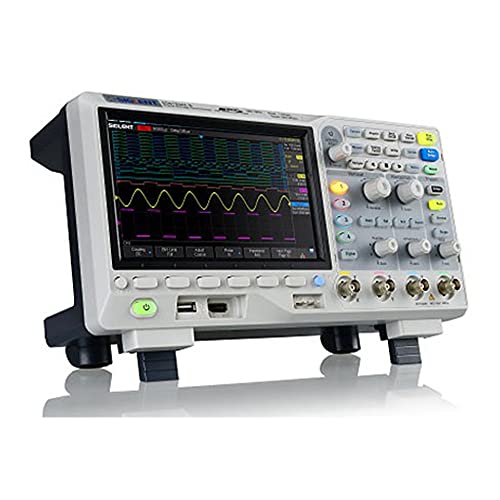
The Siglent SDS1104X-E is the strongest all-round choice for a repair bench that handles PCs alongside other electronics. Its four channels and 100 megahertz bandwidth let you monitor multiple power rails and control signals in one capture, which is exactly what power sequencing and intermittent shutdown diagnosis demand. A one gigasample per second sample rate and deep 14 megapoint memory keep waveforms detailed when you zoom into a recorded boot sequence, and serial protocol decoding is included as standard rather than sold as an add-on, which suits motherboard-level work on sensor and controller buses.
The seven-inch display is clear and the interface responds quickly, with intensity-graded traces that make occasional glitches easier to spot among repetitive waveforms. A history mode and segmented memory help catch events that happen once in many power cycles, a common pattern with marginal power supplies and cracked solder joints. For builders moving beyond basic voltage checks, this scope stays useful as repairs get more ambitious.
Specs
| Specification | Detail |
|---|---|
| Bandwidth | 100 MHz |
| Channels | 4 |
| Sample rate | 1 GSa/s |
| Memory depth | 14 Mpts |
| Display | 7-inch color display |
| Extras | Serial decoding included, waveform history mode |
2. Rigol DS1054Z
The Rigol DS1054Z has been a fixture on hobbyist and repair benches for years, and its appeal for PC troubleshooting is easy to understand. Four channels at 50 megahertz cover power rails, fan signals, clocks on slower buses, and regulator outputs with room to spare, while the one gigasample per second sample rate keeps edges honest at the time scales PC work involves. Deep memory, up to 12 megapoints as standard, supports long captures of power-up behavior that can be reviewed and measured afterwards.
The large seven-inch screen, intensity-graded display, and straightforward control layout make it approachable for a first bench scope, and the mature firmware offers a broad set of automatic measurements, math functions, and trigger types. Optional serial decoding can be added for bus work. Builders who want a proven four-channel instrument focused on the fundamentals, without paying for bandwidth they will rarely use inside a PC, will find this model a dependable centerpiece for a troubleshooting bench.
Specs
| Specification | Detail |
|---|---|
| Bandwidth | 50 MHz |
| Channels | 4 |
| Sample rate | 1 GSa/s |
| Memory depth | 12 Mpts |
| Display | 7-inch color display |
| Extras | Intensity-graded traces, extensive automatic measurements |
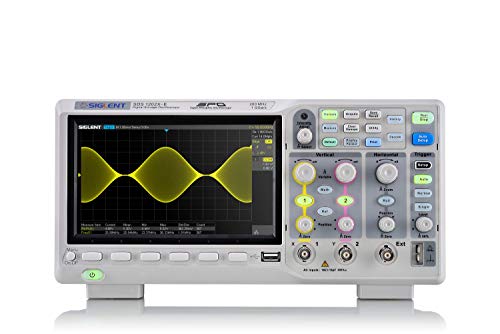
3. Siglent SDS1202X-E
Where the four-channel models trade on visibility, the Siglent SDS1202X-E trades on speed. Its 200 megahertz bandwidth and one gigasample per second sample rate render fast digital edges, crystal oscillator waveforms, and switch-mode converter switching nodes with noticeably better fidelity, which helps when a fault involves ringing, overshoot, or a marginal clock signal. Two channels are enough for the classic input-versus-output comparisons used to judge voltage regulators and power supply behavior under changing loads.
The scope shares the responsive interface and deep 14 megapoint memory of its sibling, adds serial decoding as standard, and uses a fast waveform capture rate that improves the odds of seeing rare glitches. A super phosphor style display presents signal density in a way that makes noise and occasional dropouts visible at a glance. Technicians who already know their work centers on two signals at a time, and who want the extra bandwidth for faster circuits and general electronics beyond PCs, should put this model high on the list.
Specs
| Specification | Detail |
|---|---|
| Bandwidth | 200 MHz |
| Channels | 2 |
| Sample rate | 1 GSa/s |
| Memory depth | 14 Mpts |
| Display | 7-inch color display |
| Extras | Serial decoding included, fast waveform capture rate |
4. FNIRSI 1014D
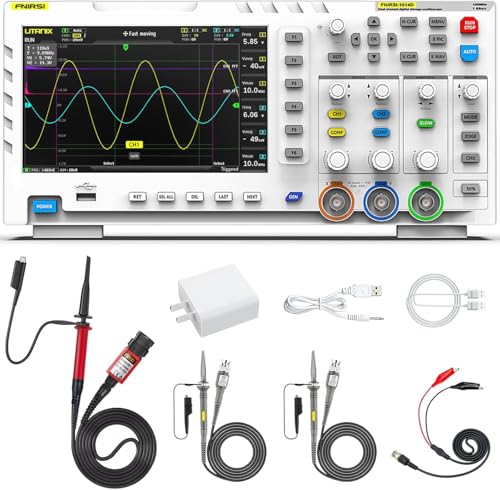
The FNIRSI 1014D packs a two-channel, 100 megahertz oscilloscope and a DDS signal generator into one compact desktop unit, which suits smaller benches and builders who also experiment with audio gear, microcontrollers, and retro hardware. The one gigasample per second sample rate matches the bench models above, and the built-in generator can inject test signals into fan controllers, audio paths, and sensor inputs, so you can watch a circuit respond without a second instrument on the desk.
A seven-inch TFT display, straightforward menus, and screenshot storage make it easy to document a fault before and after a repair. A high-voltage probe option in the box extends it to switching waveforms on the secondary side of small power supplies, within the stated probe limits. It gives up the deep memory, decoding options, and refined triggering of the larger bench scopes, but as a first oscilloscope for PC troubleshooting and hobby electronics, it covers the essential measurements in a tidy footprint.
Specs
| Specification | Detail |
|---|---|
| Bandwidth | 100 MHz |
| Channels | 2 |
| Sample rate | 1 GSa/s |
| Display | 7-inch TFT display |
| Extras | Built-in DDS signal generator, screenshot storage |
| Form factor | Compact desktop unit |
5. Hantek 2D72

The Hantek 2D72 takes the opposite approach to a bench scope: it combines a two-channel oscilloscope, a waveform generator, and a multimeter in one battery-powered handheld. That combination is genuinely useful for PC work away from the main bench, such as checking fan headers and power rails inside a built system, verifying a replacement power supply at a workbench across the room, or helping a friend whose PC fails at home. Battery operation also means the instrument floats relative to earth ground, which removes the probe ground worries that come with bench scopes for quick low-voltage checks.
Bandwidth is 70 megahertz with a 250 megasample per second sample rate, which is ample for power, fan, audio, and control signals, though fast digital edges will look softer than on the one gigasample models above. The multimeter functions handle continuity, resistance, capacitance, and diode checks, so one device covers most of a first-pass diagnosis. Repairers who value portability and an all-in-one toolkit over deep memory and decoding will appreciate how much troubleshooting fits in a single handheld unit.
Specs
| Specification | Detail |
|---|---|
| Bandwidth | 70 MHz |
| Channels | 2 |
| Sample rate | 250 MSa/s |
| Display | Color handheld display |
| Extras | Waveform generator and multimeter built in |
| Power | Rechargeable battery, portable |
FAQ
How much bandwidth do I need for PC troubleshooting?
Most signals inside a PC that a repairer can safely and usefully probe, including power rails, fan signals, reset lines, and low-speed buses, are slow enough that 50 megahertz is sufficient. Choosing 100 megahertz adds headroom for oscillator and converter waveforms and keeps the scope useful for other electronics, while 200 megahertz mainly benefits faster digital circuits beyond typical PC repair.
Can an oscilloscope find a faulty power supply?
Yes, within limits. A scope shows ripple and noise on the output rails, voltage dips during load changes, and the order and timing of rail startup, all of which point to a weak or failing unit. Work only on the low-voltage outputs, never open the power supply casing, and treat the primary side as off limits because mains voltage is present there.
Is a handheld oscilloscope good enough for motherboard repair?
A handheld model handles power checks, fan and audio signals, clock presence, and many control lines, which covers a large share of everyday faults. Board-level diagnosis that depends on deep memory, four simultaneous channels, or protocol decoding is easier on a bench scope, so frequent repair work justifies the larger instrument, while occasional troubleshooting suits a handheld well.
What should I check first on a PC that will not power on?
Start with the standby rail and the power-good signal, then watch each main rail as the power button is pressed. A rail that never rises suggests a supply or enable fault, a rail that rises and collapses suggests a short or overload, and a power-good signal that arrives before the rails settle points to a sequencing problem the motherboard may be reacting to.
Final verdict
For most PC repair benches, the Siglent SDS1104X-E is the pick to beat: four channels, included serial decoding, and deep memory make power sequencing and intermittent faults far easier to pin down. The Rigol DS1054Z remains a proven four-channel alternative for slower signals, while the Siglent SDS1202X-E suits anyone who wants 200 megahertz of bandwidth for faster circuits. On a smaller desk, the FNIRSI 1014D adds a signal generator, and the Hantek 2D72 is the portable all-in-one for checks away from the bench. Any of these five will reveal problems a multimeter alone cannot show.
Product and ASIN Reference
| Product | ASIN |
|---|---|
| Siglent SDS1104X-E | B0771N1ZF9 |
| Rigol DS1054Z | B012938E76 |
| Siglent SDS1202X-E | B06XZML6RD |
| FNIRSI 1014D | B097T5NRTZ |
| Hantek 2D72 | B07PWZTNJK |
Related guides
More from Amazon
Programs that pair well with the guide above. Offers and eligibility are set by Amazon and may change.
Free shipping on eligible items, Prime Video and more. Eligible new members can start with a free trial.
Start a Prime free trialAd-free music streaming. Eligible new subscribers can start with a free trial.
Try Music Unlimited freeA Prime membership for ages 18-24 with a trial period. Eligibility is set by Amazon.
See Prime for Young AdultsAudiobooks and podcasts to listen to on the go. Eligible new members can start with a free trial.
Try Audible freeAs an Amazon Associate we earn from qualifying purchases.