A melodica is one of the friendliest first instruments a child can pick up. It looks like a small piano keyboard, it sounds when the player blows into a mouthpiece, and it makes a real musical note from the very first breath, which is why schools have used it for generations. For families who love game nights, a melodica also fits right in: children can learn tunes like levels in a game and play together in a living room ensemble.
Choosing the right melodica matters more than most parents expect. The wrong key count can leave a child short of the notes in a method book, an instrument that is too heavy can tire small arms, and a flimsy body can leak air just when a child starts to feel confident. This guide compares five melodicas that suit young players, from a light 32-key starter to a rich 37-key step-up.
As an Amazon Associate, we earn from qualifying purchases.
Top 3 picks at a glance


What to look for in a gaming melodica for kids
Start with key count, which sets the range a child can play. A 32-key melodica covers about two and a half octaves, from F below middle C up to C two octaves above it, which is enough for most beginner tunes and school songs. A 37-key melodica adds five more notes, giving a full three octaves for a player who wants to tackle harder pieces. For a first instrument, 32 keys is the safe default.
Size and weight come next. A melodica is held in the hands while the player blows, so a long, heavy body can tire a young player during practice. Look for a compact body under 50 centimetres long and a weight under one kilogram for a child under ten.
The mouthpiece setup decides how the instrument feels to play. A short mouthpiece is simple and direct, and it works well for a child sitting at a table. A flexible tube lets the player hold the melodica flat on a lap or a desk and blow from a comfortable angle, which suits longer sessions and group playing. Every melodica in this guide ships with at least one mouthpiece and a tube, so a child can try both styles. Material shapes tone and durability: ABS plastic and resin are light and tough, while metal-cover models with phosphor bronze reeds sound warmer but weigh more. Finally, check what comes in the box: a case that doubles as a music stand is a handy bonus, and a carry bag keeps the tubes and mouthpieces together.
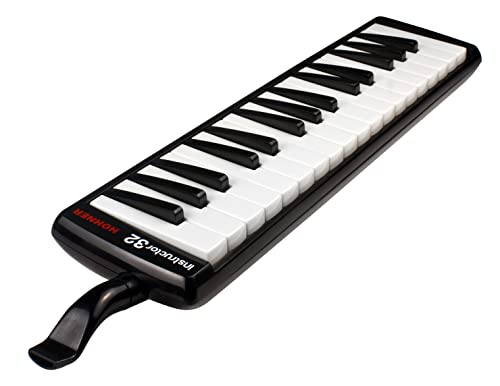
1. Hohner 32B Instructor Melodica, Black
The Hohner 32B is the classroom standard for a reason, and it is the safest first melodica for a child. Hohner created the melodica, and the 32B is its student model, built for beginners and advancing players alike. It speaks easily, it stays in tune with itself, and it survives being carried in a school bag day after day.
The 32B has 32 piano-style keys covering F to C, about two and a half octaves, which matches the range that most beginner method books assume. The ergonomic mouthpiece and the flexible tube are both included, so a child can play it held in the hands or flat on a desk. The sturdy plastic hard case doubles as a music stand.
What the 32B does not offer is the extra range of a 37-key instrument. A player who practises daily will eventually want those five extra notes for harder pieces. That is the right trade for a first melodica: the proven design removes the risk from starting, and the instrument keeps its value as a spare or a classroom backup once the player moves on.
Specs
| Feature | Detail |
|---|---|
| Keys | 32 piano-style keys |
| Range | F to C, about two and a half octaves |
| Body | Coloured acrylic, black |
| Length | 42 cm |
| Weight | 580 g |
| Mouthpieces | Ergonomic mouthpiece and flexible tube |
| Includes | Plastic hard case that doubles as a music stand |
| Best for | First-time players and school use |
| ASIN | B0055DCWKS |
2. Yamaha Pianica P-32D Melodica, Blue
The Yamaha Pianica P-32D is the school-standard alternative to the Hohner, for a family that wants Yamaha build quality in a bright, child-friendly colour. Its clear, bright tone speaks evenly across the notes, and it responds quickly even with a small amount of air.
The P-32D has 32 keys spanning F3 to C6, the same range as the Hohner, and its smooth-action keyboard gives each key its own suspension spring with anti-vibration guides. That design keeps the key feel consistent from the lowest note to the highest, which helps a young player build even finger control. The internal brass reeds carry a corrosion-resistant coating, and a seamless rubber seal encloses the air chamber to prevent leaks.
The blue body and matching hard case give the P-32D a cheerful look that children enjoy, and the case can be used as a music stand. The fixed mouthpiece and the flexible air tube are both included, so the player can switch between holding the instrument and resting it on a desk.
Specs
| Feature | Detail |
|---|---|
| Keys | 32 |
| Range | F3 to C6 |
| Body | Plastic, blue |
| Dimensions | 17.8 x 6.7 x 2.5 inches |
| Weight | 1.43 lbs (650 g) |
| Mouthpieces | Fixed mouthpiece and flexible air tube |
| Includes | Hard protective case that can be used as a music stand |
| Best for | School use and advancing beginners |
| ASIN | B0051PP2IY |
3. Eastar 32 Keys Melodica, Black
The Eastar 32 Keys Melodica is the best budget starter, a complete kit without a famous brand name. It is a soprano melodica with a full 32-key range, and it ships with two soft long tubes, two short mouthpieces, and a carrying bag, so a child can try every playing style on the first day.
At 345 grams, the Eastar is the lightest melodica in this guide, and its compact body suits small hands and younger arms. The soprano voicing gives a clear, bright tone that carries well in a living room, and the two tube sets mean a sibling or a friend can join in without sharing a mouthpiece.
The compromise is build quality: the resin body and the simple reeds do not sound as warm or as rich as the Hohner or the Yamaha, and a player who practises daily will outgrow it sooner. That is the right trade for a first try, because the instrument still teaches every skill a beginner needs, from breath control to keyboard geography.
Specs
| Feature | Detail |
|---|---|
| Keys | 32, soprano |
| Body | Resin, black |
| Dimensions | 45.5 x 9.1 x 15.7 cm |
| Weight | 345 g |
| Model number | EB006 |
| Mouthpieces | Two soft long tubes and two short mouthpieces |
| Includes | Carrying bag |
| Best for | Budget first melodicas and younger players |
| ASIN | B078JM7BH4 |
4. CAHAYA Melodica 37 Keys, Blue

The CAHAYA Melodica 37 Keys is the pick for a child who is ready for more range. Its bright blue body stands out in a classroom, and its 37 keys give a full three octaves, so a player can tackle pieces that a 32-key melodica cannot reach.
The extra keys are the headline, but the accessories matter too. Two mouthpiece tube sets are included, along with a carrying bag, so the player can switch between a short mouthpiece for close playing and a long tube for a relaxed posture. The 37-key layout also matches the range of a full piano octave set, which helps a child who already takes piano lessons transfer what they know.
The trade-off is size: at about 20 inches long in its package, the CAHAYA is the longest instrument here, and younger children may find the wider stretch tiring during long sessions. The tone is bright rather than warm, and it does not have the metal reeds of the step-up Suzuki.
Specs
| Feature | Detail |
|---|---|
| Keys | 37 |
| Body | ABS, blue |
| Model number | CY0049-2 |
| Package dimensions | 20.0 x 5.0 x 2.0 inches |
| Weight | 1 kg |
| Mouthpieces | Two mouthpiece tube sets |
| Includes | Carrying bag |
| Best for | Players ready for a full three-octave range |
| ASIN | B0B6HYV28H |
5. Suzuki M-37C Alto Melodion

The Suzuki M-37C is the step-up instrument for a child who is serious about the melodica, and it is the only metal-cover model in this guide. Suzuki calls its version the Melodion, and the M-37C is its semi-professional alto model, made in Japan with aluminium covers and phosphor bronze reeds, giving a warmer, richer tone than any plastic melodica here.
The M-37C has 37 keys covering F to F, a full three octaves, and it comes with three mouthpieces: a standard mouthpiece, a trumpet-style mouthpiece, and a flexible tube. That choice lets a player shape their tone and their posture, and it suits a child who is learning tonguing and breath control in lessons.
The compromise is weight and complexity. At 0.94 kilograms, the M-37C is the heaviest melodica here, and its richer tone rewards good breath control rather than forgiving sloppy playing. For an older child who practises regularly or plays in an ensemble, the M-37C is the clear step-up pick.
Specs
| Feature | Detail |
|---|---|
| Keys | 37, alto |
| Range | F to F, three octaves |
| Body | Aluminium covers, phosphor bronze reeds |
| Dimensions | 47 x 11 x 5.5 cm |
| Weight | 0.94 kg |
| Model number | M-37C |
| Mouthpieces | Standard, trumpet-style, and flexible tube |
| Includes | Light soft case |
| Best for | Serious young players and ensemble use |
| ASIN | B000XYFBMK |
FAQ
How many keys should a child start with on a melodica?
Start with 32 keys for most children. That range covers about two and a half octaves, which is enough for beginner tunes, school songs, and simple pop melodies. A 37-key melodica suits an older child who already reads music or plays piano.
What is the difference between a melodica, a Pianica, and a Melodion?
They are the same kind of instrument with different brand names. Yamaha calls its version the Pianica, Suzuki calls its version the Melodion, and other makers use the general name melodica.
Should a child use the short mouthpiece or the flexible tube?
Try both, because every melodica in this guide includes both. The short mouthpiece is simple and direct for playing held in the hands, while the flexible tube lets the player rest the instrument on a desk or a lap.
How do you clean and store a melodica after playing?
Shake out any moisture, wipe the keys with a cleaning cloth, and wash the mouthpiece with warm soapy water before letting it dry fully. Store the instrument in its case or bag with the tube and mouthpieces inside, so the parts stay together and the keys stay free of dust.
Final verdict
For most families, the Hohner 32B is the best first melodica for a child: it is light, proven in classrooms, and its hard case doubles as a music stand. The Yamaha P-32D is the closest rival, with the same range and a bright blue finish that children enjoy. The Eastar 32 is the sensible budget starter for a younger child, while the CAHAYA 37 gives an older player a full three-octave range. The Suzuki M-37C is the step-up for a serious young player who wants a warmer tone.
Product and ASIN Reference
| Product | ASIN |
|---|---|
| Hohner 32B Instructor Melodica, Black | B0055DCWKS |
| Yamaha Pianica P-32D Melodica, Blue | B0051PP2IY |
| Eastar 32 Keys Melodica, Black | B078JM7BH4 |
| CAHAYA Melodica 37 Keys, Blue | B0B6HYV28H |
| Suzuki M-37C Alto Melodion | B000XYFBMK |
Related guides
- Best Play Tents for Kids: Imaginative Hideaways to Enjoy: 5 Compared (2026)
- Best Picnic Sets for Kids: 5 Fun Picks for Outdoor Play: 5 Compared (2026)
- Best Golf Clubs for Kids: 5 Junior Sets for Young Golfers: 5 Compared (2026)
- Best Crochet Kits for Kids: Easy Beginner Amigurumi Sets: 5 Compared (2026)
More from Amazon
Programs that pair well with the guide above. Offers and eligibility are set by Amazon and may change.
Free shipping on eligible items, Prime Video and more. Eligible new members can start with a free trial.
Start a Prime free trialAd-free music streaming. Eligible new subscribers can start with a free trial.
Try Music Unlimited freeA Prime membership for ages 18-24 with a trial period. Eligibility is set by Amazon.
See Prime for Young AdultsAudiobooks and podcasts to listen to on the go. Eligible new members can start with a free trial.
Try Audible freeAs an Amazon Associate we earn from qualifying purchases.