Choosing the right tennis balls for kids can turn a first lesson into a lasting hobby. Standard adult balls move fast and bounce high, which can feel intimidating to a young player who is still learning to watch the ball, move into position, and swing with control. Balls made for children solve that problem by travelling more slowly and bouncing lower, giving young players extra time to prepare for each shot.
This guide brings together five strong options, from soft foam balls for the youngest beginners to low-compression felt balls for older children who are ready for longer rallies. Each pick suits a different stage of learning, so families can match the ball to the child rather than forcing the child to adapt to the ball.
As an Amazon Associate, we earn from qualifying purchases.
Top 3 picks at a glance


What to look for in tennis balls for kids
The most important factor is the stage of the ball. Youth tennis follows a simple colour system that matches ball speed and bounce to court size and player age. Red balls are the slowest and largest, made for short courts and players aged eight and under. Orange balls are a step up, made for mid-size courts and players around nine and ten. Green dot balls are faster still and suit older juniors moving toward a full-size court.
Material matters almost as much as stage. Foam balls are the softest and safest choice for indoor play, driveways, and very young children, because they barely sting on contact and move gently through the air. Felt balls feel closer to the real game and behave more predictably on outdoor courts, which makes them a better fit once a child starts taking lessons or playing regular matches.
Pack size is worth thinking about before buying. A small pack of two or three balls is fine for one child practising at home, but larger packs of twelve or more balls keep lessons flowing without constant trips to collect stray balls, and they suit group sessions, summer camps, and school programmes.
Visibility and durability round out the checklist. Bright two-tone designs help children track the ball and read its spin, which is a real advantage while hand-eye coordination is still developing. Foam balls wear out faster on rough outdoor surfaces and are best kept for smooth courts and indoor spaces, while felt balls hold up better outdoors. Pressureless balls keep their bounce for a long time because they do not rely on internal air pressure, which makes them a sensible choice for practice buckets and ball machines.
1. Penn QST 36 Foam Tennis Balls
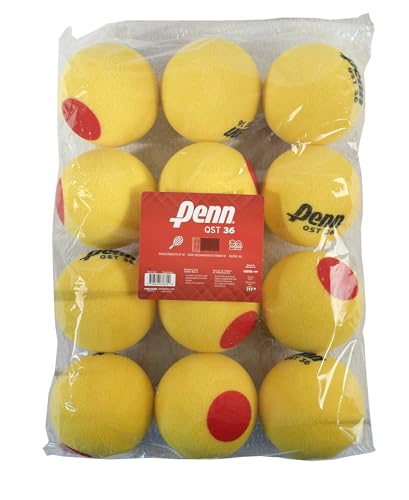
The Penn QST 36 Foam ball is a natural starting point for the youngest players. Made from high-density lightweight foam, it has an oversized diameter that gives children a bigger target to aim at. It is designed for 36-foot courts and for players aged eight and under, which is exactly the stage where most children first pick up a racket.
What sets this ball apart is how gently it behaves in the air. The foam construction slows the ball down a great deal compared with a standard ball, so children have time to watch it travel, move their feet, and set up a swing instead of reacting in a panic.
The red and yellow two-tone design is another thoughtful touch. The bright colours stand out against most court surfaces, and the two-tone split helps children see the spin on the ball, which builds early awareness of how different strokes affect the ball in flight. Because it is a foam ball, this pick is best suited to indoor courts, smooth driveways, and short-court sessions, and it is quiet on indoor floors, which makes it a good option for school halls and community centres.
Specs
| Feature | Detail |
|---|---|
| Brand | Penn |
| Ball type | Foam training ball |
| Stage | Red stage, 36-foot court |
| Age range | 8 and under |
| Material | High-density lightweight foam |
| Colour | Red and yellow |
| Approval | USTA and ITF approved for youth play |
| ASIN | B00KLXJ8YU |
2. Penn QST 60 Felt Tennis Balls
Once a child outgrows the red stage, the Penn QST 60 is the logical next step. This is a felt ball with a low-compression core, designed for 60-foot courts and for players aged nine and ten. It moves faster than a foam ball and feels much closer to a standard tennis ball.
The orange and yellow felt gives the ball excellent visibility on court, and the durable felt surface holds up well during outdoor sessions on hard courts and driveways.
A twelve-ball pack makes this option particularly useful for families and coaches. A dozen balls is enough to run a full lesson without stopping to gather balls every few minutes, and it gives children plenty of spares when balls roll under fences or into neighbouring courts. The polybag packaging also keeps the set together between sessions. The QST 60 is approved for youth play, so it meets recognised standards for bounce and speed at the orange stage.
Specs
| Feature | Detail |
|---|---|
| Brand | Penn |
| Ball type | Low-compression felt ball |
| Stage | Orange stage, 60-foot court |
| Age range | 9 and 10 |
| Pack size | 12 balls |
| Material | Durable felt with low-compression core |
| Colour | Orange and yellow |
| Approval | USTA and ITF approved for youth play |
| ASIN | B00559AVBO |
3. Wilson Starter Orange Tennis Balls, 48 Pack
For families, schools, and clubs that go through tennis balls quickly, the Wilson Starter Orange 48-pack offers serious quantity at a scale that suits group play. These are low-compression felt balls in the orange stage, made for 60-foot courts and for players around nine and ten years old.
The ball itself is built for beginners who are moving beyond foam. It has a softer bounce than a standard ball, which gives young players time to read the flight of the ball and prepare their shots.
Bulk packs are where this option earns its place. A coach running weekly group lessons can lose several balls in a single session to fences, hedges, and drains, so having nearly fifty balls on hand removes the worry of running short mid-lesson. Families with several children will also appreciate the generous count, and the balls store neatly in a ball hopper or a large mesh bag.
Specs
| Feature | Detail |
|---|---|
| Brand | Wilson |
| Ball type | Low-compression felt ball |
| Stage | Orange stage, 60-foot court |
| Age range | 9 and 10 |
| Pack size | 48 balls |
| Material | Felt with low-compression core |
| Colour | Orange |
| Best for | Group lessons, schools, and clubs |
| ASIN | B007WJ44GI |
4. Franklin Sports Pressureless Tennis Balls, 12 Pack

The Franklin Sports Pressureless Tennis Balls take a different approach to the practice ball. Instead of relying on internal pressure to create bounce, these balls are built with a solid-feeling rubber core and a durable outer layer, which means they keep a consistent low bounce over a long period of use.
A lower bounce is exactly what many young players need. These balls are official size, so they feel familiar in the hand and on the racket, while the low-pressure design keeps rallies at a manageable tempo for learners.
The twelve-pack comes with a mesh carry bag, which is a genuinely useful extra. Balls stay together between sessions, and the bag makes it easy to carry the set to the park, the club, or a friend’s driveway court. A dozen balls is a practical number for a single child or a small group, and the pressureless design means the set will still be bouncing well long after pressurised balls would have gone flat.
Specs
| Feature | Detail |
|---|---|
| Brand | Franklin Sports |
| Ball type | Pressureless training ball |
| Pack size | 12 balls |
| Included | Mesh carry bag |
| Material | Rubber core with durable outer layer |
| Court surface | All court surfaces |
| Bounce | Low bounce for training and practice |
| ASIN | B0BHFBXM9H |
5. GAMMA Quick Kids 36 Training Balls, 12 Pack

The GAMMA Quick Kids 36 is a long-standing favourite among coaches who teach the red stage. This is a low-compression felt ball designed for 36-foot courts and for players aged eight and under. Its bright yellow and orange two-tone surface is instantly recognisable on court and helps young players track the ball from the moment it leaves the racket.
Speed is the key feature here. The low-compression core makes the ball travel at a much slower pace than a standard ball, which gives children time to get into position and make a clean contact. The felt surface also gives a more realistic feel than foam, which helps children who are ready to move from soft indoor balls to proper outdoor play.
Durability is another strength. The extra-durable felt is built to survive repeated drills and rallies on hard courts, and the twelve-ball pack gives coaches enough balls to keep a lesson moving without constant interruptions. The set is also approved for youth tournaments at the 10-and-under level, so families can be confident that the ball meets the standards used in organised junior play.
Specs
| Feature | Detail |
|---|---|
| Brand | GAMMA |
| Ball type | Low-compression felt training ball |
| Stage | Red stage, 36-foot court |
| Age range | 8 and under |
| Pack size | 12 balls |
| Material | Extra-durable felt with low-compression core |
| Colour | Yellow and orange |
| Approval | USTA and ITF approved for youth play |
| ASIN | B00166T9TA |
FAQ
Which tennis balls are best for a child who has never played before?
A soft foam ball or a red-stage low-compression ball is the best starting point for a complete beginner. Foam balls are the gentlest option and suit indoor play and very young children, while red-stage felt balls add a more realistic feel for outdoor lessons on a short court.
What is the difference between red, orange, and green tennis balls for kids?
Red balls are the slowest and are made for short courts and players aged eight and under. Orange balls are faster and suit mid-size courts and players around nine and ten. Green dot balls are faster still and prepare older juniors for a full-size court.
How many tennis balls should a family buy for a young player?
A small pack of two or three balls is enough for casual backyard play, but a pack of twelve is a better choice once a child starts taking lessons. Larger packs keep practice sessions flowing and provide spares when balls go missing.
Can kids use regular adult tennis balls instead of youth balls?
Adult balls are faster and bounce higher, which makes rallies harder to sustain and can frustrate a young player who is still learning. Youth balls are designed to match a child’s height, strength, and reaction time, so they make the game more enjoyable and help good habits form earlier.
Final verdict
The best tennis balls for kids are the ones that match the child’s stage. The Penn QST 36 Foam ball is the gentlest introduction for the youngest players, while the GAMMA Quick Kids 36 and the Penn QST 60 carry children through the red and orange stages with well-made, approved felt balls. The Wilson Starter Orange 48-pack is the pick for groups and busy households that need quantity, and the Franklin Sports Pressureless set is a durable training option that keeps its bounce through long practice sessions.
Product and ASIN Reference
| Product | ASIN |
|---|---|
| Penn QST 36 Foam Tennis Balls | B00KLXJ8YU |
| Penn QST 60 Felt Tennis Balls | B00559AVBO |
| Wilson Starter Orange Tennis Balls, 48 Pack | B007WJ44GI |
| Franklin Sports Pressureless Tennis Balls, 12 Pack | B0BHFBXM9H |
| GAMMA Quick Kids 36 Training Balls, 12 Pack | B00166T9TA |
Related guides
More from Amazon
Programs that pair well with the guide above. Offers and eligibility are set by Amazon and may change.
Free shipping on eligible items, Prime Video and more. Eligible new members can start with a free trial.
Start a Prime free trialAd-free music streaming. Eligible new subscribers can start with a free trial.
Try Music Unlimited freeA Prime membership for ages 18-24 with a trial period. Eligibility is set by Amazon.
See Prime for Young AdultsAudiobooks and podcasts to listen to on the go. Eligible new members can start with a free trial.
Try Audible freeAs an Amazon Associate we earn from qualifying purchases.