
The Short Answer
Yes — OLED is worth it for a gaming monitor if you play fast-paced or atmospheric games in a room where you can control ambient light, and you can live with the one real condition: you need to practice basic panel-care habits (varied content, screen savers, periodic pixel refreshes) to manage burn-in risk over a multi-year ownership period. If you mainly play competitive titles in a bright room, leave static images on screen for hours, or simply want the lowest cost per hertz, a high-refresh LCD is still the smarter buy.
What You Actually Get
OLED changes the fundamental way a monitor produces images. Instead of a backlight shining through an LCD layer, every pixel emits its own light and can switch fully off. That delivers three things no LCD can fully match: true black levels (measured at effectively 0 nits on a per-pixel basis), near-instant pixel response times (typically around 0.03 ms gray-to-gray versus 2–8 ms on fast LCD panels), and per-pixel contrast that makes dark scenes in games like horror titles or space sims look genuinely different.
As an Amazon Associate we earn from qualifying purchases at no extra cost to you. Product prices and availability are accurate as of the date shown and are subject to change.
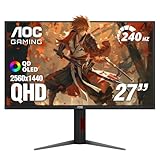

Modern OLED gaming monitors mostly use QD-OLED or WOLED panels. A typical 27-inch QD-OLED model, like the AOC Q27GAZDV or Q27GAZD, pairs a 2560 x 1440 resolution with a 240 Hz refresh rate and G-SYNC Compatible variable refresh. These monitors are slim — the panel itself is often under half an inch thick — and total unit weights usually land in the 10–15 pound range including the stand. Power draw is modest, generally 40–70 watts in typical use, though full-screen bright content can push a 27-inch panel toward its 100–150 watt rating range.
You also get wide color coverage (QD-OLED panels typically cover well over 90% of DCI-P3), HDR that actually looks like HDR thanks to per-pixel dimming, and near-zero motion blur thanks to the instant response combined with features like black frame insertion.
Pros
- Response time: Sub-0.1 ms pixel transitions eliminate ghosting and smearing behind fast-moving objects. This is the single biggest “feel” upgrade over LCD.
- Contrast and blacks: True per-pixel black transforms dark games, night maps, and space scenes. No local-dimming halos, ever.
- HDR quality: Real HDR impact in games at a fraction of the price of comparable mini-LED performance in this size class.
- Viewing angles: Color and contrast hold up at extreme angles, unlike LCD panels that wash out off-center.
- Design: Thin panels, minimal bezels, and lighter total weight than many high-refresh LCDs.
- Eye comfort for dark content: Many users report less eye strain in dim games because there’s no backlight glow behind “black” areas.
Cons
- Burn-in risk: Static HUD elements, taskbars, and game UIs can leave permanent image retention over years. Modern panels have mitigation (pixel shift, logo dimming, refresh cycles), but the risk is not zero.
- Brightness in SDR: Full-screen SDR brightness typically maxes out around 200–275 nits — noticeably dimmer than a good LCD in a sunlit room.
- Price per hertz: You pay a meaningful premium over an equivalent fast IPS panel at the same size and refresh rate.
- QD-OLED text fringing: The subpixel layout can make small white text look slightly purple-fringed, a minor issue for heavy desktop productivity use.
- Reflectivity: Many QD-OLED panels use a semi-gloss coating that reflects more light than matte LCD coatings.
- Peripheral visibility: In a very dark room, near-black content can be harder to see than on an LCD that lifts blacks slightly.
Who Should Buy It
OLED is worth the money if you check most of these boxes: you play single-player, cinematic, or immersion-heavy games where contrast sells the experience; you play competitive shooters or racers and want the sharpest motion clarity available; you game in a room where you can dim lights or game at night; and you can afford the premium without compromising on other gear. Buyers grabbing something like the AOC Q27GAZDV at around $310 or the Q27GAZD at around $330 are getting 1440p at 240 Hz on QD-OLED at what is, by 2026 standards, a genuinely accessible price — this tier of OLED was far more expensive just a couple of years ago.
Who Should Skip It
Skip OLED if you’re a purely competitive player chasing maximum frames per dollar at 1080p; if your room is bright and sunlit most of the day; if you multitask heavily with static spreadsheets, trading dashboards, or a permanent taskbar on screen for 8+ hours daily; or if you want a monitor to last five-plus years with zero maintenance thought. A fast IPS panel will serve all of those use cases better for less money.
Cheaper Alternatives
| Option | Cost | Trade-off |
|---|---|---|
| 27″ QHD fast IPS, 240–280 Hz (e.g., entry-level esports models) | $180–$280 | Worse contrast and HDR, ~2–4 ms response, but no burn-in worry and better SDR brightness |
| 27″ QHD mini-LED, 170–240 Hz | $250–$400 | Very high HDR brightness, no burn-in, but blooming around bright objects and heavier, thicker panels |
| 27″ QHD VA, 170–240 Hz | $150–$250 | Deep contrast for the price, but slower dark-pixel smearing and weaker viewing angles |
| Last-gen or open-box OLED at 1440p/240 Hz | $230–$300 | Same panel benefits for less, but shorter or unclear warranty coverage on burn-in |
FAQ
Do OLED monitors really burn in from gaming?
It’s possible but uncommon with sensible habits. Static HUDs held on screen for thousands of hours are the main culprit. Modern OLEDs include pixel shift, logo brightness detection, and scheduled compensation cycles; most gamers who vary their content and run a screensaver will get many years of use without visible wear.
Is 240 Hz QD-OLED overkill for 1440p gaming?
Not if your GPU can push high frame rates. In esports titles at 1440p, mid-to-high-end cards easily exceed 240 fps, and OLED’s instant response makes those frames noticeably cleaner. For slower single-player games, the 240 Hz matters less than the contrast — you benefit either way.
How long should an OLED gaming monitor last?
With varied content and mitigation features enabled, expect a usable lifespan comparable to LCD — commonly cited panel half-life figures run well past 30,000 hours of use. Burn-in, not general degradation, is the limiting factor, and it’s largely habit-dependent.
Is OLED worth it over a cheap 240 Hz IPS monitor?
For pure frame-rate value, no — a $200-ish fast IPS gets you the same refresh. You’re paying roughly a $50–$150 premium in this size class for dramatically better contrast, HDR, response time, and design. Whether that’s “worth it” comes down to how much you value image quality over raw specs on paper.


