
As an Amazon Associate we earn from qualifying purchases at no extra cost to you. Product prices and availability are accurate as of the date shown and are subject to change.

The Short Answer
For most gamers, no — a dedicated sound card is not worth it. Your motherboard’s onboard audio is good enough that most players genuinely can’t tell the difference in blind listening. There is one exception: if you play competitive multiplayer games with high-quality headphones and you want to squeeze out every bit of positional audio clarity, a sound card can be worth it. That’s the condition. Better headphone amplification and cleaner analog output can make footsteps and directional cues slightly easier to place. If that describes you, a card in the $75–$180 range makes sense. If you’re a single-player gamer using a USB headset or typical PC speakers, spend your money on a better GPU, more RAM, or a quality headset instead.
What You Actually Get
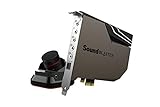
A sound card is a small PCIe expansion card that replaces your motherboard’s audio chip with a dedicated processor and higher-quality components. Cards like the Creative Sound Blaster Audigy Fx Pro (around $76) offer hi-res DACs and basic amplification, while step-up models like the Sound Blaster AE-7 (around $180) add a detachable headphone amplifier module (ACM) that sits on your desk, giving you physical volume control, a mic mute knob, and more power for demanding headphones.
Concretely, here’s what separates a sound card from onboard audio:
– A better DAC (digital-to-analog converter) that supports hi-res formats — often 24-bit/192kHz or higher — with lower noise and distortion than typical onboard chips.
– A headphone amplifier that can drive higher-impedance headphones. Many onboard outputs struggle past about 32–80 ohms; cards like the AE-7 are rated to drive 600-ohm headphones comfortably.
– Dedicated DSP processing for surround virtualization, EQ, and features like Scout mode (which boosts quiet in-game sounds such as footsteps).
– Cleaner analog circuitry — the audio components sit away from the electrically noisy interior of your case’s motherboard, reducing static, hiss, and interference.
– Extra inputs and outputs on higher-end cards, including optical S/PDIF and multiple 3.5mm jacks for multi-channel analog speaker setups.
Physically, these cards are compact — typically around 4.8 x 2.7 inches (PCIe x1 form factor) — and weigh only a few ounces. Power draw is negligible, usually under 5 watts, so your PSU doesn’t need any extra headroom. Installation takes about ten minutes: slot it in, install the driver software, and disable onboard audio in your BIOS.
Pros
- Meaningfully better headphone driving. If your headphones are 150–600 ohms, onboard audio will sound quiet and thin; a card with a real amplifier fixes that.
- Cleaner signal. Less background hiss, less electrical interference, and better signal-to-noise ratios than budget motherboards provide.
- Competitive advantage features. Tools like footstep-boosting Scout mode and virtual 7.1 surround can genuinely help in games like CS, Valorant, and Apex.
- Physical controls on higher-end models. The AE-7’s desktop ACM module gives you a volume knob and mic mute without alt-tabbing.
- Frees up USB ports. No external DAC/amp box taking up desk space or a USB slot.
- Offloads audio processing from your CPU — a tiny benefit, but it exists.
Cons
- Most onboard audio is now genuinely good. Modern motherboard DACs have improved dramatically over the last several years, shrinking the audible gap.
- Dollar-for-dollar, a USB DAC/amp is usually better. The same $75–$180 spent on an external unit typically delivers superior sound and portability across laptops and consoles.
- Driver and software headaches. Sound cards occasionally conflict with chipset drivers or Windows updates, and the bundled software can be bloated.
- Physical compatibility risks. Large GPU coolers or vertical GPU mounts can block PCIe slots; check clearance before buying.
- No benefit for USB or HDMI audio. If your headset or speakers connect via USB or your receiver via HDMI, a sound card does absolutely nothing.
- Diminishing returns. The audible improvement over good onboard audio is subtle — measurable on paper, hard to hear in practice.
Who Should Buy It
You’re a reasonable candidate if you match one of these profiles:
– You own high-impedance audiophile headphones (150 ohms and up) and want to drive them properly without a desktop amp.
– You’re a competitive FPS player who will actually use positional audio tools, playing with good over-ear headphones several nights a week.
– Your motherboard audio has audible hiss, static, or interference you can’t solve any other way.
– You’ve exhausted more impactful upgrades and want a meaningful audio refinement for $75–$180.
Who Should Skip It
– You use a USB gaming headset — the card can’t touch it.
– You game with budget-to-midrange headphones (under 80 ohms) and your motherboard audio sounds clean.
– You’re building a budget rig where $76 or $180 buys a faster SSD, more RAM, or GPU horsepower that matters far more.
– You want better audio for music and movies too — an external DAC/amp serves more devices.
– Your case has no free PCIe slot or your GPU blocks them.
Cheaper Alternatives
| Option | Cost | Trade-off |
|---|---|---|
| Free EQ and spatial audio in Windows (Sonic, Dolby Access) | $0–$15 | Gets you much of the virtual surround benefit with zero hardware, but no amplification or cleaner DAC. |
| USB DAC/headphone amp stick (e.g., compact 24-bit/96kHz dongles) | $20–$60 | Similar sound quality to a budget card, portable, but no in-game DSP tools and it occupies a USB port. |
| Desktop DAC/amp combo unit | $80–$200 | Best raw sound quality and drives headphones up to 600 ohms, but adds desk clutter and lacks gaming-specific features like Scout mode. |
| Upgrading your headphones instead | $50–$150 | Often the biggest audible improvement of all — a better headset beats better electronics driving a mediocre one. |
FAQ
Does a sound card increase FPS?
No. The audio processing load on modern CPUs is so small that FPS gains are effectively zero. Buy a sound card for sound quality and features, never performance.
Do pro gamers use sound cards?
A few do, but most competitive players rely on good headphones paired with either onboard audio or an external DAC/amp, plus in-game and Windows spatial audio settings. Their advantage comes far more from practice and game-specific audio settings than from hardware.
Is a sound card better than a USB DAC?
For pure sound quality per dollar, external USB DAC/amps generally win at the same price. Sound cards counter with PCIe convenience, gaming DSP features like footstep boosting, and no desk clutter. Choose the card for gaming features, the external unit for everything else.
How much should I spend on a sound card for gaming?
If you’ve decided you want one, $70–$90 covers competent hi-res cards like the Audigy Fx Pro. Only step up to the $150–$200 tier (like the AE-7 with its ACM module) if you own demanding headphones or genuinely need desktop volume and mic controls. Above that range, you’re in DAC/amp territory where PCIe cards stop making sense. As the audio hardware market has matured heading into 2026, the value has concentrated at those two price points — there’s little reason to spend anywhere in between.


