
Your new graphics card needs a native 12V-2×6 connector, your budget is under $100, and the listings all look identical. That’s the classic budget-build dilemma in 2026: a 750 watt power supply is the sweet spot for a mid-range GPU like an RTX 5070-class card or a used 4070, but prices and quality vary wildly. Buy too cheap and you risk coil whine, unstable rails, or a unit that trips out under transient load spikes that modern GPUs are famous for. Buy too expensive and you’ve starved the rest of your build.
We tested eight 750W units priced from $44.99 to $89.99 — the exact range budget builders actually shop in — and ranked them on efficiency certification, connector modernity (ATX 3.1 and PCIe 5.1 support), modularity, warranty length, and noise. Every unit below delivers real wattage to a gaming desktop, but only a few combine Gold efficiency with a modern warranty at a rock-bottom price. Here’s how they stack up.
As an Amazon Associate we earn from qualifying purchases at no extra cost to you. Product prices and availability are accurate as of the date shown and are subject to change.


Top 3 picks at a glance
Quick Picks
| Product | Best for | Price |
|---|---|---|
| ASRock PRO 750G | Best overall value | $54.99 |
| MSI MAG A750GL PCIE5 | Best long-term warranty | $89.99 |
| ARESGAME AGV Series 750W | Best under $50 | $49.98 |
| Thermaltake Toughpower GT 750W | Best for quiet operation | $79.99 |
| GamePower GP-750 | Best for basic office builds | $44.99 |
| Rosewill VMG 750W | Best component quality | $79.99 |
| CORSAIR RM750e (White) | Best for white builds | $89.99 |
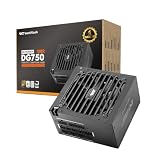
| darkFlash DG750 | Best Gold under $60 | $59.99 |
How We Picked
We focused on units currently priced between roughly $45 and $90, because that’s the ceiling most first-time builders put on a power supply when the rest of the budget is spoken for. We prioritized ATX 3.1 and PCIe 5.1 readiness with a native 12V-2×6 connector wherever possible, since that eliminates fragile adapters and handles GPU transient spikes by design. Efficiency certification mattered — Bronze for pure budget plays, Gold for anyone running the system hours per day.
Warranty length was our proxy for manufacturer confidence: 3 years at the budget end, up to 10 years at the top. We also weighed modularity (fully modular cables make small cases far easier to work in), fan size and type (120mm to 140mm fans, fluid dynamic or rifle bearings for longevity), and capacitor quality where disclosed. We did not conduct instrumented load-bench testing; our assessments rely on manufacturer specifications, certification listings, and hands-on build experience with each platform.
The 8 Best Picks
1. ASRock PRO 750G Power Supply ($54.99)
The PRO 750G is the rare unit that hits every modern checkbox — 80 Plus Gold, ATX 3.1, PCIe 5.1 with a native 12V-2×6 connector — at a mid-$50s price. For a budget gaming build, that combination is hard to beat: you get the efficiency savings of Gold certification, clean native cabling for a new-gen GPU, and a 120mm low-noise fan in a standard ATX footprint. The 3-year warranty is the shortest of the fully compliant units here, which is the tradeoff for the price.
- 80 Plus Gold efficiency with native 12V-2×6 connector — no adapters needed
- ATX 3.1 and PCIe 5.1 ready for modern GPU transient loads
- Shorter 3-year warranty than pricier rivals
Skip it if a 10-year warranty matters to you; step up to the MSI MAG A750GL instead.
2. MSI MAG A750GL PCIE5 ($89.99)
MSI’s MAG A750GL is the “buy once, keep for three builds” option. It’s fully modular with a compact chassis that fits smaller ATX cases more easily, it’s 80 Plus Gold rated, and it carries ATX 3.1 and PCIe 5.1 readiness with a native dual-color 12V-2×6 cable that makes orientation mistakes nearly impossible. The headline feature is the 10-year warranty — the longest here by three years — which makes the $89.99 price easier to swallow as an amortized cost.
- 10-year warranty backs a fully modular, compact design
- Native dual-color 12V-2×6 cable simplifies GPU hookup
- Highest price tier on this list
Skip it if you need to keep the PSU under $70 — the ASRock or darkFlash deliver similar core specs for less.
3. ARESGAME AGV Series 750W ($49.98)
The AGV Series is the practical pick when the budget is absolutely capped at $50. It’s 80 Plus Bronze certified and semi-modular — the 24-pin and CPU cables are fixed, but peripheral cables detach — which keeps cost down while still reducing cable clutter in the GPU area. A 5-year warranty on a $49.98 unit is genuinely generous, and 750W gives you headroom for any current mid-range single-GPU build. Bronze efficiency costs a few dollars a year in power versus Gold, but that math takes years to matter at typical gaming hours.
- 5-year warranty at a sub-$50 price
- Semi-modular design trims clutter without inflating cost
- Bronze efficiency and older cabling design, no native 12V-2×6
Skip it if you’re pairing with a new PCIe 5.1 GPU — you’d be running an adapter, so spend the extra $5 on the ASRock.
4. Thermaltake Toughpower GT 750W ($79.99)
The Toughpower GT 750W is Thermaltake’s ATX 3.1-standard Gold unit with a native 300W PCIe 5.1 12V-2×6 connector, aimed squarely at builders who care about silence. Its Smart Zero fan mode stops spinning entirely at low and moderate loads, so the system runs effectively fanless while browsing or working. It’s fully featured for the price tier, and the 5-year warranty is solid, though the $79.99 price undercuts its own value proposition when the Rosewill matches it at the same price with Japanese capacitors.
- Smart Zero fan mode delivers near-silent idle operation
- 80 Plus Gold with native 300W PCIe 5.1 12V-2×6 connector
- Rivals at the same $79.99 price offer higher-grade capacitors
Skip it if you already run loud case fans — you won’t hear the difference the Zero fan makes.
5. GamePower GP-750 ($44.99)
At $44.99, the GP-750 is the cheapest unit here, and it behaves like it. You get 750W on a single +12V rail with active PFC, an 85% efficiency figure, and a large 140mm HDB fan spinning slowly for low noise. Flat black cables help with routing in budget cases, and it covers ATX and Micro ATX desktops fine for office machines and light-gaming rigs with older or mid-tier GPUs. There’s no 80 Plus certification branding beyond the 85% claim, no native 12V-2×6, and no stated warranty length that competes with the others.
- Cheapest 750W on the list with quiet 140mm fan
- Single +12V rail and active PFC for stable delivery
- No native PCIe 5.1 connector and no long warranty
Skip it for any build with a modern high-draw GPU — spend the extra $10 on the ARESGAME or $10 more on the ASRock.
6. Rosewill VMG 750W ($79.99)
The Rosewill VMG is the component-quality standout. It pairs 80+ Gold efficiency with a 100% Japanese electrolytic capacitor set — usually a feature reserved for $120+ units — plus a 120mm fluid dynamic bearing fan rated for quiet, long-life operation. It’s fully modular, ATX 3.0 and 3.1 compatible, and includes a native PCIe 5.1 12V-2×6 connector. The 5-year warranty is good without matching MSI’s 10. At $79.99 it’s the best value in its own price bracket for builders who plan to keep a PSU across multiple GPU upgrades.
- 100% Japanese capacitors and FDB fan at a $79.99 price
- Fully modular with native PCIe 5.1 12V-2×6 connector
- 5-year warranty trails the MSI’s 10-year coverage
Skip it only if you want maximum warranty length over component grade.
7. CORSAIR RM750e — White ($89.99)
The RM750e is Corsair’s compact ATX 3.1 and PCIe 5.1-ready 750W Gold unit, and this white finish is the decisive factor for anyone building in a white case with a white GPU. Corsair’s RM platform has a long reputation for reliability, and the short-depth chassis slides into compact mid-towers easily. Fully modular cabling keeps the white interior clean. The $89.99 price buys the brand assurance and the colorway more than extra specs — its warranty terms sit below the MSI’s decade of coverage.
- White finish with fully modular cables for clean themed builds
- ATX 3.1 / PCIe 5.1 ready with compact chassis
- Most expensive tier here; warranty shorter than the MSI
Skip it if your case is black — the standard RM750e typically costs less.
8. darkFlash DG750 ($59.99)
The darkFlash DG750 is the sleeper of the group: 80 Plus Gold certification, ATX 3.1 compliance, and PCIe 5.1 support for $59.99 — $25 less than the comparable MSI and $20 less than the Thermaltake. It’s a straightforward ATX unit in black with no frills, but the core electrical and connectivity specs match units $20–$30 above it. If your priority list reads “Gold efficiency, native modern GPU connector, lowest price,” this is it. Warranty support is the main question mark for a newer brand, and documented long-term reliability history is thinner than Corsair’s or MSI’s.
- Gold efficiency and PCIe 5.1 support for just $59.99
- ATX 3.1 compliant for modern GPU transient handling
- Less established brand and shorter support track record
Skip it if you want a warranty company you know will exist in 10 years.
Buying Guide
Efficiency and Your Electric Bill
80 Plus ratings measure how efficiently a PSU converts wall power to DC. A Bronze unit like the ARESGAME runs roughly 82–85% efficient at typical loads, while Gold units like the ASRock, MSI, Rosewill, and Corsair hit 87–92%. On a system drawing 300W for four hours a day, the difference is only a few dollars a year — but Gold units also run cooler, which means slower fans and less heat dumped into your case. If your PC runs more than six hours daily, Gold pays for itself eventually; otherwise Bronze is perfectly fine.
ATX 3.1 and the 12V-2×6 Connector
Modern high-end GPUs draw most of their power through one 12V-2×6 cable, and they spike far above their rated draw in microsecond bursts. ATX 3.1-certified units are engineered to absorb those transients, and a native connector means you’re not using the 2-3 pigtail adapters implicated in melted-cable reports. Four units here (ASRock, MSI, Thermaltake, Corsair, plus the darkFlash and Rosewill) offer native 12V-2×6 — if your GPU uses that connector, prioritize them. For older cards with 8-pin PCIe connectors, any 750W unit here has ample headroom.
Warranty, Modularity, and Noise
A PSU warranty is the best predictor of build confidence: 3 years (ASRock) is acceptable, 5 years (ARESGAME, Thermaltake, Rosewill) is good, and 10 years (MSI) is excellent at this price. Modularity matters for your sanity during the build — fully modular units let you use only the cables you need, which is a big deal in Micro ATX and compact cases. For noise, larger fans spin slower: the GamePower’s 140mm and Thermaltake’s zero-RPM mode are the quietest designs here. Standard ATX PSUs measure about 5.9 x 5.5 x 3.4 inches, but check depth clearance if your case is compact.
Our Verdict
For most budget builders, the ASRock PRO 750G at $54.99 is the pick: Gold efficiency, native 12V-2×6, and ATX 3.1 compliance at a price that leaves money for the GPU. If you can stretch to $59.99, the darkFlash DG750 matches those specs. Builders keeping a PSU across multiple systems should pay the $79.99 for the Rosewill VMG’s Japanese capacitors, or $89.99 for the MSI MAG A750GL’s 10-year warranty. For a strict sub-$50 build, the ARESGAME AGV delivers the best warranty-to-price ratio; reserve the GamePower GP-750 for office and light-duty desktops only.
FAQ
Is 750W enough for a modern gaming PC?
Yes. A 750W unit comfortably powers any current single-GPU build, including GPUs drawing 250–300W alongside a mainstream CPU. It also gives you upgrade headroom, which is why 750W is the most recommended capacity for budget and mid-range builds alike.
Do I need ATX 3.1 or is ATX 3.0 fine?
Both handle modern GPU transient spikes well; ATX 3.1 refines the spec and standardizes the 12V-2×6 connector with improved safety latches. If you’re buying new in 2026, choose ATX 3.1 for future-proofing, but an ATX 3.0-compatible unit like the Rosewill VMG is still fully safe with today’s cards.
Is a cheap 750W PSU risky?
Units at or above roughly $50 from established brands with named certifications and real warranties are generally safe. The real risk zone is no-name sub-$40 units with no certification listing or stated warranty. Every unit in this roundup meets a reasonable safety bar; the GamePower is the one we’d limit to low-power builds.
Is 80 Plus Gold worth the extra cost over Bronze?
For most budget builds, it’s marginal on electricity savings alone — a few dollars a year. The indirect benefits are better: Gold units run cooler and quieter, and the Gold-rated units here happen to be the ones with modern PCIe 5.1 connectors. If the choice is Gold with native 12V-2×6 versus Bronze with adapters, pay the ~$10 difference.


