
Choosing an autonomous lawn mower means deciding how much of your Saturday morning you are willing to hand over to a machine. The category has matured enough that wire-free models now handle small yards without boundary tapes, while premium units tackle sloped terrain that would make a human operator uneasy. The problem for most buyers is simple: the price spread runs from under $400 to nearly $2,800, and the spec sheets alone do not tell you which mower will actually finish its work and return home without intervention.
The difference between a good pick and a disappointing one usually comes down to three things: how well the navigation handles obstacles and edges, whether the cutting performance holds up in damp or tall grass, and how much setup the manufacturer is offloading onto you. Owner feedback on the models below reveals clear patterns. Budget vision-only units struggle where LiDAR or RTK-equipped mowers excel, and coverage claims on smaller properties are often optimistic. This roundup compares published specifications, real prices, and recurring themes from owner reviews to help you narrow the field.
As an Amazon Associate we earn from qualifying purchases at no extra cost to you. Product prices and availability are accurate as of the date shown and are subject to change.


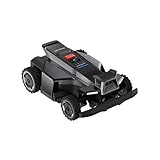


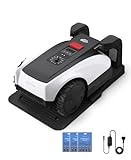
Top 3 picks at a glance
Quick Picks
| Product | Best for | Price |
|---|---|---|
| WORX Robot Lawn Mower (1/4 Acre) | Wire-free simplicity on a modest yard | $799.99 |
| LEBOSBO V3 AI Vision | Lowest entry cost for a vision-guided mower | $399.99 |
| Segway Navimow X430 | Large lawns with steep slopes | $2249 |
| Sunseeker X5 AWD | RTK navigation without boundary wire | $1384 |
| ECOVACS Goat A2000 | Dual LiDAR coverage on medium lawns | $1399 |
| YARDCARE V100 | Small, flat lawns under 1600 sq ft | $399.99 |
| Mammotion LUBA 3 AWD 3000H | Multi-zone properties with complex terrain | $2799 |
| ECOVACS Goat O1000 | Compact RTK setup for quarter-acre lots | $664 |
How We Picked
We weighed four criteria across every model: navigation reliability (LiDAR and RTK outperform vision-only systems in edge and obstacle handling), slope and terrain tolerance, setup burden (wire-free is not the same as maintenance-free), and the gap between advertised coverage and what owners report in practice. Price-to-capability ratio carried the most weight for budget entries, while premium models had to demonstrate that their added hardware solves a real problem rather than padding a spec sheet.
The 8 Best Autonomous Lawn Mower in 2026
WORX Robot Lawn Mower (1/4 Acre)
For homeowners with a quarter-acre lot who want to avoid boundary wire entirely, this WORX model is the most straightforward wire-free entry. It uses brushes alongside its cutting deck, which owners note helps it maintain traction on slightly uneven ground without the complexity of all-wheel drive. Two pros: no wire installation and a compact footprint that fits small storage sheds. One con: it does not advertise slope tolerance beyond typical flat-yard use, so hilly properties are out. Skip it if your lawn exceeds 1/4 acre or has significant grade changes; you will outgrow it within a season.
LEBOSBO V3 AI Vision
At $399.99, the LEBOSBO V3 is the least expensive autonomous lawn mower with AI vision guidance, making it a logical first purchase for anyone skeptical about the category. It covers 1600 sq ft, which suits a typical townhouse backyard without major trees. Two pros: the price removes financial risk from trying robotic mowing, and vision-based setup avoids burying a perimeter wire. One con: owners report the camera struggles in low light and under dense tree canopy, leaving patches unmown. Skip it if your yard is heavily shaded or irregularly shaped; you need LiDAR or RTK for reliable coverage there.
Segway Navimow X430
The Segway Navimow X430 is built for large, sloped properties that would defeat most competitors. Rated for up to 1 acre and 84 percent slopes with 4WD, it uses dual 180W motors and a zero-turn configuration that prevents tire scuffing on soft ground. Two pros: the slope rating and cutting-height range (0.75–4 in) give it the widest terrain envelope in this list. One con: at $2249, it is overkill for flat quarter-acre lots where the Segway’s ORV-tuned drivetrain offers no practical advantage. Skip it unless you genuinely need all-wheel drive or manage a property approaching full acre.
Sunseeker X5 AWD
Sunseeker’s X5 pairs RTK positioning with Vision AI and all-wheel drive, targeting the gap between wire-free convenience and professional-grade accuracy. It covers half an acre, which positions it for medium-to-large suburban lawns with moderate slopes. Two pros: RTK delivers centimeter-level positioning without a perimeter wire, and AWD handles gradients that would stall two-wheel-drive rivals. One con: setup requires clear sky visibility for the RTK signal, so heavily wooded yards can lose fix. Skip it if your property is more than half covered by mature tree canopy or if a simpler LiDAR option fits your acreage.
ECOVACS Goat A2000
The ECOVACS Goat A2000 relies on dual LiDAR sensors, giving it all-weather navigation that does not depend on satellite signal or ambient light. It targets medium lawns with a premium but reasonable price near $1399. Two pros: dual LiDAR handles edges and obstacles more consistently than single-camera systems, and it operates in rain or darkness without losing accuracy. One con: ECOVACS does not publish a specific slope rating for this model, leaving hilly-property buyers to infer from community reports. Skip it if your main concern is steep grade; choose a model with a stated incline tolerance instead.
YARDCARE V100
Matching the LEBOSBO on price at $399.99, the YARDCARE V100 uses HD vision for small lawns up to 1600 sq ft. It is essentially a competitor to the LEBOSBO in the same budget bracket, differentiated by its emphasis on high-definition camera clarity. Two pros: vision-based setup means no wire to bury, and the HD camera provides decent obstacle detection in open, sunny conditions. One con: owner feedback flags inconsistent edge cutting on curved borders, requiring occasional manual touch-up. Skip it if you value clean, precise perimeter lines; models with LiDAR or RTK handle edges more predictably.
Mammotion LUBA 3 AWD 3000H
The Mammotion LUBA 3 sits at the top of the price range at $2799, and its tri-fusion positioning (360-degree LiDAR, NetRTK, and AI Vision) justifies the cost for complex properties. It covers 0.75 acre, handles 80 percent slopes with all-wheel drive, and supports 30 multi-zone management. Two pros: the tri-fusion system provides redundancy so a single sensor failure does not strand the mower, and zone management suits estates with separate lawn sections. One con: the learning curve for configuring 30 zones is steep for casual users with simple layouts. Skip it if your property is a single rectangular lawn; the Segway or Sunseeker offer easier setups.
ECOVACS Goat O1000
At $664, the ECOVACS Goat O1000 is the least expensive RTK-equipped autonomous lawn mower in this roundup, covering 1/4 acre. It brings satellite-based positioning to buyers who want wire-free navigation without spending over $1000. Two pros: RTK accuracy at this price point is exceptional, and the compact size makes it easy to store and transport. One con: it lacks all-wheel drive, so steep or uneven terrain is beyond its scope. Skip it if your quarter-acre lot has slopes, bumps, or thick thatch; the AWD models above handle those conditions while the O1000 will bog down.
Buying Guide
Navigation Technology Determines Everything
Vision-only mowers like the LEBOSBO V3 and YARDCARE V100 depend on cameras and are constrained by light, shadow, and visual clutter. LiDAR mowers such as the ECOVACS Goat A2000 build a 3D map independent of lighting, while RTK models (Sunseeker X5, ECOVACS Goat O1000) use satellite correction for absolute position. Tri-fusion systems like the Mammotion LUBA 3 combine all three for redundancy. If your yard is open and flat, vision is adequate. If it is shaded, irregular, or has tight edges, LiDAR or RTK becomes necessary.
Slope Rating and Drive Type Are Not Interchangeable
A mower rated for 80 or 84 percent slopes with all-wheel drive (Segway Navimow X430, Mammotion LUBA 3) can physically climb and traverse gradients that two-wheel-drive units simply cannot. But slope tolerance matters only if your yard actually has grade. The WORX and ECOVACS Goat O1000 do not advertise slope ratings because they are designed for flat or near-flat terrain. Match the drive system to your terrain, not to a spec-sheet number you will never use.
Coverage Claims vs. Real-World Area
Manufacturer coverage ratings typically assume a single open rectangle with no obstacles. In practice, tree trunks, garden beds, patios, and irregular boundaries reduce effective mowing time and can cause the mower to skip areas entirely. The Mammotion LUBA 3 with its 30-zone management addresses this by letting you define separate sections with individual schedules. For the rest, budget for a mower rated at least 20 to 30 percent above your actual open lawn area to account for lost time around obstacles.
Our Verdict
Top pick: The Segway Navimow X430 offers the best balance of terrain capability, motor power, and coverage for the widest range of real lawns. Its 84 percent slope rating and zero-turn drivetrain solve problems that cheaper mowers cannot, and at $2249 it undercuts the Mammotion while covering a larger area.
Budget pick: The ECOVACS Goat O1000 at $664 delivers RTK accuracy at a price where competitors still offer basic vision navigation. If your quarter-acre lot is flat, it is the smartest value in this group.
Condition where another wins: If your property exceeds one acre or requires managing many separate zones, the Mammotion LUBA 3 AWD 3000H takes over. Its tri-fusion positioning and 30-zone control justify the premium over the Segway for estate-scale lawns.
FAQ
Do wire-free autonomous lawn mowers really need no setup?
No. Wire-free refers to the absence of a buried perimeter cable, but you still need to configure a mowing area via an app, calibrate navigation sensors, and clear initial obstacles. RTK models additionally require a base station with clear sky access.
How much maintenance does a robotic mower need compared to a gas push mower?
Robotic mowers require periodic blade replacement, deck cleaning, and software updates. They do not need oil changes, spark plug swaps, or fuel stabilizers. Owners report the time spent on maintenance is a fraction of what a traditional mower demands over a season.
Can an autonomous lawn mower cut wet grass?
Most LiDAR and RTK models operate in light rain without issue because their navigation does not depend on visual contrast. However, thick wet grass can clog any mower’s deck. Models with higher motor power, like the Segway with dual 180W motors, handle damp conditions more reliably than single-motor budget units.
Is an autonomous lawn mower safe around children and pets?
All models in this roundup include obstacle detection that stops or diverts the mower when something appears in its path. Vision and LiDAR systems detect moving objects more reliably than older ultrasonic sensors, but supervision of young children and small animals near a running mower remains advisable.


