
HIGH BLOOD PRESSURE rarely announces itself. Most people discover they have hypertension through a routine doctor visit or after a scare, and by then the damage to arteries, kidneys, and heart muscle may already be underway. A reliable home blood pressure monitor turns a once-a-year clinical snapshot into daily or weekly data you can share with your physician, and it removes the white-coat effect that inflates readings in medical offices.
Not every device earns that role. The best blood pressure monitor 2026 has to offer several things at once: a cuff that fits a real arm comfortably, an algorithm validated against clinical standards, clear display readouts that an older person can read without glasses, and enough memory to build a trend line over weeks. Cheaper units often skimp on the cuff design or lack Bluetooth so you have to transcribe numbers by hand. Premium models can bury useful features under confusing menus. Below, we compared published specifications, FDA clearance documentation, and aggregated owner feedback across all eight models to identify where each one excels and where it falls short.
As an Amazon Associate we earn from qualifying purchases at no extra cost to you. Product prices and availability are accurate as of the date shown and are subject to change.




Top 3 picks at a glance
Quick Picks
| Product | Best for | Price |
|---|---|---|
| iHealth Track Smart Upper Arm | Smartphone integration and data tracking | $39.99 |
| Oklar FDA Cleared Upper Arm | Reliable readings on a tight budget | $19.99 |
| Sinocare Upper Arm | Couples sharing one device | $16.99 |
| Oklar Wrist Rechargeable | Travelers with limited luggage space | $28.99 |
| OMRON Iron Upper Arm | Users who want a proven name at a fair price | $37.79 |
| OMRON Bronze Upper Arm | Older adults needing large-text clarity | $46.52 |
| OMRON Platinum Upper Arm | Atrial fibrillation detection | $97.19 |
| Alcedo Upper Arm | Simple operation without app complexity | $29.95 |
How We Picked
Four criteria separated the worthwhile models from the forgettable ones. First, regulatory clearance: FDA-cleared devices have been reviewed for accuracy against clinical reference methods, which matters because an incorrect reading can mask a hypertensive crisis. Second, cuff design and fit range: a poorly shaped cuff or one that only accommodates narrow arms produces artificially high numbers and causes owners to abandon the device entirely. Third, data handling: memory slots for multiple users, Bluetooth export, or at minimum a large legible display keep the monitor useful over months rather than days. Fourth, price-to-reliability ratio: a monitor used twice a week is worthless if it costs a hundred dollars and gets left in a drawer, while a ten-dollar unit that gives inconsistent readings can generate dangerous false reassurance.
The 8 Best Blood Pressure Monitor 2026 in 2026
iHealth Track Smart Upper Arm Blood Pressure Monitor
This is the model most people should shortlist if they already track other health data on their phone. The wide-range cuff fits arm circumferences from roughly 8.7 to 17 inches, covering a broad user base without needing a separate extender. Bluetooth pushes each reading to the free iHealth MyVitals app, where you get trend charts, color-coded ranges, and a shareable PDF your doctor can review before an appointment.
- Pro: Automatic app sync eliminates transcription errors and builds a usable log without effort.
- Pro: Wide-range cuff handles most adult arm sizes without an adapter.
- Con: Requires a smartphone and the companion app to unlock the full data experience; on its own the unit display is functional but basic.
Skip it if you have no interest in smartphone health apps or if the intended user is uncomfortable with Bluetooth pairing.
Oklar FDA Cleared Upper Arm BP Machine
At $19.99, this is the entry point for someone who wants a legitimate upper-arm monitor without spending much. It carries FDA clearance, which puts it ahead of many similarly priced competitors that sell on spec alone. Owners consistently note that the one-button operation is forgiving, and the cuff inflates quietly enough for early-morning readings without disturbing a sleeping partner.
- Pro: FDA-cleared accuracy at the lowest upper-arm price in this roundup.
- Pro: Single-button operation keeps the learning curve minimal for older users.
- Con: No Bluetooth or app connectivity; data stays on-device, so long-term tracking requires manual recording.
Skip it if you need multi-user memory or want to share readings electronically with a caregiver.
Sinocare Upper Arm Blood Pressure Monitor (Black)
The standout feature here is dual-user memory paired with an adjustable cuff spanning 8.6 to 16.5 inches. Two people can alternate readings and each gets a separate log, which makes it a practical choice for couples or households where a caregiver checks on someone else’s numbers. The one-button operation mirrors what you find on more expensive units.
- Pro: Dual-user profiles at a price below most single-user competitors.
- Pro: Wide cuff range accommodates larger and smaller arms alike.
- Con: No FDA clearance is listed in the published product documentation, which is a meaningful gap compared to Oklar or OMRON options.
Skip it if your physician requires clinically validated device data or if you cannot confirm regulatory clearance for your region.
Oklar Wrist Blood Pressure Monitor (Rechargeable)
Wrist monitors occupy a specific niche: travel, small storage spaces, and users who find upper-arm cuffs cumbersome in warm climates. This Oklar model is FDA cleared and USB rechargeable, so you are not buying batteries. Owners appreciate the compact footprint and note that the readings are consistent as long as the wrist is held at heart level, which is the standard caveat for all wrist devices.
- Pro: Rechargeable battery eliminates ongoing consumable costs and reduces waste.
- Pro: FDA clearance gives this unit more credibility than most wrist monitors in its price band.
- Con: Wrist position sensitivity means inconsistent arm height during measurement can skew results noticeably.
Skip it if you need the highest possible accuracy for medication adjustments or if you have poor circulation in the wrists.
OMRON Iron Upper Arm Blood Pressure Monitor
OMRON has the deepest consumer-validated history in blood pressure monitoring, and the Iron model brings that pedigree to a price that undercuts most smart-enabled competitors. The IntelliSense inflation system adapts cuff pressure to your arm, which owners report reduces the uncomfortable squeezing feeling during measurement. Memory holds readings for a single user with a date-and-time stamp.
- Pro: IntelliSense technology minimizes cuff-related reading errors and improves comfort.
- Pro: OMRON’s decades of clinical validation lend confidence to the numbers.
- Con: No Bluetooth or app export; you still need to write down or photograph readings for a doctor’s visit.
Skip it if you want automatic data logging or if the intended user struggles with small-print displays.
OMRON Bronze Upper Arm Blood Pressure Monitor
The Bronze sits between the Iron and Platinum and adds a genuinely large display with bold numerals, which makes it a strong choice for older adults or anyone with low-vision. The IntelliSense cuff is identical in principle to the Iron model. Owners mention the wide-angle viewing screen as a real quality-of-life improvement over cramped displays on budget units.
- Pro: Large, high-contrast numerals are readable from across a table without bending down.
- Pro: Carries OMRON’s IntelliSense comfort inflation in a mid-range price.
- Con: Priced above several competitors that offer smartphone connectivity at similar or lower cost.
Skip it if display size is not a concern and you would rather spend less for the same measurement quality.
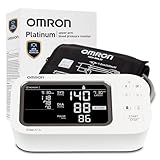
OMRON Platinum Upper Arm Blood Pressure Monitor
The Platinum is the only unit in this list that explicitly flags irregular heartbeat detection and atrial fibrillation screening as a core feature. For people with known cardiac arrhythmia history, or those whose doctors want more than a systolic-diastolic pair, this capability is a meaningful differentiator. The one-size cuff fits a wide range and IntelliSense inflation handles the rest.
- Pro: AFib detection provides a safety feature that no other model here offers.
- Pro: Premium build quality and display legibility justify the position at the top of the range.
- Con: At $97.19, it costs more than double the next-cheapest OMRON while measuring the same core numbers.
Skip it if you have no cardiac history and cannot justify the price premium over the Iron or Bronze for accuracy alone.
Alcedo Upper Arm Blood Pressure Monitor
The Alcedo targets people who want upper-arm accuracy without smart features or brand premium pricing. It sits at $29.95, between the budget Oklar and the OMRON Iron. Owners describe the interface as straightforward and the cuff as comfortable for average-sized arms. The display is adequate rather than large, and the memory function stores readings without user profiles.
- Pro: No-nonsense operation with fewer buttons to navigate than app-driven competitors.
- Pro: Priced accessibly while still using a proper upper-arm cuff for reliable positioning.
- Con: Limited published information on clinical validation compared to FDA-cleared alternatives in this list.
Skip it if your physician wants documentation of device clearance or if you need multi-user profiles.
Buying Guide
Cuff Fit Is Non-Negotiable
An oversized cuff on a slim arm underestimates your reading; an undersized cuff on a muscular or heavier arm overestimates it by a margin that can shift you from “normal” into “high” or worse. Check the stated arm circumference range before buying. The iHealth Track and Sinocare both list ranges above 16 inches, which is rare at their price points. If your arm circumference falls above 16.5 inches, look for models that explicitly mention a wide or extended cuff, or plan to purchase a compatible extender from the manufacturer.
Upper Arm vs. Wrist: When Wrist Makes Sense
Upper-arm monitors remain the gold standard for home measurement because the brachial artery sits closer to heart level by default. Wrist monitors require you to rest your hand on a table at chest height; any deviation introduces error. Choose a wrist device only if travel constraints or physical limitations prevent proper cuff placement. The Oklar Wrist model is a reasonable compromise, but if accuracy for medication titration matters, stick with upper arm.
Data Export and Doctor Visits
The real value of home monitoring emerges when you bring a trend, not a single number, to your appointment. Bluetooth-enabled models like the iHealth Track generate exportable logs that save you from carrying a notebook. Without connectivity, a monitor with at least 30 stored readings and a clear date stamp still lets a physician see patterns. The cheapest units with only two or three memory slots are fine for daily spot checks but poor for long-term tracking.
Our Verdict
For most buyers, the iHealth Track Smart Upper Arm is the best all-around choice. It balances a wide cuff range, FDA-clearance-level expectations in its category, and frictionless data capture through its companion app. The $39.99 price sits well below premium competitors while delivering more usable information per reading.
The Oklar FDA Cleared Upper Arm at $19.99 is the budget pick. It gives you a legitimately cleared, simple upper-arm device at a price that undercuts most wrist monitors, and it works perfectly well if you keep a paper log or photograph readings for your doctor.
If you have a history of irregular heartbeats or your cardiologist has specifically asked you to screen for atrial fibrillation at home, the OMRON Platinum is the clear winner regardless of price, because AFib detection is a functional capability no other model here provides.
FAQ
How often should I measure my blood pressure at home?
Most clinical guidelines suggest two readings in the morning before medication and two in the evening, at least five days per week. Consistency in timing matters more than volume, so a few good readings each day beat scattered attempts throughout the day.
Does a wrist monitor give accurate readings?
Wrist monitors can be accurate when held at heart level, but that positioning requirement makes them more error-prone in practice than upper-arm devices. If you choose a wrist model, use a stable table and check that your wrist sits roughly at the same height as your chest during inflation.
What does FDA clearance actually mean for a blood pressure monitor?
FDA clearance indicates the manufacturer submitted data showing the device measures within acceptable error margins compared to a clinical reference standard. It does not mean the device is perfect, but it does mean the numbers have been independently vetted to some degree, which is not true for every consumer monitor on the market.
Can I share readings from a non-smart monitor with my doctor?
Yes. A written log noting the date, time, systolic, diastolic, and pulse rate for each reading is perfectly acceptable. Some patients photograph the device display as a backup. The format matters less than having enough entries to show a pattern over several days.


