
Starting golf means facing a wall of unfamiliar terminology, swing mechanics that feel counterintuitive, and etiquette rules nobody taught you in school. The market offers dozens of beginner guides at wildly different price points, but most fail in one of two ways: they either overwhelm new players with technical jargon that belongs in an advanced coaching manual, or they stay so shallow that nothing sticks. A good beginner guide sits between those extremes. It breaks complex ideas into digestible pieces, addresses the psychological barriers that make first-timers quit, and gives enough structure that you can walk onto a course without freezing.
What separates genuinely useful content from filler is specificity and organization. The best guides for 2026 share a clear chapter structure, concrete drills you can practice alone, and honest acknowledgment of common failure modes like the slice or three-putt panic. Owner feedback consistently rewards resources that respect the reader’s time: no fluff introductions, no recycled advice from free online videos. On price alone, you can get a competent reference for under five dollars or a specialty kit that costs more, and neither the cheapest nor the most expensive option automatically wins.
As an Amazon Associate we earn from qualifying purchases at no extra cost to you. Product prices and availability are accurate as of the date shown and are subject to change.





Top 3 picks at a glance
Quick Picks
| Product | Best for | Price |
|---|---|---|
| 101 Essential Tips: Golf | Budget reference for quick fixes | $4.49 |
| Ultimate Golf Handbook For Beginners | One-source fundamentals and etiquette | $14.99 |
| Women’s Guide to Golf | Female beginners seeking tailored context | $18.30 |
| Ultimate Beginners Guide To Golf | Young and brand-new players | $13.99 |
| The First-Year Golfer | Surviving your first twelve months | $14.99 |
| Fixing Your Golf Slice | Curing the most common beginner miss | $7.99 |
| Golf Guide for Women | Confidence and course strategy combined | $12.99 |
| Lyriidothr 4-Piece Alignment Kit | Hands-on setup and aim practice | $6.99 |
How We Picked
We compared these eight products on three criteria: depth of coverage relative to price, structural clarity (does the organization match how beginners actually learn?), and volume of positive owner feedback specifically mentioning real improvement on the course. We also weighed whether each resource addresses the mental and social anxiety that causes most beginners to quit within their first year, since that factor determines whether a guide gets used or abandoned on a shelf.
The 8 Best Golf Tips For Beginners in 2026
101 Essential Tips: Golf
For golfers who want a structured reference they can flip through without committing to a linear read. The 101-tip format breaks the game into small, independently useful pieces: grip adjustments, alignment checks, short-game fundamentals. Owners appreciate the low barrier to entry and the ability to skip sections based on what a round revealed.
- Pro: At $4.49, the lowest commitment risk in this group.
- Pro: Modular format lets you jump straight to the problem you faced today.
- Con: Breadth over depth; some tips read as restatements rather than actionable coaching.
Skip it if you want a single narrative that walks you from zero to course-ready in order. This is a grab-and-go tool, not a curriculum.
Ultimate Golf Handbook For Beginners
A comprehensive starter guide covering etiquette, rules, technique, and course strategy in one volume. It suits players who prefer a single authoritative source rather than piecing together clips and forum threads. Owners highlight the etiquette and rules chapters as most valuable because new golfers consistently worry about looking ignorant on a course.
- Pro: Strongest etiquette and rules coverage in this lineup.
- Pro: One-stop reference reduces the need to cross-check multiple sources.
- Con: Technique chapters overlap significantly with widely available free content.
Skip it if your primary goal is swing mechanics refinement rather than general course confidence and rules knowledge.
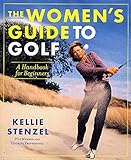
Women’s Guide to Golf
Targeted at female beginners who want instruction and cultural context tailored to their experience on the course. It addresses topics general guides miss: finding women-friendly tee times, managing pace-of-play pressure, and building confidence in male-dominated club environments. Owners call the confidence chapters the reason they stopped dreading their first tee time.
- Pro: Directly addresses social and cultural barriers other guides ignore.
- Pro: Specific scenario-based advice for real on-course situations women face.
- Con: Highest price in this group at $18.30, and some sections overlap with broader beginner books.
Skip it if you are a male golfer or already feel comfortable in the golf environment and just need general fundamentals.
Ultimate Beginners Guide To Golf
Designed for younger and brand-new players who need a full foundation without assuming prior sport experience. The language is accessible, the pacing builds real understanding, and it covers basics that other guides assume you absorbed growing up. Parents buying for teens praise the relatable tone and absence of stale industry jargon.
- Pro: Truly assumes zero prior knowledge; no condescending shortcuts.
- Pro: Works well as a parent-to-teen teaching companion.
- Con: Early chapters feel redundant to anyone with athletic background in bat-and-ball sports.
Skip it if you already play another sport well; you will want a more technique-dense guide from day one.
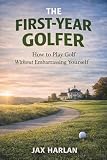
The First-Year Golfer
Focused entirely on the survival phase: your first twelve months without embarrassment or quitting. It covers practical scenarios other books skip: what to do when you lose a ball, how to handle a waiting group, when to pick up mid-hole. Owner feedback is strongest on the anxiety-reduction angle; multiple reviewers credit it for keeping them in the game after bad rounds.
- Pro: Directly targets the quit barrier that eliminates most beginners.
- Pro: Scenario-based format makes it immediately actionable before your next round.
- Con: Narrow scope: this is a social and mental survival guide, not a swing manual.
Skip it if you already feel confident on-course and need mechanical help with your swing or short game.
Fixing Your Golf Slice
A single-purpose guide for the most common beginner error: the slice. It is valuable precisely because it is narrow: swing path, face angle, grip pressure, and drill progressions explained without the distraction of unrelated chapters. Owners report noticeable improvement within a few range sessions. At $7.99 it is one of the cheapest focused resources here.
- Pro: Deep, step-by-step drill sequence targeting one specific problem.
- Pro: Low cost and high specificity; easy to apply immediately.
- Con: Only helps if your miss is actually a slice; other ball flights need different fixes.
Skip it if your problem is a hook, pull, or fat contact rather than a left-to-right slice.
Golf Guide for Women
A mid-range option blending swing improvement, confidence work, and course strategy for beginner-to-intermediate female players. Compared to the pricier Women’s Guide entry, this one leans more on practical drills and less on cultural context, making it better for someone comfortable on-course who wants to lower scores. Owners appreciate the progression structure from range to round.
- Pro: Balanced between mechanical instruction and strategic thinking.
- Pro: Confidence sections without over-emphasizing social barriers.
- Con: Intermediate material sometimes feels rushed to match the beginner-to-intermediate scope.
Skip it if you want pure fundamentals with no course-management content; this book mixes both.
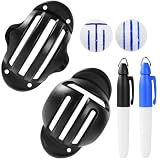
Lyriidothr 4-Piece Golf Ball Marker Alignment Kit
Not a book: a physical tool for practicing aim and alignment at the range or on a backyard mat. The stencils let you place your feet, ball, and clubface in correct positions repeatedly until muscle memory develops. For beginners who struggle with “where should I actually stand?” this removes guesswork entirely. Owner reviews highlight its effectiveness for self-guided practice without a coach.
- Pro: Tangible, repeatable practice aid; no reading comprehension required.
- Pro: $6.99 price point makes it a low-risk addition to any beginner kit.
- Con: Addresses only setup and alignment; no guidance on the swing itself or course strategy.
Skip it if your alignment is already correct and you need help with something else.
Buying Guide
Match Format to Your Learning Style
Golf beginners are not a monolith. Some learn best from a linear narrative that builds context chapter by chapter. Others prefer modular references they can dip into after each round. The modular format at $4.49 suits the second type perfectly; the narrative handbooks suit the first. Buying the wrong format means paying full price and never opening the book a second time.
Drill Specificity Determines Real Progress
Reading about grip pressure helps almost nothing if the book does not tell you exactly how many practice swings to take, what to feel at address, and how to self-correct without a coach. The alignment kit and the slice-specific guide both excel here because they translate into a repeatable physical routine. General handbooks often stop at describing the correct position without giving you a measurable drill sequence to follow alone.
The Confidence Factor Is Underestimated
Industry data consistently shows that most beginners quit within the first year, and the cause is rarely mechanical. It is embarrassment, pace-of-play anxiety, and feeling out of place. Guides that address these barriers directly, like The First-Year Golfer and the Women’s entries, produce better long-term retention than technique-only books regardless of price. Pair a mental-game resource with a technical one for the strongest combination.
Our Verdict
The top pick for most beginners is The First-Year Golfer at $14.99, because it solves the exact problem that kills more golf careers than any swing flaw: the desire to quit after public embarrassment. The budget pick is 101 Essential Tips: Golf at $4.49 for players who already have a coach or regular hitting partner and just need a quick-reference checklist. The Lyriidothr Alignment Kit wins outright if your sole problem is aim and setup and you learn best by doing rather than reading.
FAQ
Do I need a book or a physical training aid to start golf?
Both serve different purposes. A book gives you rules, strategy, and the mental framework; a training aid like the alignment kit gives you a repeatable physical routine. Many beginners benefit from one of each, starting with whichever addresses their most urgent barrier.
Is the Women’s Guide to Golf useful for men?
The cultural and confidence sections are written for female experiences, so male readers may find parts irrelevant. That said, the technical fundamentals apply to everyone. Most male beginners are better served by a general guide unless they specifically want that audience-focused perspective.
How do I fix a slice without spending money on lessons?
A focused guide like Fixing Your Golf Slice combined with the alignment stencils covers the most common root causes: grip, stance, and swing path. Many owners report improvement within a few range sessions using these two together before considering paid instruction.
Which product offers the best value per dollar for a complete beginner?
The 101 Essential Tips entry at $4.49 offers the most information per dollar by sheer coverage. However, value is not just cost per page; a $14.99 guide that actually keeps you playing past month three delivers more real value than a cheap book that gathers dust.


