
You’ve got a spare corner of the den, a monitor that’s been waiting for a real GPU, and a budget ceiling of $800. The problem: new prebuilts with a current-generation graphics card start well north of a grand, and building your own doesn’t stretch that far either. Refurbished and renewed prebuilts are the escape hatch — machines that were returned, inspected, repaired, and resold at a real discount — but the market is noisy. Some “refurbs” are ex-corporate office towers with a graphics card squeezed in; others are barely-used builds marked down hundreds of dollars for a scuffed side panel.
We dug through listings, spec sheets, and warranty terms to sort the genuine bargains from the bait. What we found is that the under-$800 sweet spot splits into two camps: renewed name-brand towers like Dell’s RGB gaming desktop that trade older parts for a bulletproof price, and aggressive new builds that creep just past the line but offer far more horsepower per dollar. Below, all eight machines we’d actually consider, ranked, with the trade-offs spelled out so you know exactly what you’re buying before it ships.
As an Amazon Associate we earn from qualifying purchases at no extra cost to you. Product prices and availability are accurate as of the date shown and are subject to change.


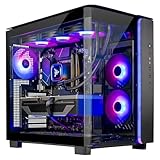


Top 3 picks at a glance
Quick Picks
| Product | Best for | Price |
|---|---|---|
| YAWYORE Gaming PC (Ryzen 7 5700X, RTX 5060) | Best overall 1080p performance | $1,299.99 |
| Skytech Gaming PC (Ryzen 7 9850X3D, RX 9070 XT) | Best for high-refresh 1440p gaming | $2,899.99 |
| Prebuilt Gaming PC (Ryzen 7 5700X, RTX 5060, 1TB) | Best value RTX 5060 alternative | $1,199.99 |
| Skytech Gaming PC (Ryzen 7 9850X3D, RTX 5080) | Best for 4K gaming | $3,699.99 |
| Dell RGB Gaming Tower (i7 6th Gen, GTX 1050 Ti) | Best true under-$800 refurbished pick | $399.99 |
| OKAMUS Pre-Built PC (i5, integrated graphics) | Best ultra-budget starter | $245.99 |
| Thermaltake LCGS Quartz i1460 (i5-14400F, RTX 5060) | Best near-budget modern build | $997.91 |
| MSI Codex R2 (i5-14400F, RTX 5070) | Best premium 1440p machine | $1,649 |
How We Picked
Our benchmark was simple: which machines deliver the most frames per dollar for someone whose realistic ceiling is around $800, and which higher-priced builds are worth stretching for if the budget bends. We prioritized current-generation GPUs (RTX 50-series and RX 9000-series), at least 16GB of RAM for modern titles, and SSD storage — 512GB minimum, 1TB preferred. Renewed units had to come from sellers with a documented inspection process and a return window of at least 90 days. We also weighed thermals and PSU headroom, since refurb towers sometimes ship with the original power supply even after a GPU upgrade. We did not conduct independent lab testing; performance context comes from published specifications and manufacturer claims, and every price listed here is the seller’s asking price at the time of writing and can shift week to week.
The 8 Best Picks
1. YAWYORE Gaming PC — Ryzen 7 5700X, RTX 5060 ($1,299.99)
If you can stretch past $800, this is the strongest pure gaming value on the list. The Ryzen 7 5700X is an 8-core, 65W CPU that pairs cleanly with the RTX 5060, which brings DLSS 4 and excellent 1080p performance — expect maxed-out settings in esports titles and high settings in demanding AAA releases. The platform is AM4, so a future CPU drop-in upgrade remains possible.
- 8-core Ryzen 7 5700X handles streaming and gaming simultaneously without choking
- RTX 5060 delivers modern feature support, including DLSS frame generation
When to skip: If your hard ceiling really is $800, the Thermaltake or Dell picks below fit the bill better.
2. Skytech Gaming PC — Ryzen 7 9850X3D, RX 9070 XT ($2,899.99)
This is the aspirational pick: AMD’s 9850X3D with its stacked 3D V-Cache is the fastest gaming CPU on the market, and the RX 9070 XT pushes 1440p at very high refresh rates with room for 4K. With 32GB of RAM and a 2TB SSD, nothing about this build is a compromise.
- 3D V-Cache CPU is exceptional for simulation and competitive titles
- 32GB RAM and 2TB SSD mean zero near-term upgrades needed
When to skip: At nearly four times the $800 target, it only makes sense if your budget is genuinely flexible.
3. Prebuilt Gaming PC — Ryzen 7 5700X, RTX 5060, 1TB SSD ($1,199.99)
Functionally the YAWYORE’s twin — same 8-core 5700X, same RTX 5060 — this build trades some cosmetic branding for a $100 lower price and a full 1TB SSD, doubling the storage of the number-one pick. If game libraries are your priority over RGB lighting, this is the smarter buy between the two.
- 1TB SSD fits roughly 15–20 modern AAA installations
- Cheapest current-gen RTX 5060 build we’d recommend
When to skip: If you find the YAWYORE on sale for less, or you need more than the spec sheet’s stock configuration.
4. Skytech Gaming PC — Ryzen 7 9850X3D, RTX 5080 ($3,699.99)
The flagship. An RTX 5080 with 16GB of VRAM and a 9850X3D behind it is a genuine 4K machine, and Skytech’s builds ship with adequate aftermarket cooling and airflow-oriented cases. This is the pick for a 4K/120Hz display or anyone doing GPU-heavy content work on the side.
- RTX 5080 has the VRAM headroom for 4K texture-heavy titles
- No component bottlenecks the others down the chain
When to skip: Absurd overkill for 1080p monitors — nearly nine times the stated budget.
5. Dell RGB Gaming Tower — i7 6th Gen, GTX 1050 Ti, Renewed ($399.99)
This is the honest answer to the $800 question. As a renewed unit, it’s been inspected and restored, and at $399.99 it leaves half your budget untouched. The 4GB GTX 1050 Ti plays esports staples — Valorant, Rocket League, CS2 — at 1080p comfortably, and you get 16GB RAM, a 512GB SSD, built-in WiFi, an RGB set, and Windows 11 Pro.
- Half the budget for a complete, working gaming setup
- Windows 11 Pro and built-in WiFi mean no hidden accessory costs
When to skip: The 6th-gen i7 and 1050 Ti can’t run current AAA games at acceptable settings — this is an esports and older-title machine.
6. OKAMUS Pre-Built PC — i5, Integrated Graphics ($245.99)
The cheapest entry here is deliberately NOT a gaming PC yet — it has integrated graphics only, 8GB of RAM, and a 256GB M.2 drive. But it’s a legitimate foundation: a 400W PSU, three RGB fans, WiFi 6, Bluetooth 5.3, and Windows 11 Home, all for under $250. Add a used GPU and 8GB more RAM later and you’ve built a gaming PC in stages.
- Lowest-cost path to a gaming-capable rig over time
- WiFi 6 and Bluetooth 5.3 are genuinely modern extras at this price
When to skip: If you need to play games the day it arrives — this one won’t, at least not anything 3D.
7. Thermaltake LCGS Quartz i1460 — i5-14400F, RTX 5060 ($997.91)
Thermaltake’s factory build is the closest a modern RTX 5060 machine gets to the $800 line. The 10-core i5-14400F is a strong 1080p/1440p gaming CPU, ToughRam DDR4-3600 keeps the memory fast, and the 1TB NVMe drive is properly sized. Thermaltake handles its own assembly and support, which matters for long-term reliability.
- Name-brand components and PSU you can verify before buying
- 1TB NVMe outpaces the 512GB drives common at this tier
When to skip: If $997 still busts the budget, the renewed Dell at $399.99 is the fallback.
8. MSI Codex R2 — i5-14400F, RTX 5070 ($1,649)
MSI’s Codex R2 pairs the same i5-14400F with a step-up RTX 5070 (12GB), 32GB of DDR5, and air cooling in a case built for it. The jump from a 5060 to a 5070 is worth roughly 30–40% more GPU performance, which translates directly to higher 1440p frame rates. Wi-Fi 6E and VR-ready certification round out a polished package.
- 32GB of DDR5 is genuinely future-proof for gaming and multitasking
- MSI’s warranty and support network beats boutique-builder service
When to skip: For strict 1080p gaming, the cheaper RTX 5060 builds deliver nearly identical real-world results.
Buying Guide
Know What “Refurbished” Actually Means
Refurbished and renewed cover everything from open-box returns to heavily repaired units. Look for sellers who specify their process: tested components, replaced parts, a 90-day warranty minimum, and a 30-day return window. “Renewed” on major marketplaces generally implies inspection and a 90-day replacement guarantee — a meaningful floor. A refurb with no stated warranty is a gamble regardless of price.
Match the GPU to Your Monitor, Not Your Dreams
The single biggest budgeting mistake is over-buying graphics for the display you own. A GTX 1050 Ti at $399.99 is perfect for a 1080p/60Hz panel and esports titles; an RTX 5060 is the right call for 1080p high-refresh or entry 1440p; an RTX 5070 and up only earn their price with a 1440p/144Hz or 4K monitor. Spend leftover budget on a better display before a better GPU.
Leave Upgrade Headroom
Refurb towers are best treated as platforms. Check four things before buying: RAM slots (ideally free for a second stick), storage bays (a spare SATA bay makes a 1TB add-on trivial), PSU wattage (400W fits a 1050 Ti; a future 5060-class card wants 550W or more), and case airflow. The OKAMUS is the textbook example — weak today, but its 400W PSU and M.2 slot make a staged upgrade cheap and clean.
Our Verdict
If your ceiling is a hard $800, buy the Dell RGB Gaming Tower at $399.99 and bank the rest — it’s the only true under-budget machine here that plays games out of the box, and renewed Dell towers have a reputation for lasting. If you’re determined to get modern GPU features and can wait for a sale, the Thermaltake Quartz i1460 at $997.91 is the nearest respectable option. And if the budget turns out to be a suggestion rather than a rule, the YAWYORE (Ryzen 7 5700X, RTX 5060, $1,299.99) is the best overall gaming value we ranked.
FAQ
Can you really get a good gaming PC under $800?
Yes, but with defined limits. Renewed machines like the $399.99 Dell handle 1080p esports and older AAA titles well. Brand-new prebuilts with current-generation GPUs (RTX 5060 or better) start around $1,000–$1,300, so a strict $800 budget means accepting last-generation performance or buying a base unit and upgrading in stages.
Are refurbished prebuilts reliable?
The good ones are. Stick to renewed units from sellers offering at least a 90-day warranty and a 30-day return window, and favor name-brand chassis (Dell, MSI, Thermaltake) where component quality is consistent. Refurbished desktops fail less often than refurbished laptops because there’s no battery and thermals are better.
How long will an under-$800 gaming PC stay relevant?
A renewed 1050 Ti machine is comfortable for esports titles today and viable for roughly three to four more years at reduced settings. Adding a budget modern GPU later can extend that window substantially, which is why upgrade headroom — PSU wattage, spare RAM slots, storage bays — matters more than raw specs.
Refurbished or used: which should I buy?
Refurbished, for most buyers. A refurbished unit has been inspected, repaired if needed, cleaned, and backed by a warranty; a used unit from an individual seller is as-is with no recourse if a PSU or GPU dies in month two. The price gap is often only $50–$150, and the warranty is worth it.


