
The Short Answer
No, you do not need a dedicated sound card for budget gaming. For 95% of budget gamers, the integrated audio chip built directly into your motherboard is more than adequate. Unless you are using a motherboard that is more than a decade old, or you are experiencing distracting electrical static, buzzing, or hissing through your headphones when your graphics card is under heavy load, spending extra money on a sound card is unnecessary.
As we look ahead toward 2026, motherboard manufacturers have standardized high-quality onboard audio capacitors and shielding, even on entry-level motherboards priced between $70 and $110. Your limited budget is far better spent on a faster graphics card, more RAM, or a higher-quality headset, all of which will have a much more noticeable impact on your daily gaming experience.
As an Amazon Associate we earn from qualifying purchases at no extra cost to you. Product prices and availability are accurate as of the date shown and are subject to change.

What You Actually Get
To understand why dedicated sound cards have transitioned from a gaming necessity to a niche luxury, it helps to look at what they actually do. A sound card handles two primary jobs: digital-to-analog conversion (DAC) and amplification. Your computer stores game audio as digital 1s and 0s, but your headphones require analog electrical waves to vibrate their drivers and produce sound.
On a standard budget motherboard, a small integrated chip (typically a Realtek ALC897 or ALC1220 codec) performs this conversion. Because this chip sits on the main motherboard PCB, it shares a ground plane with high-wattage components like your CPU (drawing 65W to 125W) and your GPU (drawing 150W to 300W or more). This close proximity can introduce electromagnetic interference (EMI), which translates to audible static, pop noises, or a high-pitched whine when you move your mouse or when your frame rates climb.
A dedicated sound card solves this issue by isolating the audio processing hardware. If you opt for an internal PCIe card like the Creative Sound Blaster Audigy Fx Pro (priced around $75.99), you get a dedicated circuit board measuring approximately 4.6 x 4.8 inches and weighing under 3 ounces. This card features specialized operational amplifiers, high-grade gold-plated capacitors, and a high-resolution DAC capable of 24-bit/192kHz audio playback with a 114dB signal-to-noise ratio (SNR). It also features a dedicated 600-ohm headphone amplifier, which can easily drive demanding studio-grade headphones that would sound quiet and hollow when plugged directly into a budget motherboard.
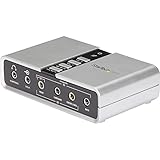
Alternatively, an external option like the StarTech 7.1 USB Audio Adapter (priced around $38) bypasses the internal chassis altogether. Measuring 3.9 x 2.4 x 1 inches and weighing about 3.5 ounces, this external unit connects via a standard USB port and runs on 5V bus power. By moving the audio conversion entirely outside of your PC case, it completely eliminates internal EMI. It also provides convenient physical volume controls, a mute button, and multiple 3.5mm jacks for true analog 7.1 surround sound systems, alongside optical S/PDIF inputs and outputs for older home theater receivers.
Pros
- Elimination of Electrical Noise: By isolating the audio components from the high-draw power phases of your CPU and graphics card, a dedicated sound card eliminates background hiss, static, and buzzing.
- Powerful Headphone Amplification: Dedicated cards feature built-in amplifiers that can drive high-impedance headphones (up to 600 ohms), delivering richer bass, wider dynamic range, and higher maximum volume levels.
- Legacy and Expanded Connectivity: Budget motherboards often strip away optical ports and multi-channel analog jacks. A dedicated card restores these connections, allowing you to hook up older 5.1 or 7.1 speaker systems.
- Advanced Software Control: Dedicated hardware comes with robust software suites that offer precise multi-band equalizers, mic noise-reduction algorithms, and customizable virtual surround sound profiles that do not tax your system’s processor.
Cons
- High Opportunity Cost for Budget Builds: Spending $38 to $75 on audio hardware takes money away from core performance components. In a budget build, that money could upgrade your GPU to a tier that yields an extra 15 to 20 frames per second.
- Physical Space and Obstruction: Internal PCIe cards sit directly below your graphics card. In compact Micro-ATX or Mini-ITX cases, this can physically block the intake fans of your GPU, leading to higher system temperatures and louder fan noise.
- No Benefit for USB Headsets: If you use a USB gaming headset or a wireless headset, it already has its own built-in sound card inside the cable dongle or the headset itself. A dedicated internal sound card will do absolutely nothing to improve its sound.
- Driver and Compatibility Headaches: Budget-tier sound cards occasionally suffer from abandoned software support, leading to driver conflicts, system crashes, or settings being reset after major operating system updates.
Who Should Buy It
You should consider buying a dedicated sound card if you fall into a few specific categories. First, if you own high-impedance, studio-grade headphones (such as the Beyerdynamic DT 990 Pro 250-ohm version) and you find that your current motherboard cannot push them to a satisfying volume. Second, if you hear an annoying buzzing sound in your headset every time your graphics card starts rendering a game, an external USB sound card is the easiest and most effective fix. Finally, if you are determined to connect an older analog 5.1 speaker set or an optical-only home theater receiver to a budget motherboard that only features a single green 3.5mm line-out jack, a dedicated card is a necessity.
Who Should Skip It
You should skip the sound card if you are using a standard USB-connected gaming headset, wireless gaming headphones, or budget analog earbuds (under 32 ohms of impedance). If your current gaming audio sounds clear, crisp, and gets plenty loud without any background static, a sound card will offer no audible improvement. If you are working with a strict total system budget of under $800, you should absolutely skip this upgrade and allocate every single dollar toward your processor, graphics card, or a fast NVMe solid-state drive.
Cheaper Alternatives
If you are experiencing audio issues on your budget rig but do not want to spend $40 to $75 on a dedicated sound card, there are several incredibly cost-effective workarounds available:
| Option | Estimated Cost | Trade-off |
|---|---|---|
| Apple USB-C to 3.5mm Dongle | $9.00 | Incredibly clean, static-free DAC performance, but has limited power output for high-impedance headphones and requires a USB-C port. |
| Rerouting Front Panel Audio Cable | $0.00 | Free fix. Opening your PC case and routing the HD Audio cable away from the power supply cables and GPU can completely eliminate static. |
| Budget USB Gaming Headset | $40.00 – $60.00 | Bypasses onboard motherboard audio entirely by using its own integrated digital USB controller, but locks you into using that specific headset. |
| Software Equalizer (e.g., Equalizer APO) | $0.00 | Allows you to manually tune your motherboard’s audio profile and boost dialogue or footsteps for free, but requires manual setup and troubleshooting. |
FAQ
Will a dedicated sound card increase my in-game FPS?
No. In the early days of PC gaming, sound cards offloaded audio processing from the weak central processor. Today, modern CPUs have multiple cores and handle game audio processing with less than 1% of their total capacity. Installing a sound card will not yield any measurable increase in your frame rates.
Can I use an external USB sound card instead of an internal PCIe card?
Yes, and for budget gaming, an external USB option is usually preferred. External USB sound cards sit outside of your computer chassis, isolating them completely from the electromagnetic interference generated by your graphics card and power supply. They also do not block airflow inside your computer case.
Do USB headsets benefit from an internal sound card?
No. USB headsets completely bypass your motherboard’s onboard audio and any internal PCIe sound card you have installed. They act as their own independent audio devices, converting digital signals to analog sound via a small control chip built directly into the headset’s wire or ear cups.
Why does my microphone static disappear when I unplug my laptop/PC charger?
This is caused by a ground loop, which is a common issue on budget motherboards with poor electrical isolation. An external USB sound card or a simple ground loop isolator (which costs around $10) will break this electrical loop and clean up your microphone transmission instantly.


