
A buyer searching for a fortnite cloud gaming pc is solving a specific problem: they want high-settings Fortnite without owning a workstation-class rig, or they need a local machine that also decodes cloud streams from GeForce NOW or Xbox Cloud Gaming without stuttering. The cloud angle adds a twist that pure local-build advice misses — your PC handles video decoding and input processing for the remote session, so underpowered systems bottleneck even when game logic runs elsewhere.
What separates a good pick from a bad one in this niche is headroom. A CPU and GPU combo with breathing room for both native sessions and cloud-decode tasks will stay usable longer. Owners consistently report that 16GB of RAM feels adequate today but tight once streaming overlays, launchers, and voice chat compete for memory. Beyond raw specs, included extras like controllers, build quality, and upgrade paths matter more than benchmark numbers because cloud gaming hardware ages differently from pure local-play setups.
As an Amazon Associate we earn from qualifying purchases at no extra cost to you. Product prices and availability are accurate as of the date shown and are subject to change.


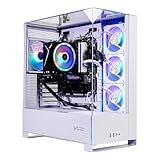

Top 3 picks at a glance
Quick Picks
| Product | Best for | Price |
|---|---|---|
| Skytech Crystal (Ryzen 7 5700) | Best value RTX 5060 build | $1,149.99 |
| Evounic 12-Core Desktop | Budget GTX 1080 Ti option | $758.88 |
| VRA Bundle (i7-4790 / RX 580) | Lowest entry price | $449 |
| Skytech Crystal (Ryzen 7 7700) | Maximum DDR5 headroom | $1,599.99 |
| PowerA OPS v1 Controller | Cloud-native gamepad | $41.09 |
| OnePro Cloud Handheld | Portable cloud play | $272.99 |
| Skytech Archangel 5 | Balanced Intel option | $1,249.99 |
| Skytech Azure 3 | Thermal headroom pick | $1,379.99 |
How We Picked
We filtered these picks on four criteria. First, GPU tier and VRAM — enough horsepower to run Fortnite locally at competitive settings while decoding cloud streams without frame drops. Second, RAM capacity and speed — 16GB DDR5 or more keeps streaming overlays, game launchers, and voice chat from stealing bandwidth mid-match. Third, connectivity quality — Wi-Fi hardware and port selection determine whether a cloud session stays stable or drops packets during fights. Fourth, total cost relative to included extras like bundled controllers or peripherals that would otherwise add to the sticker price.
The 8 Best Fortnite Cloud Gaming PC in 2026
Skytech Gaming Crystal (Ryzen 7 5700)
This is the value anchor of the list. It suits buyers who want competitive native Fortnite settings plus reliable cloud-stream decoding without paying a premium. The 32GB of DDR4 means overlays, voice chat, and a browser coexist without memory pressure, and the 1TB NVMe SSD accommodates Fortnite, a cloud launcher, and a few other titles comfortably.
- Pro: 32GB DDR4 delivers genuine multitasking headroom for simultaneous cloud and local workloads.
- Pro: RTX 5060 decodes remote 1080p streams smoothly while handling native play.
- Con: DDR4 at 3200 MHz trails DDR5 in sustained frame stability during dense effects scenes.
Skip this if you want the latest memory standard for maximum long-term relevance.
Evounic Gaming Desktop 12-Core
For buyers who already own cloud-game subscriptions and primarily need a capable decode machine, the 11GB of VRAM and multi-core CPU keep frame pacing steady during fast-building sequences. The price sits well under RTX 5060 alternatives, making it a reasonable compromise for cloud-first users.
- Pro: 11GB VRAM provides unusual headroom for its price tier, useful for high-quality cloud streams.
- Pro: 12-core CPU handles background encoding and streaming apps without choking the game.
- Con: The GTX 1080 Ti lacks modern upscaling features, limiting native-resolution flexibility.
Skip this if you plan to run demanding AAA titles natively alongside Fortnite.
VRA Gaming PC Bundle (i7-4790 / RX 580)
At the lowest cost on this list, this bundle pairs an older Intel Core i7-4790 with an RX 580 8GB. The RX 580 remains adequate for 1080p cloud-stream decoding, and the quad-core i7 still handles Fortnite at moderate settings. For a dedicated cloud terminal, the math works.
- Pro: Lowest total cost by a wide margin, freeing budget for a monitor or controller.
- Pro: 8GB VRAM prevents texture pop-in during high-quality cloud sessions.
- Con: The 4790 lacks modern IPC gains; native gameplay at high settings will struggle.
Skip this if you expect to play anything locally beyond Fortnite or light indie titles.
Skytech Gaming Crystal (Ryzen 7 7700)
The higher-tier Crystal swaps to a Ryzen 7 7700 and DDR5 5600 memory alongside an RTX 5060 Ti 8GB. This is the spec-ceiling pick for buyers who want maximum frame stability in both native and cloud modes. The faster RAM reduces stutter during peak action, and 32GB DDR5 future-proofs against increasingly hungry launchers.
- Pro: DDR5 5600 plus the 7700 IPC gains yield the smoothest sustained frametimes here.
- Pro: RTX 5060 Ti adds a performance layer above the base 5060 for native play.
- Con: The price overshoots what a cloud-primary use case strictly requires.
Skip this if your primary goal is cloud decode and you already own a capable GPU.
PowerA OPS v1 Wireless Controller
A controller, not a PC, but it earns a slot because cloud gaming with a gamepad feels far more natural than keyboard-and-mouse on a tablet or handheld. It supports wireless, wired, and Bluetooth connections, features Hall Effect thumbsticks that resist drift, and offers mappable buttons plus turbo functions. For the price, it removes input friction that makes cloud Fortnite feel sluggish.
- Pro: Hall Effect sticks eliminate drift, a common cloud-session complaint.
- Pro: Three connection modes pair with PCs, phones, and handhelds alike.
- Con: No haptic feedback or adaptive triggers, lacking premium controller feel.
Skip this if you strictly play with keyboard and mouse and never touch a gamepad.
OnePro Cloud Handheld
The OnePro is a dedicated cloud terminal, not a local gaming PC. Its 7-inch 1080p touchscreen and lightweight chassis make it ideal for playing Fortnite through Xbox Cloud Gaming or GeForce NOW away from a desk. With 64GB of storage and long battery life, it handles streaming apps and a handful of native retro titles.
- Pro: True portability with a full cloud session in a handheld form factor.
- Pro: 1080p touchscreen renders cloud streams at native resolution with no upscaling artifacts.
- Con: 64GB storage fills quickly if you also install native games or apps.
Skip this if you need a machine for local gameplay or content creation alongside cloud sessions.
Skytech Gaming Archangel 5
The Archangel 5 uses an Intel i5-14400F paired with an RTX 5060 and 16GB DDR5 at 6000 MHz. It lands between the two Crystal variants as a balanced Intel option. The 14400F hybrid architecture handles cloud decode efficiently while delivering strong single-thread performance for native Fortnite, and the 750W PSU leaves upgrade space.
- Pro: DDR5 6000 MHz is the fastest memory in this roundup, aiding frame pacing.
- Pro: Intel hybrid scheduling keeps background tasks off game-critical performance cores.
- Con: 16GB of RAM feels tighter than 32GB when overlays and launchers run simultaneously.
Skip this if you routinely multitask heavily and want the extra memory headroom of a 32GB kit.
Skytech Gaming Azure 3
The Azure 3 pairs a Ryzen 7 9700X with an RTX 5060, 16GB DDR5 6000, and a 360mm ARGB AIO cooler. That cooling matters for cloud gaming because sustained decode sessions generate constant heat in a compact chassis. The 9700X delivers the strongest CPU performance of any option here, and the 850W ATX 3 PSU supports future GPU swaps.
- Pro: 360mm AIO keeps thermals low during long cloud sessions, preventing throttling.
- Pro: ATX 3 PSU with native 12VHPWR compatibility simplifies a future GPU upgrade.
- Con: 16GB DDR5 is the same limit as the Archangel 5 at a higher price.
Skip this if cooling is not a concern in your setup or you will not upgrade the GPU later.
Buying Guide
GPU Tier and VRAM for Cloud Decode
The GPU handles two jobs in a cloud gaming build: native rendering and video decode of incoming streams. For decode, VRAM matters more than raw clock speed because 1080p and 1440p streams require frame buffers that survive high-motion scenes without dropping packets to system memory. An RTX 5060 or RX 580 with 8GB sits at a practical floor. If you also play natively at high settings, a 5060 Ti or card with more VRAM buys headroom during late-game storm circles where particle effects spike.
RAM Speed and Capacity
16GB has become the bare minimum for cloud-plus-local multitasking. Cloud clients, Discord, streaming overlays, and a web browser easily push memory usage past that threshold mid-match, causing stutter that feels like network lag but is actually swap-file thrashing. DDR5 at 5600 or 6000 MHz reduces the latency penalty of those page faults, and a 32GB kit eliminates the problem entirely. If your budget forces a 16GB choice, close all background apps before starting a cloud session.
Connectivity and Peripheral Compatibility
Cloud gaming is only as stable as your network stack. A desktop with a quality Wi-Fi adapter and clear line of sight to your router will outperform a wired-connection handheld behind a congested home network. Check for a dedicated Ethernet port, antenna placement, and band support. For controllers, confirm that your cloud service input latency profile matches the device — a gamepad with mappable buttons and a turbo function lets you compensate for small input delays that cloud streaming introduces.
Our Verdict
The Skytech Crystal with the Ryzen 7 5700 and RTX 5060 at $1,149.99 is the top pick: 32GB DDR4 and modern GPU decode coverage at the best price-to-capability ratio for cloud-primary users. The VRA bundle at $449 is the budget pick, with RX 580 VRAM sufficient for cloud decode at moderate quality. The OnePro handheld becomes the right answer if your primary scenario is playing away from a fixed desk, since no desktop here matches its portability.
FAQ
Can a cloud gaming PC also run Fortnite natively?
Yes, as long as the GPU and CPU meet Epic recommended specs. Most RTX 5060 builds on this list run Fortnite natively at high settings while also handling cloud decode tasks, giving you a dual-purpose machine.
How much bandwidth does Fortnite cloud gaming need?
A stable 15-25 Mbps download connection with low jitter is the typical recommendation. Bandwidth alone is not enough — your PC Wi-Fi adapter and router quality matter more for consistent frame delivery than raw megabit speed.
Is DDR4 still good enough for this use case?
DDR4 at 3200 MHz with 32GB capacity still handles cloud decode and native play without measurable frame drops in most scenarios. The difference versus DDR5 becomes noticeable only when many background tasks compete for memory bandwidth simultaneously.
Do I need a special controller for cloud Fortnite?
Not strictly, but a gamepad with mappable buttons and Hall Effect sticks reduces the input-latency frustration that some players feel when switching from keyboard to cloud sessions. The PowerA OPS v1 addresses this at minimal cost.


