
A homeowner staring at a grimy driveway, mildew-covered fence, or oil-stained patio faces one practical question: will this machine last long enough to justify the price? That is the real reason so many buyers filter their search for a honda pressure washer. Honda engines are common in the small-engine world, easy to source replacement parts for, and forgiving of occasional maintenance lapses — exactly what most residential users need from a machine that sits under a tarp between spring and fall cleanups.
What separates a good gas pressure washer from a mediocre one is not headline PSI alone. Flow rate (GPM) determines how fast dirt actually comes off; pump construction determines whether the machine survives more than a few seasons; and the engine determines whether starting and servicing it becomes a daily frustration. Price gaps in this group run from under $350 to well over $1,300, and not every tier earns its premium. This roundup compares eight models across published specifications and aggregated owner feedback to show where the money goes.
As an Amazon Associate we earn from qualifying purchases at no extra cost to you. Product prices and availability are accurate as of the date shown and are subject to change.


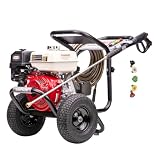


Top 3 picks at a glance
Quick Picks
| Product | Best for | Price |
|---|---|---|
| Simpson PowerShot 3500 PSI | Mid-range driveway cleaning with a proven Honda engine | $639.99 |
| Simpson Clean Machine 3400 PSI | Lowest entry price in the lineup | $354.99 |
| Simpson Aluminum Series 3600 PSI | Lightweight build without sacrificing power | $746.90 |
| DeWalt 3300 PSI DXPW3300-S | Buyers who want DeWalt service network access | $359 |
| Simpson PS60869 PowerShot 4000 PSI | Heavy-duty residential and light commercial jobs | $999 |
| Simpson Aluminum Series 4200 PSI | Maximum PSI for large-acreage properties | $1,399.99 |
| Simpson PS3228 PowerShot 3300 PSI | Compact storage and hose flexibility | $629 |
| Westinghouse WPX3400 | Value with onboard soap tank included | $349 |
How We Picked
Four criteria drove every inclusion and ranking here. First, engine type and tier: a honda pressure washer with a GX200, GX270, or GX390 means different service intervals, power reserves, and long-term reliability. Second, the balance between PSI and GPM, because a machine that scores high on one axis but low on the other cleans more slowly than its sticker suggests. Third, pump construction — axial-cam pumps are cheaper but shorter-lived, while triplex pumps justify their premium. Fourth, real price-per-feature value measured against published owner complaints and praise, not marketing copy.
The 8 Best Honda Pressure Washer in 2026
Simpson PowerShot 3500 PSI
This is the default recommendation for homeowners with a two-car driveway and a weekly maintenance habit. The Honda GX200 is the most widely used small engine in North America, meaning any repair shop nearby can service it without special ordering parts. Owners consistently praise the pull-start reliability and the frame’s resistance to rust compared to cheaper alternatives. The 3500 PSI / 2.5 GPM combination handles automotive surfaces, siding, and patio stone without overthinking. At $639.99 it sits in a crowded mid-range, and the bundled hose length is shorter than what professionals expect. Skip it if your cleaning tasks rarely exceed a single vehicle and a short walkway; the Clean Machine below covers those jobs for roughly half the price.
Simpson Clean Machine 3400 PSI
The Clean Machine trades the Honda engine for a CRX unit to cut its price nearly in half. For buyers who prioritize a low initial cost over long-term engine serviceability, that trade is rational. The 3400 PSI / 2.5 GPM output is close enough to the PowerShot that most residential tasks feel identical in cleaning speed. Owners who report satisfaction tend to use it seasonally rather than weekly. The con is straightforward: a non-Honda engine means part availability and mechanic familiarity drop, and resale value follows. Skip it if you plan heavy use or live far from a small-engine specialist.
Simpson Aluminum Series 3600 PSI
Aluminum construction shaves significant weight off the frame, which matters if you carry the unit up stairs or load it into a truck bed repeatedly. The Honda GX200 keeps serviceability on par with the PowerShot, and the 3600 PSI / 2.5 GPM rating places it between the PowerShot and the 4000-psi model in the lineup. Owners appreciate the corrosion resistance in coastal and high-humidity regions where steel frames deteriorate faster. The $746.90 price tag is a premium of roughly a hundred dollars over the PowerShot for a weight and material upgrade that only some users value. Skip it if your machine stays on flat ground and you have no rust concerns.
DeWalt 3300 PSI DXPW3300-S
DeWalt enters this comparison on the strength of its residential model line and the brand’s nationwide service infrastructure. The 3300 PSI / 2.4 GPM output is modest, positioning it as a light-duty option at $359. Owners who already own DeWalt battery tools and trust the brand ecosystem report satisfaction with the purchasing simplicity. The lower GPM means longer cleaning times on large surfaces compared to the Honda-powered models above. The DXPW3300-S designation signals a residential build grade, so durability expectations should stay proportional. Skip it if you need a honda pressure washer specifically for engine reliability or if your projects include commercial-scale surfaces.
Simpson PS60869 PowerShot 4000 PSI
This is the workhorse of the group. The Honda GX270 is a step up in displacement and torque from the GX200, giving the AAA Triplex pump more consistent pressure under sustained load. The 4000 PSI / 3.5 GPM combination is genuinely fast on concrete, barn siding, and heavy equipment. At $999, buyers receive the spray gun, wand, five quick-connect nozzle tips, and a 3/8-inch by 50-foot Monster hose included — a bundle that would cost extra on lesser models. Owners note the unit is heavy and less nimble in tight spaces. Skip it if your cleaning surface area is small; you are paying for capacity you will not use weekly.
Simpson Aluminum Series 4200 PSI
At $1,399.99, this is the most expensive unit in the roundup and the highest-PSI machine listed. The Honda GX390 is the largest engine in this group, designed for near-continuous duty cycles. The 4200 PSI / 2.5 GPM pairing favors blasting stubborn deposits over fast coverage, since the flow rate is moderate. Aluminum construction keeps the frame manageable despite the larger engine. This model appeals to owners of acreage, commercial vehicles, or property with years of accumulated grime. The price puts it outside most homeowner budgets. Skip it unless your use case genuinely demands sustained high-pressure output beyond what the 4000-psi model delivers.
Simpson PS3228 PowerShot 3300 PSI
The PS3228 is the most compact honda pressure washer in this lineup at $629, pairing a Honda GX200 with a 5/16-inch by 25-foot MorFlex hose that stores more easily than bulkier rubber lines. Owners cite maneuverability and reduced fatigue during detail work on furniture, vehicles, and small patio sections. The 3300 PSI / 2.5 GPM rating is sufficient for residential tasks but slower on large concrete areas compared to higher-flow models. The five quick-connect nozzle tips and included extension wand make it versatile out of the box. Skip it if your primary job is a long driveway, where the shorter hose becomes a limitation you will work around constantly.
Westinghouse WPX3400
The Westinghouse rounds out the budget tier at $349 with a 3400 PSI / 2.6 GPM rating that edges out the DeWalt on paper and sits below the Clean Machine’s price. The onboard soap tank is a practical inclusion that eliminates a separate chemical applicator for common tasks like car washing and fence treatment. Owners appreciate the simplicity of the package and its suitability for occasional weekend use. The unit is best understood as a seasonal tool rather than a workhorse; pump longevity under frequent use is the most common concern. Skip it if you need a honda pressure washer with GX200-class engine support or plan to run the machine more than a few times per season.
Buying Guide
PSI and GPM: Why Flow Rate Decides Cleaning Speed
Pressure in PSI determines how deeply a jet can break a bond; flow rate in GPM determines how much surface area that jet covers per minute. For most residential cleaning, raising GPM reduces total job time more effectively than raising PSI. A 3300 PSI / 3.5 GPM machine cleans faster than a 4000 PSI / 2.5 GPM machine on open concrete, even though the second has a higher pressure number. Match GPM to the largest flat area you clean regularly, and treat PSI as the force needed to dislodge specific contaminants like oil or paint residue.
Honda Engine Tiers: GX200 vs. GX270 vs. GX390
The GX200 is the smallest and lightest of the three, adequate for machines up to 3600 PSI in intermittent use. The GX270 adds displacement and torque headroom, making it the better match for triplex pumps and longer continuous run times. The GX390 is the most powerful, designed for machines pushing 4000 PSI and above where pump demand is highest. Any honda pressure washer with these engines benefits from a shared parts network, but sizing the engine to the pump prevents the engine from laboring at the edge of its power band, which accelerates wear over time.
Pump Construction: Axial-Cam vs. Triplex
Most units under $700 in this group use axial-cam pumps, which are simpler and cheaper but have shorter service lives under frequent use. Triplex pumps — like the AAA Triplex in the PS60869 — use three plungers to deliver smoother pressure with less pulsation, and they tolerate continuous operation far better. If you use a pressure washer more than once per week or on commercial jobs, a triplex pump is the single most meaningful upgrade in the entire specification sheet. For seasonal homeowner use, an axial-cam pump from a reputable brand will serve its purpose.
Our Verdict
The top pick is the Simpson PS60869 PowerShot 4000 PSI. It balances a proven Honda GX270 engine, a triplex pump, high flow rate, and a complete hose-and-tip bundle into a package that will remain functional for years of weekly use. The budget pick is the Westinghouse WPX3400 at $349, which offers the lowest entry cost with a usable feature set for occasional jobs. One condition changes the ranking: if you live in a coastal area with high humidity and salt exposure, the Simpson Aluminum Series 3600 PSI becomes the better choice over the PowerShot 3500 because aluminum resists the corrosion that steel frames cannot.
FAQ
Do all pressure washers with Honda engines perform the same?
No. The Honda engine is the power source, but cleaning performance depends on pump type, nozzle design, and the PSI-GPM combination. Two units with the same GX200 can feel noticeably different if one uses an axial-cam pump and the other uses a triplex.
Is 2.5 GPM enough for a two-car driveway?
Yes, though expect longer run times than you would with a 3.5 GPM machine. For a typical two-car concrete driveway, 2.5 GPM paired with 3300-3500 PSI will complete the job in a single session without excessive fatigue.
What does “49-State” mean in a product listing?
It indicates the unit is certified for sale in 49 U.S. states, with California excluded due to its stricter emissions regulations on small engines. If you live in California, verify emissions compliance before purchasing.
Can I use a honda pressure washer to wash a car without damaging paint?
Yes, provided you use a wide-angle nozzle tip (typically 40 degrees or the soap setting) and maintain a distance of at least two feet from the surface. Lower-pressure models like the PS3228 are more forgiving on paint than high-PSI units with narrow tips.


