
Top 3 picks at a glance
The Short Answer
A mid range gaming PC in 2026 typically draws between 350 and 500 watts while gaming, with brief peaks of 550 to 650 watts under heavy CPU and GPU load. At idle or browsing the desktop, that same system drops to 55 to 85 watts, and during light productivity tasks it sits around 120 to 180 watts. For that power profile, a quality 650W to 850W 80 Plus Gold power supply gives you the ideal headroom for efficiency, quiet operation, and future upgrades, without overspending on wattage you will not use.
Most mid range builds today pair a 65 to 105 watt CPU, such as an AMD Ryzen 7 7700 / 7700X or Intel Core i5 equivalent, with a 150 to 250 watt graphics card, such as an NVIDIA RTX 5060 or RTX 5070. Add 30 to 50 watts for motherboard, RAM, NVMe storage, fans, and cooling, and you land squarely in that 400 to 475 watt gaming sweet spot. If you are sizing a desk, cabinet, or power setup for this class of PC, plan for the physical footprint of a mid-tower case and a circuit that can comfortably handle a 6 to 8 amp draw at 120V.
As an Amazon Associate we earn from qualifying purchases at no extra cost to you. Product prices and availability are accurate as of the date shown and are subject to change.

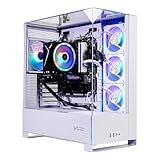


Standard Sizes
Power draw tells you what to plug it into, but physical size tells you if it will actually fit your space. Gaming PCs are categorized by case form factor, not just internal specs. A mid range system is almost always built in a mid-tower, though compact micro-ATX and larger full-tower options exist at similar price points of $1,400 to $2,200.
| Form Factor | Height (in / cm) | Width (in / cm) | Depth (in / cm) | Typical Empty Weight | Best For |
|---|---|---|---|---|---|
| Compact Micro-ATX Mid-Tower | 14.5 – 16.5 in / 36.8 – 41.9 cm | 7.5 – 8.5 in / 19.1 – 21.6 cm | 14.0 – 16.0 in / 35.6 – 40.6 cm | 13 – 18 lbs / 5.9 – 8.2 kg | Small desks, apartments |
| Standard Mid-Tower (Most Common for Mid Range) | 17.0 – 19.5 in / 43.2 – 49.5 cm | 8.0 – 9.5 in / 20.3 – 24.1 cm | 17.5 – 19.5 in / 44.5 – 49.5 cm | 18 – 26 lbs / 8.2 – 11.8 kg | Balanced airflow and space |
| O11 Vision / Wide Dual-Chamber Mid-Tower | 18.5 – 19.5 in / 47.0 – 49.5 cm | 11.0 – 12.5 in / 27.9 – 31.8 cm | 18.0 – 19.0 in / 45.7 – 48.3 cm | 22 – 30 lbs / 10.0 – 13.6 kg | Showcase builds with 360mm AIO |
| Full-Tower | 21.0 – 24.0 in / 53.3 – 61.0 cm | 9.0 – 10.5 in / 22.9 – 26.7 cm | 20.0 – 23.5 in / 50.8 – 59.7 cm | 28 – 38 lbs / 12.7 – 17.2 kg | Maximum expansion, large coolers |
| Mini-ITX Cube / SFF | 11.0 – 13.5 in / 27.9 – 34.3 cm | 7.0 – 8.0 in / 17.8 – 20.3 cm | 12.5 – 15.0 in / 31.8 – 38.1 cm | 10 – 15 lbs / 4.5 – 6.8 kg | Ultra-compact setups |
Fully assembled weight with components, glass panels, and a 240mm to 360mm AIO cooler adds 8 to 12 pounds to the empty case weight. A typical mid range mid-tower with an RTX 5070, 32GB RAM, and air or liquid cooling will weigh 28 to 35 pounds total. For wattage planning, use this quick reference: RTX 5060 builds usually game at 340 to 420 watts system draw, RTX 5070 builds at 400 to 500 watts, and both idle under 85 watts. A 750W Gold PSU covers the first comfortably, while 750W to 850W is ideal for the second, especially if you use a 360mm AIO and multiple fans.
How to Measure Your Space
Before you buy, measure where the PC will live, not just the desk surface. Gaming cases need breathing room for intake and exhaust, plus clearance for cables and power draw from the wall.
- Measure your footprint: Use a tape measure to record the maximum width and depth of the spot where the tower will sit. For a desk floor compartment, measure inside the cabinet, not the outer frame. Add 2 inches (5 cm) to the case width and 3 inches (7.6 cm) to the depth for cables at the rear.
- Check vertical clearance: Measure from the surface to the lowest shelf or drawer above. You need at least 3 to 4 inches (7.6 to 10.2 cm) above the top exhaust fans or radiator. Never enclose the top of a case with a 360mm AIO.
- Confirm rear and side airflow: Leave 4 to 6 inches (10.2 to 15.2 cm) behind the PC for exhaust and power cables, and at least 2 inches (5 cm) on the intake side. Glass-front or solid-front panels need even more rear clearance.
- Measure your power access: Note the distance to the wall outlet and to your UPS or surge protector. Mid range PCs draw up to 5.5 amps at peak, so they should be on a 15 amp circuit not shared with a space heater or large appliance. Avoid extension cords; use a 14-gauge surge protector or UPS rated for 900 to 1500VA.
- Account for peripherals and heat: A 27 to 32 inch monitor, keyboard, and mousepad need a desk at least 48 inches wide (121.9 cm) and 24 inches deep (61 cm) if the tower also sits on top. If the PC will be on the floor, use a hard stand or 0.5 inch riser to keep bottom intakes off carpet and reduce dust.
- Tape it out: Use painter’s tape to mark the case dimensions on your desk or floor. Sit at the desk and check knee clearance, legroom, and whether the side glass will be blocked by a wall.
By Room or Use Case
Small Bedroom or Apartment Desk (48 to 55 Inch Desk)
Choose a compact micro-ATX or slim standard mid-tower: 16.5 inches tall or less, 8.5 inches wide, and under 16 inches deep. This saves 3 to 5 inches of desk depth for your monitor and keeps total system weight under 30 pounds for easy moving. These smaller cases still house an RTX 5060 and 750W Gold PSU with power draw around 350 to 420 watts gaming, but they limit you to a 240mm AIO or air cooler. Keep the tower on top of the desk on the side opposite your dominant hand to preserve airflow and avoid kicking it below.
Dedicated Home Office or Gaming Room
A standard mid-tower is the ideal fit here at 17 to 19.5 inches tall and 17.5 to 19.5 inches deep. It accommodates a full-size RTX 5070 (11 to 13 inches long), a 360mm front or top radiator, and four to six 120mm fans without crowding. Expect 400 to 500 watts gaming draw and plan your outlet layout accordingly: a 750W to 850W Gold ATX 3.0 or ATX 3.1 PSU is the standard pairing at this tier and handles transient spikes cleanly. Allow a 30 inch (76.2 cm) wide space on the desk or a dedicated floor stand with 18 by 20 inches of floor footprint.
Living Room or Family Space
If the PC shares space with a TV console, prioritize quiet operation and cord management over show lighting. A 18 to 19 inch tall wide dual-chamber case like an O11 Vision style looks great next to a media unit but needs a wider shelf: 11 to 12.5 inches wide plus 4 inches for side ventilation if placed in a cabinet. These systems often include upgraded cooling and lighting, pushing gaming draw to the high end of mid range at 450 to 520 watts. Use a hard floor mat under the case, keep it 6 inches from the wall for hot air exhaust, and connect to a TV or monitor with a certified high-speed cable routed with 2 inches of slack to prevent port strain.
Streamer, Student, or Work-From-Home Hybrid
When the PC must handle gaming, streaming, and work calls, prioritize desk ergonomics. Keep the tower off the main work surface if your desk is under 60 inches wide. A mid-tower on a side cart or floor stand frees 8 to 10 inches of desk width and reduces fan noise at ear level. This use case also benefits from extra power headroom, as streaming while gaming can add 25 to 40 watts to total draw compared to gaming alone. A 750W Gold PSU remains sufficient, but if you plan to add capture cards, extra storage, or upgrade to a higher-tier GPU later, starting at 850W Gold saves you a future swap.
Common Sizing Mistakes
1. Buying for wattage, not wall power: Shoppers focus on the PSU rating and forget the room circuit. A mid range PC does not need a 20 amp outlet, but it should not share a power strip with a printer, heater, or vacuum. Place it on a dedicated surge protector and leave 30 percent headroom on the strip’s rating.
2. Forgetting GPU and cooler depth: Mid range does not mean small. An RTX 5070 and a 360mm AIO add 2 to 3 inches to effective case depth and height. Always check the manufacturer’s clearance specs for GPU length (330 to 340mm) and radiator support, not just the outer case dimensions.
3. No breathing room: Sliding a glass-front mid-tower tight against a wall or inside a closed cabinet traps heat and forces fans to run louder. Without 4 to 6 inches of rear exhaust space and open top ventilation, internal temperatures can rise 8 to 15 degrees, which shortens component life.
4. Measuring the desk, not the chair space: A 19 inch deep tower on a 24 inch deep desk looks fine until you sit down and your knees hit the case below. If the PC goes in a desk cubby, confirm the cubby is at least 20 inches deep and 20 inches tall, or move the tower to the floor on a stand.
5. Ignoring weight and floor type: A 35 pound PC on a thin particle-board shelf will sag over time. Place heavier wide-body cases on solid wood, metal, or floor stands. On carpet, always use a board or stand to prevent PSU intake blockage and dust buildup.
FAQ
How much electricity does a mid range gaming PC use per hour?
At typical gaming load, a mid range PC with an RTX 5060 or RTX 5070 uses 0.35 to 0.50 kilowatt-hours per hour. If you pay the national average of $0.15 to $0.18 per kWh, that is about 5 to 9 cents per hour of gaming. At idle, usage drops to 0.055 to 0.085 kWh per hour, or less than 2 cents per hour. Running 3 hours of demanding games daily adds roughly $5 to $8 per month to your electric bill.
What size power supply do I actually need for a mid range build?
For an RTX 5060 system, a 650W to 750W 80 Plus Gold PSU is plenty. For an RTX 5070 system, choose 750W to 850W Gold, ideally ATX 3.0 or newer, to handle short power spikes. You do not need 1000W or more unless you plan to upgrade to an RTX 5080/5090 class card. Quality matters more than raw wattage; a well-built 750W Gold unit will run quieter and more efficiently at 50 to 60 percent load than a cheap 1000W unit at 35 percent.
Will a mid range gaming PC fit on a standard desk?
Yes, but measure first. A standard office desk is 47 to 60 inches wide and 24 inches deep. A standard mid-tower at 8 to 9.5 inches wide and 18 inches deep fits on top if you have a 55 inch or wider desk, or on the floor on a stand if your desk is smaller. Leave the 4 to 6 inches of rear clearance noted above and keep the top exhaust open. If your desk has a closed PC compartment, confirm it is at least 20 inches tall, 10 inches wide, and 20 inches deep with an open back.
How loud and hot will it make my room?
Under gaming load a well-cooled mid range system exhausts 350 to 500 watts of heat into the room, similar to two to three people sitting in that space. In a 120 square foot room with the door closed, expect a 2 to 4 degree Fahrenheit rise after an hour. Noise at idle is typically 28 to 34 dBA, barely audible, and 36 to 44 dBA while gaming, about the level of a quiet conversation. Cases with mesh fronts and 240mm to 360mm AIOs run cooler and quieter than solid-panel cases with fewer fans.


