
The Short Answer
For most builders, no — budget liquid cooling is not worth it over a good air cooler. The honest answer is: it’s only worth it if you specifically need the lower RAM clearance footprint of a 240mm radiator, you want a cleaner look with the fans mounted elsewhere in the case, or you’re chasing every last few degrees on a hot-running CPU that a tower air cooler struggles to cool quietly. If none of those apply to you, a quality air cooler delivers 90–95% of the thermal performance for roughly half the price.
What You Actually Get
Budget all-in-one (AIO) liquid coolers live in a specific price band: roughly $70–$110 for a 240mm unit. The CoolerMaster MasterLiquid ML240L RGB V2 at $89.99 is a representative example — a closed-loop system with a 240mm radiator, a Gen3 dual-chamber pump, two 120mm SickleFlow ARGB PWM fans, and support for AMD AM4/AM5 and Intel LGA1700/1200 sockets.
As an Amazon Associate we earn from qualifying purchases at no extra cost to you. Product prices and availability are accurate as of the date shown and are subject to change.
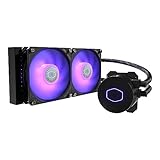

What does “$90 of liquid cooling” actually buy you? A closed loop is not a custom loop. The pump, water block, tubing, and radiator come pre-assembled and pre-filled. You cannot refill it, upgrade it, or repair it. Most budget AIOs carry a 3–5 year warranty, after which the unit is disposable — pumps wear, coolant slowly permeates through the tubing, and there is no service path.
On the other side of the ring is air. The Thermalright Peerless Assassin 120 SE ARGB at $36.90 is the poster child for budget air cooling: a dual-tower heatsink with six heat pipes, AGHP anti-gravity technology, and two 120mm PWM fans. It weighs around 1.36 kg (about 3 pounds) bare, stands roughly 155mm tall, and cools CPUs in the 245W TDP class on paper. Socket support covers AM4, AM5, LGA1700, LGA115x, LGA1155, LGA1200, and the newer LGA1851.
In real-world use, a well-designed dual-tower air cooler and a budget 240mm AIO often land within a few degrees Celsius of each other under sustained load. The AIO sometimes wins by 2–5°C; sometimes the air cooler matches it outright. What you pay extra for with liquid is mostly aesthetics, clearance flexibility, and marginally quieter peak cooling on very hot chips.
Pros
- Better peak heat dissipation headroom. A 240mm radiator has more raw surface area than a dual-tower air cooler, which matters when you’re running a 200W+ chip at sustained load for long rendering or streaming sessions.
- Frees up the socket area. With the cooling mass moved to the radiator, you get unrestricted access around the CPU socket — important for tall RGB RAM, motherboards with tall VRM heatsinks near the socket, or ITX builds where a 155mm tower won’t fit.
- Less weight hanging off the motherboard. A tower cooler can weigh over 1.3 kg; some builders worry about stress during transport. AIOs put that weight on the case panel instead.
- Aesthetics. ARGB fans on a radiator, glowing pump block, and no giant metal slab blocking the view of your motherboard are genuinely appealing if you care about a windowed build.
- Cooler VRM area airflow patterns. Exhausting radiator air out the top or front can, in some case layouts, keep heat away from the motherboard’s power delivery.
Cons
- Roughly 2–3x the cost. At $89.99 versus $36.90 for the Peerless Assassin, the AIO costs about $53 more for a few degrees of difference in most builds.
- Pump is a single point of failure. If the pump dies, your CPU overheats immediately and the unit is garbage. If a fan dies on an air cooler, the massive heatsink keeps the system alive long enough to shut down safely.
- Finite lifespan. Closed loops slowly lose coolant through permeation. Budget AIOs are not designed to be serviced or refilled.
- More installation complexity. You’re mounting a pump block, routing tubes, fitting a radiator, and managing fans — plus needing a case with a 240mm radiator mount. Many budget mid-towers only support 240mm radiators in the front, which means pre-heating intake air.
- Pump noise. Budget pumps whine at higher RPM. Air coolers have no pump, just fans — and two good PWM fans are easier to silence.
- Larger cooling potential than many systems need. If your CPU runs at 88W under load, spending $90 on liquid cooling buys you nothing a $37 air cooler wouldn’t.
Who Should Buy It
Buy a budget 240mm AIO if you’re running a hot, high-wattage CPU (think 150W+ sustained), you’re building a small form factor case where a 155mm tower physically won’t clear the side panel, you use tall RAM that collides with tower cooler fins, or you simply want the look and your budget has room after everything else is covered. It’s also a reasonable pick if you plan to upgrade to a hotter CPU later and want the headroom waiting for you.
Who Should Skip It
Skip it if you’re building a mid-range or budget rig with a 65W–105W class CPU. A $36.90 Peerless Assassin 120 SE will handle a Ryzen 5 or Ryzen 7 non-X chip or a mid-range Intel part quietly and effectively, leaving you $50+ for a better GPU, faster storage, or more RAM — upgrades you will actually feel. Skip it also if you want a set-and-forget system with the longest possible trouble-free lifespan; air coolers routinely outlast multiple PC builds.
Cheaper Alternatives
| Option | Cost | Trade-off |
|---|---|---|
| Thermalright Peerless Assassin 120 SE ARGB | $36.90 | Bulkier in the socket area; needs ~155mm of case height clearance; performance within a few degrees of most budget 240mm AIOs |
| Single-tower air cooler (e.g., Thermalright Assassin X 120 R SE class) | $18–$25 | Handles 65W–120W CPUs fine; less headroom for overclocked or high-TDP chips; smaller heatsink and one fan |
| Stock/box cooler upgrade route | $0 extra | Fine for idle and light loads, but noisy and thermally throttled under sustained load on most non-Intel-K and Ryzen non-X chips |
FAQ
Do budget AIOs leak?
Genuine catastrophic leaks are rare on any closed loop from a known brand, and warranties typically cover leak damage. The far more common failure mode is a worn or noisy pump after several years, not a leak. Still, mount the radiator with the pump at the lowest point in the loop to maximize pump lifespan.
How long does a budget liquid cooler last?
Plan on the warranty window — typically 3 to 5 years on models like the MasterLiquid ML240L V2. Closed loops slowly lose coolant through tubing permeation, and pump bearings wear. Some units run fine for 6–8 years, but budget AIOs are not designed to be refilled or serviced.
Will a 240mm AIO cool better than a dual-tower air cooler?
Only slightly, and only in the right conditions. Under short bursts the results are often identical; under long sustained loads on high-wattage CPUs, a 240mm radiator may pull ahead by a few degrees Celsius. For typical gaming builds, the difference rarely changes performance.
Is liquid cooling worth it for gaming in 2026?
For pure gaming, generally no — most modern gaming CPUs are efficiently cooled by a $30–$50 air cooler, and GPU heat dominates your case thermals anyway. Liquid cooling becomes worth considering for sustained heavy workloads, small form factor builds, or specific clearance and aesthetic needs, not for typical gaming.


