
The best aquariums for beginners are usually 20–29-gallon glass kits: they provide more room for stable water conditions than small desktop tanks, while remaining manageable to set up and maintain. For the strongest balance, start with a 20-gallon kit; choose a 29-gallon kit if you have the space, or a 10-gallon kit only when its smaller footprint is essential and you’ll keep stocking light.
As an Amazon Associate we earn from qualifying purchases at no extra cost to you.

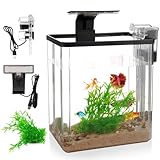

Our Top Picks
 THE FRESHWATER AQUARIUM HANDBOOK: The Ultimate Beginner-to-Expert Guide6 x 0.67 x 9 Inches0.9 PoundsCheck on Amazon
 Freshwater Aquarium Guide for Beginners: Setting Up a5.5 x 0.15 x 8.5 inches0.27 PoundsCheck on Amazon

Top 3 picks at a glance
Beginner aquarium kits ranked by volume and ease
| Rank | Tank size | Example kit | Clarity and noise | First-cycle forgiveness |
|---|---|---|---|---|
| 1 | 20 gallons | Aqueon 20-gallon glass aquarium starter kit | Glass resists scratches and stays clear; filter noise depends on flow and water level. | Good balance: enough water to dilute routine changes in waste, but still compact. |
| 2 | 29 gallons | Aqueon 29-gallon glass aquarium starter kit | Glass offers crisp viewing; a larger filter may be audible if it splashes or vibrates. | Most forgiving of these options for small day-to-day fluctuations, provided it is not overstocked. |
| 3 | 10 gallons | Aqueon 10-gallon glass aquarium starter kit | Glass is clear and scratch-resistant; compact filters can hum or trickle. | Less forgiving: a small amount of uneaten food or evaporation has a bigger effect. |
| 4 | 5 gallons | Fluval Spec V | Glass viewing panels and a built-in filtration compartment; pump sound can carry through the cabinet. | Least forgiving for beginners, especially if stocked with fish; best suited to a carefully maintained small setup. |
Kit contents can change, so check the included filter, heater, and light before buying. A starter kit is a convenient base, not a guarantee that every component suits every species. In particular, confirm that the heater can maintain the temperature your chosen livestock needs.
Why the 20-gallon kit wins for most first tanks
A larger volume does not prevent problems, but it slows how quickly they develop. If the same amount of waste enters a 20-gallon tank and a 10-gallon tank, the resulting concentration is roughly half as high in the larger tank, before accounting for filtration and other factors. That extra buffer gives a new keeper more time to notice and correct a feeding or maintenance mistake.
A 20-gallon setup is also a useful middle ground for equipment: it can accommodate common beginner-friendly community fish, depending on their adult size and behavior, without requiring the floor space or water-change volume of a much larger aquarium. Research species before buying; “beginner-friendly” does not mean every fish can share the same tank.
Glass or acrylic: choose for the room, not just the view
- Glass: A practical default for beginners. It is harder to scratch during routine cleaning and generally offers clear viewing. It is heavier and can crack if struck or supported unevenly.
- Acrylic: Lighter and more impact-resistant, which can be useful for larger tanks or locations where weight matters. It scratches more easily, so use tools labeled safe for acrylic rather than a blade or abrasive pad.
Both materials can look clear when clean and properly lit. Avoid judging clarity from an empty-tank image alone: reflections, room lighting, algae, and scratches all affect what you see in daily use. For a small starter kit, glass is usually the lower-maintenance choice. Consider acrylic when reduced weight is a meaningful advantage and you are prepared to clean it gently.
How to judge filter noise before it becomes annoying
Kit listings rarely provide a useful noise level in decibels, and perceived sound varies with the room and furniture. A filter that seems quiet in a shop may produce an irritating trickle beside a bed. Hang-on-back filters can splash if the water level drops; internal filters and pumps can transmit a hum through the tank or cabinet.
- Look for an adjustable-flow filter, or one with a design that returns water below the surface.
- Keep the water at the filter’s recommended level. In a hang-on-back filter, topping off evaporation often reduces a falling-water sound.
- Make sure the filter sits flat and its housing does not touch a wall or cabinet panel that can amplify vibration.
- Do not switch off filtration to silence it. The filter supports oxygen exchange and houses beneficial bacteria.
If quiet operation matters most, prioritize a well-fitted filter and a stable setup over tank material. A different filter may be quieter, but it must be appropriately sized and must not reduce circulation or biological filtration.
The first nitrogen cycle: make the tank ready before adding fish
During the nitrogen cycle, beneficial microbes establish themselves in the filter and other surfaces. They convert toxic ammonia from waste into nitrite, then into the less toxic nitrate. A new tank does not have enough of these microbes immediately, so adding a full fish load on day one can expose fish to dangerous ammonia or nitrite.
A safer setup sequence
- Set up the tank and equipment. Place it on a level stand rated for the filled aquarium’s weight. A gallon of water weighs about 8.34 pounds, so 20 gallons alone is roughly 167 pounds; glass, substrate, and décor add more.
- Use dechlorinated water. Treat tap water with an aquarium conditioner according to its label. Chlorine and chloramine can harm fish and the bacteria you are trying to establish.
- Run the filter continuously. Keep it operating around the clock. Rinse filter media in removed tank water, not untreated tap water, to avoid damaging its bacterial community.
- Cycle before stocking. Use a fishless cycling method and an aquarium test kit that measures ammonia, nitrite, and nitrate. Follow the method’s ammonia instructions; adding extra ammonia or fish food does not make the process safer.
- Confirm the cycle with tests. Before adding livestock, verify that ammonia and nitrite return to zero after an appropriate ammonia source is added, following a reliable cycling guide. Then add fish gradually rather than all at once.
There is no dependable fixed number of days for every new aquarium. The cycle can take several weeks, and a bottle or starter kit cannot guarantee an instant, fully established biological filter. Testing is more useful than the calendar. If fish are already in the tank, test ammonia and nitrite daily; if either is detectable, promptly use a properly conditioned partial water change and seek species-specific guidance.
Choose by your actual constraints
| Your situation | Best fit | Why |
|---|---|---|
| You have room for a standard starter tank and want a forgiving first cycle. | 20 gallons | More water volume than a nano tank without the footprint of a large aquarium. |
| You have a sturdy stand and enough space for a larger setup. | 29 gallons | More water provides additional stability, though equipment and water changes are larger too. |
| You need a compact tank and can test and maintain water consistently. | 10 gallons | Fits tighter spaces, but small tanks react faster to waste and temperature changes. |
| You want a small display for suitable invertebrates or a carefully planned nano setup. | 5-gallon class | Compact and visually neat, but the narrow margin for error makes it a poor choice for many beginner fish setups. |
What to buy beyond the box
Budget for a liquid or reliable aquarium test kit, water conditioner, a siphon for water changes, and a thermometer. You may also need a heater suited to the tank and livestock, a secure stand, and a lid to reduce evaporation and prevent jumping. Check that the filter media is suitable for biological filtration; replacing all media at once can remove much of the established bacteria.
For most new keepers, the best aquarium for beginners is a 20-gallon glass kit paired with a fishless cycle, regular testing, and a modest initial stocking plan. A 29-gallon kit offers more stability if space allows; smaller kits can work, but they reward careful maintenance rather than forgiving it.
Frequently asked questions
Can I add fish immediately after setting up a beginner aquarium?
No, you should cycle the aquarium before adding livestock. A new tank does not initially contain enough beneficial microbes to process waste safely, so fish added on day one may be exposed to dangerous ammonia or nitrite. Use a fishless cycling method, run the filter continuously, and confirm with tests that ammonia and nitrite return to zero after an appropriate ammonia source is added.
How much weight should my aquarium stand support?
Your stand should be rated for the filled aquarium’s total weight, including water, glass, substrate, and décor. A gallon of water weighs about 8.34 pounds, so 20 gallons of water alone weighs roughly 167 pounds. Place the aquarium on a level stand, because uneven support can create problems for a glass tank.
Do I need a heater if my starter kit includes one?
You should confirm that the included heater can maintain the temperature required by your chosen livestock. Kit contents can change, and a starter kit is only a convenient base rather than a guarantee that every component suits every species. You may also need a heater if the kit does not include one or if its heater is not appropriate for the animals.
What should I do if my aquarium filter is too loud?
First, check that the filter sits flat, the water is at its recommended level, and its housing is not touching a wall or cabinet panel. A falling-water sound may decrease when evaporation is topped off. Do not switch filtration off to silence it, because the filter supports oxygen exchange and houses beneficial bacteria.
How often should I replace aquarium filter media?
Avoid replacing all filter media at once, because established media can contain much of the aquarium’s beneficial bacteria. Rinse filter media in removed tank water rather than untreated tap water to protect its bacterial community. If you choose different media, make sure it remains suitable for biological filtration and does not reduce appropriate circulation.


