
A raised bed planter solves a problem that soil, drainage, and back strain conspire to create in every backyard: getting healthy root depth in compacted or poor native ground without spending an entire season fighting it. The right metal or wood bed buys you control over soil composition, better drainage, and a defined growing footprint — but the wrong one leaks through its seams after one season, warps under sun exposure, or costs more than the harvest it will ever yield.
Across this comparison we weighed published dimensions, material certifications, assembly complexity, load ratings, and recurring complaints from long-term owners to separate planters that genuinely extend a growing season from those that merely look tidy in a product photo. What follows is an honest breakdown of eight raised bed planters currently competing for your garden budget in 2026, ranked in order of how well they balance price against the specs that matter most.
As an Amazon Associate we earn from qualifying purchases at no extra cost to you. Product prices and availability are accurate as of the date shown and are subject to change.



Top 3 picks at a glance
Quick Picks
| Product | Best For | Price |
|---|---|---|
| Rakukiri 5ft Oval Galvanized Bed | Lowest entry price with certified recycled metal | $16.99 |
| Land Guard Oval Galvanized Kit | Budget oval bed with slightly larger footprint | $19.99 |
| Land Guard 2-Pack 6×3×2 ft | Deep-rooted vegetables and companion planting zones | $69.99 |
| LEETOLLA Elevate 32″ with Wheels | Gardeners with limited mobility or patio growing | $59.84 |
| SnugNiture 3-Piece 4x2x1.5ft | Small-space growers wanting multiple planting zones | $79.99 |
| Best Choice Products 72x24x30in Elevated Wood | Patio and balcony growers needing no-dig access | $129.99 |
| Utopia Home 4x2x1ft Single | Herb beginners who want a one-bed starter | $19.49 |
| Tegarbed 4x2x1ft 2-Pack | Growers who want crop separation at low cost | $49.99 |
How We Picked
We filtered this category through four criteria that consistently predict long-term satisfaction in owner reviews: structural durability under repeated freeze-thaw or UV exposure, root-zone depth relative to the crops you plan to grow, assembly difficulty for a single person without specialty tools, and total cost per square foot of usable growing area. A planter that checks every box but costs more per square foot than a competitor with comparable durability is a poor value, and a planter that is dirt cheap but rusts or warps within two seasons wastes both money and a growing season.
The 8 Best Raised Bed Planters in 2026
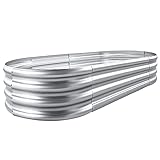
Rakukiri 5ft Oval Galvanized Bed
This is the planter for gardeners who want to dip a toe into raised bed growing without committing meaningful money to an unproven setup. The GRS certification confirms the galvanized steel is made from recycled material, which matters if sustainability influences your purchasing decisions. The oval footprint gives roughly 18 to 20 square feet of growing surface, enough for a solid mix of herbs and shallow-rooted vegetables.
- Pro: Lowest price in this roundup with a verifiable recycled-material certification that competitors in this tier typically skip.
- Pro: Rot-resistant metal eliminates the cedar-rot worry that haunts wood-frame beds after three or four wet seasons.
- Con: At roughly one foot of wall height, the soil volume limits root depth for carrots, beets, and other taproot crops.
Skip it if your main goal is growing deep-rooted vegetables or you need a bed that doubles as a seating-height border — the shallow profile and open top make it strictly functional.
Land Guard Oval Galvanized Kit
For $3 more than the Rakukiri, Land Guard offers a similar oval galvanized design with a slightly larger published footprint. This is a sensible choice if you want a bit more growing surface without jumping to the two-dollar-tier price of multi-pack kits. Owners consistently note the clean crimped edges that reduce the sharp-metal handling complaints common in ultra-budget beds.
- Pro: Crimped rolled edges make assembly and maintenance safer on bare hands than raw-cut metal alternatives.
- Pro: Oval shape maximizes planting area per linear foot of wall compared to rectangular boxes of similar perimeter.
- Con: No included liner or drainage mesh, meaning you will spend an extra season budget on landscape fabric and hardware cloth.
Skip it if you dislike sourcing accessories separately or want a plug-and-play experience; the total setup cost creeps upward once you add a liner.
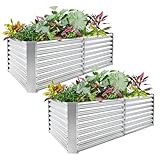
Land Guard 2-Pack 6x3x2 ft Galvanized Beds
Two feet of depth changes the conversation entirely. This 2-pack is aimed at gardeners who want to grow a serious vegetable rotation — potatoes, carrots, onions, and large-rooted crops all benefit from that volume. The six-by-three-foot dimensions give roughly eighteen square feet per bed, and owning two lets you separate heavy feeders from light ones without building a fence between root zones.
- Pro: Two-foot wall depth accommodates crops that simply cannot thrive in a one-foot box, expanding your realistic growing list significantly.
- Pro: Buying as a matched pair saves roughly fifteen percent versus ordering two single units from competing brands of identical depth.
- Con: Combined footprint approaches twenty square feet before pathways, which can overwhelm a small yard or narrow side strip.
Skip it if your space is under forty square feet total or you are primarily growing salad greens and herbs that do not need that much soil depth.
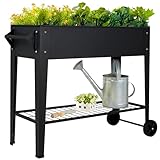
LEETOLLA Elevate 32-Inch Raised Bed with Wheels
Elevated gardening with wheels solves a problem that most ground-level beds ignore: moving a planted bed to chase sunlight, shelter it from frost, or reposition it on uneven patio pavers. At 32 inches tall, it is also the most ergonomic option here for anyone with knee or lower-back limitations. This is a niche pick but a genuinely thoughtful one.
- Pro: Locking caster wheels let you reposition the entire bed seasonally, a feature absent from every other product in this comparison.
- Pro: Raised 32-inch height means you never kneel or crouch, which dramatically lowers the physical barrier to daily maintenance.
- Con: Wheel axles and swivel joints add failure points that ground-based galvanized beds simply do not have; expect maintenance beyond the first two seasons.
Skip it if your garden is on soft or uneven soil where wheels will sink and jam — this design is best suited to hard surfaces like concrete, pavers, or compacted gravel.
SnugNiture 3-Piece 4x2x1.5ft Galvanized Beds
Three separate oval beds in one kit lets you build a modular layout that adapts to awkward yard shapes — around a tree, along a fence line, or in a courtyard corner. Each bed holds approximately six square feet of soil at eighteen inches deep, a middle ground that supports most salad greens, herbs, and medium-rooted vegetables without requiring the soil volume of a two-foot bed.
- Pro: The three-unit design lets you stagger planting times or isolate a pest problem to a single small bed rather than losing an entire season’s harvest.
- Pro: Brown powder-coated finish resists the heat-absorption problem that bare silver galvanized steel creates in full-sun southern climates.
- Con: At $79.99 for three shallow beds, the cost per square foot is higher than the Land Guard two-pack despite less total depth.
Skip it if you want to grow deep-rooted vegetables in one continuous soil mass; the eighteen-inch ceiling and separate compartments constrain options.
Best Choice Products 72x24x30in Elevated Wood Bed
This is the only wood-frame option in the list, and it earns its place through sheer build quality. Thirty inches of height, six legs, a 300-pound weight rating, and a built-in divider panel make it suitable for balcony growing where soil weight and stability are genuine concerns. The natural wood finish ages gracefully and blends with patio furniture rather than looking like an industrial container.
- Pro: The 300-pound capacity and six-leg base are explicitly rated, which matters on elevated surfaces where an unverified bed is a safety risk.
- Pro: Divider panel lets you run two crop zones with different soil mixes in one unit, saving space on narrow patios.
- Con: Wood construction demands periodic sealing or staining to avoid the rot cycle that galvanized metal options eliminate entirely.
Skip it if you want a zero-maintenance, set-it-and-forget-it bed; wood at this price point requires a seasonal care routine that metal does not.
Utopia Home 4x2x1ft Single Galvanized Bed
A single four-by-two-foot bed at one foot deep is the most minimal entry point for a first-time gardener testing whether they will actually maintain a raised bed through a full season. At under twenty dollars, the downside of abandonment is negligible. Assembly is straightforward, and the galvanized steel will survive a decade outdoors if you fill it and walk away.
- Pro: Smallest total footprint and lowest cost make it the lowest-risk way to start raised bed gardening with zero commitment pressure.
- Pro: Simple flat-pack design with minimal fasteners; most owners report assembly in under fifteen minutes with only a screwdriver.
- Con: Eight square feet of growing area fills up fast — one mature tomato plant alone can consume half the space, leaving little room for companion crops.
Skip it if you already know what you want to grow and need more than a handful of herbs or a single row of radishes.
Tegarbed 4x2x1ft 2-Pack Metal Beds
Two separate shallow beds at $25 each offer more spatial flexibility than one double-sized unit. This suits gardeners who want to place beds in different microclimates across a yard — one in morning sun for leafy greens, another in afternoon shade for root vegetables. The bottomless design ensures drainage and soil contact without requiring drainage holes that can clog over time.
- Pro: Bottomless construction eliminates the drainage-plate cleaning step that frustrates owners of enclosed-base beds, and roots can reach native soil below.
- Pro: Two separate units let you test different soil amendments side by side without cross-contamination, a genuine benefit for experimenters.
- Con: One-foot depth shared with the Utopia single means the same root-volume limitation for deep crops, and the $49.99 total outlay approaches the price of one Land Guard two-foot bed.
Skip it if your primary crops are carrots, beets, potatoes, or parsnips; you would get more usable root zone from the deeper Land Guard pair at a comparable total spend.
Buying Guide
Depth Determines What You Can Grow
Wall height is not a cosmetic spec — it defines your realistic crop list. A six-inch bed handles microgreens and lettuce. A twelve-inch bed supports herbs, radishes, and shallow-rooted greens. Eighteen inches opens up medium root crops like bush beans and most brassicas. Twenty-four inches and above is where carrots, parsnips, potatoes, and onions become genuinely viable. Buy for the deepest crop you intend to grow, not the shallowest.
Metal Gauge and Coating Quality Predict Lifespan
Galvanized steel is the default material at this price point, but not all galvanization is equal. Look for products that specify gauge thickness or cite certifications like the GRS recycling standard on the Rakukiri bed. Thin, lightly coated steel warps within two summers of full sun exposure and develops rust spots at every scratch. Thicker-gauge beds with powder-coated finishes (like the SnugNiture brown option) resist both warping and heat absorption.
Cost Per Square Foot Beats Sticker Price
A $16.99 bed with eight square feet of growing area costs just over $2 per square foot. A $69.99 two-pack with thirty-six square feet at two-foot depth costs under $2 per square foot but delivers three times the root volume per dollar. Calculate usable soil volume — length times width times depth — rather than comparing sticker prices across products with fundamentally different capacities.
Our Verdict
The Land Guard 2-Pack 6x3x2 ft is the strongest overall value in this group. Two feet of depth is the threshold that separates casual gardening from serious food production, and the paired format keeps cost per square foot competitive while giving you two independent zones for crop rotation. The best budget pick is the Rakukiri 5ft Oval at $16.99 — for that price you get certified recycled galvanized steel with no rot risk, and if it does not stick, you are out the cost of a lunch. The exception worth noting: if you are gardening on a balcony or elevated patio, the Best Choice Products elevated wood bed wins outright because its 300-pound load rating and six-leg base are the only verified stability specs in this list that address overhead weight constraints.
FAQ
Do raised beds need a bottom?
No. Most gardeners recommend leaving the bottom open so excess water drains into native soil and deeper-rooted crops can reach it. Enclosed bottoms are only necessary when growing on concrete, a rooftop, or a surface where you cannot allow water to escape below the bed.
How deep should a raised bed be for vegetables?
Six to eight inches works for leafy greens and herbs. Ten to twelve inches handles most common vegetables like peppers and bush beans. For root crops such as carrots, beets, and potatoes, you need at least eighteen inches of soil depth, with twenty-four inches being ideal for full-size yields.
Does galvanized steel leach chemicals into soil?
Modern galvanization uses a zinc coating that is considered safe for food gardens by major agricultural extension programs. The older concern involved cadmium traces in low-grade steel, but products with verifiable certifications like the GRS standard on the Rakukiri bed address this specifically. Avoid beds that do not disclose their coating source.
Can raised beds work on a patio or balcony?
Yes, with two caveats. First, confirm your surface can support the combined weight of soil and plants — saturated soil weighs roughly 100 pounds per cubic foot, so a four-by-two-by-one-foot bed holds close to 800 pounds when wet. Second, choose a bed with a liner or tray to protect the underlying surface from staining and water damage.


