Our Short List of 3
All 5 Picks at a Glance
| Product | Specs | Action |
|---|---|---|
 1. SanDisk 128GB Extreme PRO SDXC UHS-I Card | Check price on Amazon | |
 2. Lexar 128GB Professional 1667x SDXC UHS-II Card | Check price on Amazon | |
 3. Sony 128GB TOUGH-G Series SDXC UHS-II Card | Check price on Amazon | |
 4. Kingston 128GB Canvas React Plus SDXC UHS-II Card | Check price on Amazon | |
 5. PNY 128GB Elite-X SDXC UHS-I Card | Check price on Amazon |
If you shoot photos and video alongside gaming and streaming, your camera card quietly decides how smooth a session feels. A slow card can stall burst shooting, interrupt long clips, and turn a file transfer into a long wait. A well matched card does the opposite: the buffer clears quickly, clips record without drama, and offloading footage feels routine.
This guide covers full size SDXC cards only, in UHS-I and UHS-II formats, from established brands. Every pick is a 128GB card, a practical size that holds a long day of stills or several extended video sessions. The list moves from affordable UHS-I workhorses to fast UHS-II cards, so you can match the card to your camera rather than paying for speed it cannot use.
As an Amazon Associate, we earn from qualifying purchases.
Our Top Picks
Top 3 picks at a glance
What to look for in SD cards for cameras and creators
Start with the bus type. UHS-I cards use a single row of contacts and top out at lower rates, while UHS-II cards add a second row and move data much faster in cameras and readers that support them. A UHS-II card still works in a UHS-I camera, at UHS-I speeds. If your camera has UHS-II slots and you shoot bursts or high bit rate video, UHS-II earns its keep.
Next, read the speed classes rather than the headline read speed alone. Class 10 is a baseline. The U rating, U1 or U3, describes minimum sustained write performance for video, and U3 is the safer choice for 4K recording. The V rating goes further: V30, V60, and V90 guarantee minimum sustained write speeds of 30, 60, and 90 megabytes per second. For creators, the V rating is the most honest number on the label, because long clips depend on sustained writes, not short peaks.
Published speeds still matter, in different places. Write speed affects how fast the buffer clears during burst stills and whether high frame rate video records cleanly. Read speed affects how quickly you copy a full card to a computer, especially with a fast UHS-II reader. Weigh both sides against your routine.
Capacity is a workflow choice as much as a storage choice. A 128GB card balances room and risk well for most mirrorless cameras and camcorders: it holds thousands of stills or hours of Full HD footage, and a good amount of 4K footage, without putting a multi day project on one card. Format the card in the camera you will use, and keep a spare in the bag.
Finally, consider build and support. Some cards add reinforced housings and resistance to water, shock, and temperature extremes, which matters for outdoor shoots and travel. Others focus on value. Clear model numbers and reputable listings also matter, because lookalike cards exist. The five cards below cover that full range.
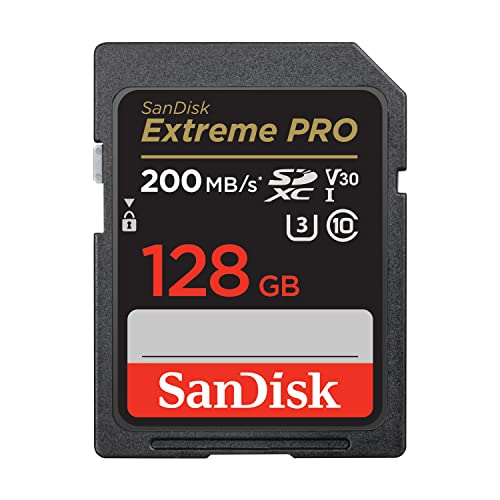
1. SanDisk 128GB Extreme PRO SDXC UHS-I Card
The SanDisk Extreme PRO UHS-I card is the default recommendation for the widest range of cameras, balancing speed, capacity, and broad compatibility. As a UHS-I card, it fits and performs in nearly every camera with a full size SD slot, from older DSLRs to current mirrorless bodies. For UHS-I cameras, it is close to the fastest experience that slot can deliver.
In camera, the U3 and V30 ratings support 4K UHD video and confident burst shooting. The published write speed gives the buffer room to clear between sequences, which helps at events and sports days where moments arrive in clusters. It is also a calm choice for camcorders and second cameras, where predictable behavior matters most.
At the desk, the published read speed stands out for a UHS-I card, thanks to SanDisk QuickFlow technology with a compatible reader. That shortens the copy step after a shoot. If your workflow is photo heavy with regular 4K clips and your camera is UHS-I only, this is the straightforward first pick.
2. Lexar 128GB Professional 1667x SDXC UHS-II Card
The Lexar Professional 1667x moves up to UHS-II in a sensible middle tier for creators who want faster handling without flagship pricing tiers. Its V60 rating doubles the guaranteed sustained write floor of V30 cards, suiting higher bit rate 4K recording and longer bursts. For hybrid shooters splitting time between stills, video, and streaming content, that headroom means fewer interruptions.
In a UHS-II camera, the card supports rapid buffer clearing and smooth recording. In a UHS-I camera it remains fully usable at reduced speeds, so it can travel between bodies in a mixed kit as a shared card for main and backup cameras.
Offloading is where many creators feel UHS-II first. With a UHS-II reader, the published read speed moves a full card noticeably faster than a typical UHS-I setup, saving time on deadline days. For long creator sessions and B-roll weeks, this Lexar is a balanced step up.
3. Sony 128GB TOUGH-G Series SDXC UHS-II Card
The Sony TOUGH-G series card is the rugged flagship here, built for creators who shoot outdoors or travel often. Sony describes the TOUGH design as a one piece molded construction without the usual fragile ribs and write protect switch, with bend, drop, dust, and water resistance beyond a standard card. For field work, that construction is the headline.
Performance matches the build. The V90 rating provides the highest guaranteed sustained write level in this guide, supporting demanding video modes and sustained bursts. Published read and write speeds sit at the top of the SD format, so in camera handling and desk transfers are as fast as full size SD allows.
This card makes the most sense when a failed card would be costly: weddings, travel work, and one chance events. It is more card than a casual home setup needs, but as a primary working card, V90 performance plus reinforced construction is difficult to match.
4. Kingston 128GB Canvas React Plus SDXC UHS-II Card
The Kingston Canvas React Plus is another V90 option, aimed at creators with Full HD, 4K, and 8K capable cameras who need sustained speed. Its ratings place it alongside the fastest cards here, with strong published read and write speeds. For video led creators, that sustained performance is the reason to choose this tier.
A V90 card like this suits cameras with high bit rate codecs, high frame rate modes, and fast continuous stills. It keeps pace with long takes and repeated bursts, and 128GB gives useful room for a dedicated video session. It also works well as a main card for tutorials and product footage recorded in long blocks.
At the computer, the high published read speed moves large video files quickly with a UHS-II reader. If video performance comes first and you want a V90 alternative from another major brand, the Canvas React Plus belongs on your short list alongside the Sony card.
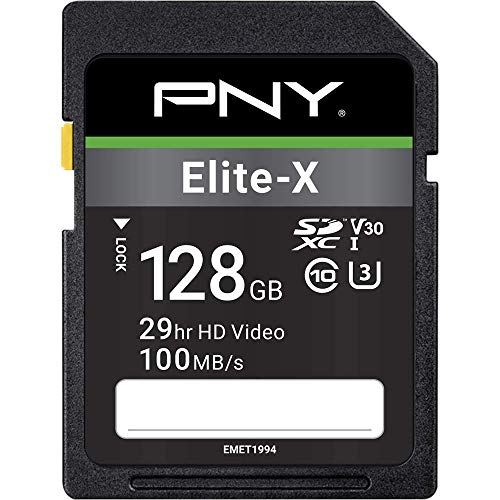
5. PNY 128GB Elite-X SDXC UHS-I Card
The PNY Elite-X closes the list as the simple value pick for everyday cameras, backup slots, and second bodies. It is a UHS-I card with Class 10, U3, and V30 ratings, covering Full HD and 4K UHD needs for many mainstream cameras and camcorders. Not every slot needs a flagship card.
For stills, home video, school events, and creator B cameras, the Elite-X provides the essential ratings without paying for UHS-II hardware your camera may not support. It also works well as a dedicated timelapse card or a bag spare for the day a main card fills up.
Desk transfer speeds are modest compared with the UHS-II cards above, and that is the honest trade off here. With shorter clips and smaller photo sets, you may never notice. For creators building a small rotation of cards on a budget, the Elite-X is an easy addition.
FAQ
Do I need UHS-II, or is UHS-I enough for 4K video?
For many cameras, a U3 and V30 rated UHS-I card is enough for standard 4K recording, because the V rating guarantees the sustained write speed needed. UHS-II becomes worthwhile when your camera supports it and offers higher bit rate modes, faster bursts, or high frame rate recording, and when you want faster transfers with a UHS-II reader. Check your manual for the ratings each mode requires.
What does V30, V60, and V90 actually mean?
The V rating states a minimum sustained write speed in megabytes per second: V30 means at least 30, V60 at least 60, and V90 at least 90, maintained during recording. Higher ratings suit higher bit rate video. The rating matters more for long clips than peak speeds, because a clip fails on sustained performance, not on a brief burst.
Can I use these full size SD cards in a camera that takes microSD cards?
No, not directly, because the physical sizes differ. These picks are full size SDXC cards for cameras, camcorders, and readers with full size SD slots. Some microSD cards include an adapter that lets them fit a full size slot, but that is the reverse direction and a different product class. Match the card format printed in your camera manual, and avoid forcing any card or adapter that does not fit cleanly.
How should I format and care for camera cards?
Format each card in the camera you plan to use before an important shoot, after copying and backing up its contents. Keep cards in a protective case rather than loose in a pocket, and copy footage to at least one additional drive before reformatting. Retire a card that produces errors, and keep a labeled spare.
Final verdict
For most creators with UHS-I cameras, the SanDisk Extreme PRO UHS-I card is the best starting point. Step up to the Lexar Professional 1667x for V60 headroom, or choose between the Sony TOUGH-G and Kingston Canvas React Plus for V90 sustained speed, with the Sony adding the most rugged build. Keep the PNY Elite-X as a dependable spare. Match the V rating to your camera modes first.
Product and ASIN Reference
| Product | ASIN |
|---|---|
| SanDisk 128GB Extreme PRO SDXC UHS-I Card | B09X7FXHVJ |
| Lexar 128GB Professional 1667x SDXC UHS-II Card | B07NLY7N7L |
| Sony 128GB TOUGH-G Series SDXC UHS-II Card | B07H9GDFRW |
| Kingston 128GB Canvas React Plus SDXC UHS-II Card | B09XC3D96V |
| PNY 128GB Elite-X SDXC UHS-I Card | B07R7C4CSP |
Related guides
More from Amazon
Programs that pair well with the guide above. Offers and eligibility are set by Amazon and may change.
Free shipping on eligible items, Prime Video and more. Eligible new members can start with a free trial.
Start a Prime free trialAd-free music streaming. Eligible new subscribers can start with a free trial.
Try Music Unlimited freeA Prime membership for ages 18-24 with a trial period. Eligibility is set by Amazon.
See Prime for Young AdultsAudiobooks and podcasts to listen to on the go. Eligible new members can start with a free trial.
Try Audible freeAs an Amazon Associate we earn from qualifying purchases.