
The Short Answer
Yes — liquid cooling is worth it for a gaming PC if you’re running a high-wattage CPU (roughly 200W and up) or you care about noise levels and case aesthetics as much as raw performance. For a mid-range build using something like a Ryzen 7 8700F or a 65W-class processor, a good $40–$100 air cooler does essentially the same job, and spending extra on liquid cooling buys you looks and lower noise, not higher frame rates.
The one condition that actually decides the question: your CPU’s heat output. Liquid cooling earns its price tag on hot chips; on efficient ones, it’s a luxury.
As an Amazon Associate we earn from qualifying purchases at no extra cost to you. Product prices and availability are accurate as of the date shown and are subject to change.
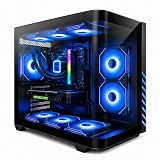

What You Actually Get
A liquid cooler — usually an all-in-one (AIO) closed loop — moves heat from your CPU via a cold plate and pump, through tubing, to a radiator where fans exhaust it. Compared with a tower air cooler, here’s what changes in practice:
- Thermal headroom: A quality 240mm AIO typically keeps a hot CPU 5–10°C cooler under sustained all-core loads than a comparable air cooler. In gaming, where CPUs rarely hit peak thermal loads, the gap shrinks to 2–5°C or disappears entirely.
- Noise: Heat is spread across a large radiator, so fans can spin slower. A well-tuned 240mm or 360mm loop is often quieter at idle and under load than a compact air cooler fighting to dump heat from a small fin stack.
- Radiator sizes: Common options are 120mm (~11 inches), 240mm (~11 x 5 inches), 280mm, and 360mm (~15.7 x 5 inches). Most cases today support at least a 240mm up top or front.
- Aesthetics: A cleaner-looking build with an unobstructed view of the motherboard, often with RGB on the pump cap and fans.
It’s also worth knowing that liquid cooling is now standard on many prebuilts — for example, liquid-cooled gaming PCs with a Ryzen 7 8700F and RTX 4060 Ti sit around $1,100–$1,200, while a step-up system with a Ryzen 7 9700X and RTX 5060 Ti runs roughly $1,500. In that price bracket, the loop is included; you’re not paying a line-item premium for it.
Pros
- Better sustained performance on hot CPUs: Chips like the Ryzen 9 7900X or Intel Core i9-class processors throttle less with a 280mm or 360mm radiator than with mid-range air.
- Lower noise under load: Larger surface area means slower fan curves. Many 240mm AIOs hold full-load noise in the low-to-mid 30s dBA range versus high 30s to 40s for smaller air coolers under the same load.
- Better clearance for RAM and VRMs: No towering dual-tower heatsink hanging over your memory slots — low-profile RAM and tall RGB sticks fit without issue.
- Easier handling during builds: A small pump block weighs under 2 pounds; compare that to flagship air coolers at 3.5+ pounds that stress the motherboard during installation and transport.
- Cleaner interior and better case airflow options: Radiators up top free the front of the case for intake fans.
- Long warranties on AIOs: Major brands back their closed loops for 5–6 years, often longer than the pump’s realistic service life.
Cons
- Cost: Expect $60–$100 for a decent 240mm, $120–$180 for a 360mm, versus $25–$50 for air cooling that matches it on efficient chips.
- More failure points: A pump failure kills your cooling instantly; a fan failure on an air cooler leaves you a passive fallback. Pumps typically last 5–7 years, and coolant slowly permeates tubing over time.
- Installation complexity: You’re mounting a radiator, routing tubes, and managing fan headers. Fifteen extra minutes and more room for mistakes.
- Case compatibility: A 360mm radiator needs roughly 15.7 inches of mounting space and clearance for thick (often 1.2-inch) radiators plus fans — check your case spec sheet before buying.
- Wasted money on efficient CPUs: Pairing a $150 AIO with a 65W chip is performance theater; the CPU never generates enough heat to use the capacity.
- Rare but real leak risk: Modern AIOs rarely leak, but the consequence is worse than a failed air cooler.
Who Should Buy It
- High-end CPU builders: If your processor draws 200W+ under load (Ryzen 9 X3D and X-series, Intel i7/i9 K-series), a 280mm or 360mm AIO pays for itself in sustained boost clocks.
- Noise-sensitive gamers: If your PC lives in your bedroom or living room and you play with headphones off, liquid cooling is the quieter path.
- Small-form-factor builders: In compact cases, a front-mounted 240mm radiator often outperforms the only air cooler that fits.
- Showpiece builders: If the glass panel matters to you, AIOs deliver a cleaner look with a clear view of the board.
Who Should Skip It
- Budget builders under ~$1,000: Every dollar toward a better GPU matters more. A $30 air cooler pairs perfectly with a mid-range chip.
- 65W and 88W CPU owners: Chips like the Ryzen 7 8700F or non-X Ryzen 5 and 7 parts run fine on a $25–$40 tower cooler with headroom to spare.
- Set-it-and-forget-it buyers: Air coolers have one moving part per fan, no pump, no coolant, and essentially never fail catastrophically. If longevity and simplicity top your list, stay with air.
- Older or budget cases: If your case can’t fit a 240mm radiator properly, forcing in an undersized AIO performs worse than a good air cooler anyway.
Cheaper Alternatives
| Option | Cost | Trade-off |
|---|---|---|
| Quality tower air cooler (e.g., dual-tower, 6 heat pipes) | $30–$50 | Handles CPUs up to ~180W; taller than RAM clearance on some boards; more visible in the case |
| Stock or included cooler | $0 | Fine for 65W chips at stock settings; louder under load; no overclocking headroom |
| Undervolting your CPU in BIOS | $0 | Cuts 10–20W of heat for free; takes 30 minutes of stability testing |
| Adding case fans for airflow | $10–$30 | Improves GPU and VRM cooling too; doesn’t lower CPU peak temps as directly as a better CPU cooler |
| Used or last-gen 240mm AIO | $40–$70 | Check pump condition and warranty transfer; risk of unknown wear |
FAQ
Does liquid cooling increase FPS?
Not directly in most games. If your CPU is thermally throttling, better cooling restores lost frames — often a few percent. On a CPU that isn’t throttling, liquid cooling changes temperatures, not frame rates. Spend the difference on your GPU if FPS is the goal.
How long do liquid coolers last?
Most all-in-one units last 5–7 years. Manufacturers typically warrant them for 5–6 years, and coolant loss through tubing is gradual. Air coolers, with no pump or fluid, can last decades and only ever need a fan replacement.
Is a 240mm liquid cooler enough for gaming?
Yes, for the vast majority of gaming builds. A 240mm handles CPUs up to roughly 200–220W comfortably. Step up to 280mm or 360mm only for flagship, high-wattage processors or heavy productivity workloads like video rendering.
Do liquid-cooled prebuilt PCs cost more?
Only marginally, and often not at all. Liquid-cooled systems with a Ryzen 7 8700F and RTX 4060 Ti start around $1,100–$1,200, while higher-spec prebuilts with a Ryzen 7 9700X and RTX 5060 Ti land near $1,500 — competitive with air-cooled equivalents. By 2026, liquid cooling on mid-tier prebuilts is largely a standard inclusion rather than a premium upsell.


