
Buying a gaming PC built around AMD’s Ryzen 9 silicon means you’re paying for high core counts, strong multi-threaded throughput, and a platform that still leaves headroom for heavy workloads on top of frame-rate chasing. The problem most buyers face is not whether Ryzen 9 is capable — it is that two machines sharing the same CPU can differ by thousands of dollars based on GPU pairing, cooling architecture, storage tier, and build quality, and the price sheet rarely makes that gap obvious at a glance.
This roundup compares eight gaming PC AMD Ryzen 9 configurations published for 2026, sorting them on spec sheets, listed prices, and recurring themes in owner feedback. Good picks balance GPU throughput against CPU ceiling, deliver adequate cooling under sustained load, and avoid padding a price with components the buyer does not need. Bad picks lock you into a single bottleneck — a weak GPU paired with a flagship CPU, a thermal design that throttles within minutes, or a storage layout that forces a second drive purchase. Below, each entry is assessed on that framework.
As an Amazon Associate we earn from qualifying purchases at no extra cost to you. Product prices and availability are accurate as of the date shown and are subject to change.
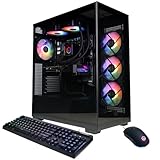


Top 3 picks at a glance
Quick Picks
| Product | Best for | Price |
|---|---|---|
| CyberPowerPC Ryzen 9 9900X / RTX 5070 | Balanced 1440p build | $2,339.99 |
| MSI AEGIS ZS2 (Renewed) | Budget-conscious entry | $1,449.99 |
| MSI Aegis ZS Ryzen 9 9900X / RTX 5080 | Enthusiast all-in-one | $3,330 |
| Panorama XL RTX 5080 | Warranty-focused buyers | $3,299.99 |
| iBUYPOWER Slate Ryzen 9 7900X / RTX 5080 | High-value flagship GPU | $2,799.99 |
| Skytech Legacy 4 Ryzen 9 9950X3D / RTX 5090 | No-compromise 4K gaming | $6,999.99 |
| iBUYPOWER Element Ryzen 9 7900X / RTX 5070 | Best price-to-performance | $2,187.86 |
| Thermaltake LCGS View Ryzen 9 9950X3D / RTX 5080 | RGB showcase builds | $3,846.99 |
How We Picked
We evaluated every machine on four criteria. First, GPU-to-CPU balance: a Ryzen 9 that outruns its paired graphics card is wasted silicon, so we flagged configurations where the GPU is the clear ceiling. Second, cooling adequacy for sustained loads, because a flagship chip throttling in a cramped chassis defeats the purpose. Third, included peripherals and connectivity extras that add real value versus marketing filler. Fourth, warranty coverage and renewal status, which materially affect risk for buyers spending above two thousand dollars.
The 8 Best Gaming PC AMD Ryzen 9 in 2026
CyberPowerPC Gaming PC — AMD Ryzen 9 9900X, GeForce RTX 5070 12GB
A solid mid-tier choice for players who game at 1440p and occasionally render or stream. The 9900X brings twelve cores, which keeps background tasks from stuttering frame delivery.
- Pro: Strong multi-threaded CPU headroom for the price bracket
- Pro: RTX 5070 handles current AAA titles at high settings without frame drops
- Con: 12GB of VRAM limits texture fidelity at 4K, forcing compromise on future titles
Skip this if you plan to play at native 4K or need more than twelve gigabytes of video memory for creative workloads alongside gaming.
MSI AEGIS ZS2 A7NVM-1487US Desktop PC (Renewed)
Targeted at buyers who want Ryzen 9 performance without crossing the thousand-dollar threshold. The renewed status means MSI factory-refurbished units with a 32GB DDR5 and 1TB Gen4 NVMe foundation.
- Pro: Lowest listed price among all eight entries
- Pro: DDR5 memory and Gen4 storage tier are future-proof for the CPU class
- Con: RTX 5060 Ti is the weakest GPU in this lineup, creating a clear bottleneck under the 7900X
Skip if you cannot tolerate the “renewed” condition or if your target resolution exceeds 1080p at high settings.
MSI Aegis ZS Gaming Desktop — Ryzen 9 9900X, GeForce RTX 5080
An enthusiast build that pairs liquid cooling with Wi-Fi 7 and includes a keyboard and mouse out of the box. Aimed at buyers who want a turnkey high-end system with DIY-friendly internals.
- Pro: Liquid cooling sustains the 9900X boost clocks under prolonged gaming sessions
- Pro: Wi-Fi 7 and included peripherals reduce the true total cost of ownership
- Con: At $3,330 it sits close to the Panorama XL entry but lacks a comparable multi-year warranty
Skip if warranty length is your top concern or if you prefer air-cooled simplicity.
Panorama XL RTX 5080 — 16-Core AMD Ryzen 9 5900XT
Built around the 5900XT, a sixteen-core Zen 3 refresh, paired with DDR4 rather than DDR5. The three-year warranty is the standout differentiator here, backed by internal Wi-Fi 6E.
- Pro: 3-year warranty exceeds what most competitors in this price range offer
- Pro: Sixteen cores deliver strong parallel throughput for streaming and encoding
- Con: DDR4 memory platform is a generational step behind the newer AM5 boards in this list
Skip if you need the latest memory standard or plan to upgrade the CPU without swapping the motherboard.
iBUYPOWER Slate — Ryzen 9 7900X, RTX 5080 16GB
The most direct path to RTX 5080 performance without crossing three thousand dollars. The 7900X and DDR5 5200MHz RAM form a well-matched pair for 1440p and entry-4K gaming.
- Pro: 16GB VRAM on the RTX 5080 provides substantial texture headroom for years
- Pro: Price undercuts other RTX 5080 configurations in this list by several hundred dollars
- Con: Ships with Windows 11 Home rather than Pro, omitting BitLocker and Hyper-V features
Skip if you require Windows Pro editions or need a specific aesthetic like transparent side panels.
Skytech Gaming Legacy 4 — Ryzen 9 9950X3D, RTX 5090
The no-compromise option. The 9950X3D combines high core counts with 3D V-Cache, and the RTX 5090 at $6,999.99 sets the ceiling for frame rates at native 4K ultra settings.
- Pro: Top-tier CPU and GPU pairing eliminates any meaningful bottleneck
- Pro: 3D V-Cache architecture delivers measurable gains in cache-sensitive game engines
- Con: Price is nearly triple the budget entry, and upgrade headroom beyond this pairing is minimal
Skip unless you demand the absolute highest frame rates regardless of cost or play at ultrawide resolutions.
iBUYPOWER Element — Ryzen 9 7900X, RTX 5070 12GB
At $2,187.86 this is the most efficient Ryzen 9 plus RTX 5070 combination listed. A 1TB NVMe SSD covers most game libraries without immediate expansion.
- Pro: Best price-to-performance ratio in the mid-range tier of this group
- Pro: 7900X provides twelve Zen 4 cores that will remain relevant through several GPU generations
- Con: RTX 5070 12GB will require settings reductions at 4K within two game cycles
Skip if 4K native gaming is your primary use case rather than 1440p high-refresh play.
Thermaltake LCGS View 9580S-380XL — Ryzen 9 9950X3D, RTX 5080
A showcase machine for buyers who want visual presence alongside the 9950X3D and RTX 5080 pairing. RGB DDR5 at 6000MT/s, a transparent chassis, and X870 platform support round out the feature set.
- Pro: 9950X3D plus RTX 5080 is a near-flagship combination at a sub-four-thousand price
- Pro: 6000MT/s DDR5 on an X870 board ensures memory subsystem headroom for future CPU swaps
- Con: At $3,846.99 you pay a visible premium over the iBUYPOWER Slate’s identical GPU tier
Skip if you do not value RGB aesthetics or the transparent case design, as the same silicon is available for less.
Buying Guide
Match the GPU to your resolution target
A Ryzen 9 does not raise frame rates on its own; the GPU sets that ceiling. At 1080p high-refresh, an RTX 5060 Ti suffices and the CPU’s extra cores go largely unused. At 1440p ultra, the RTX 5070 class is the sweet spot where twelve gigabytes of VRAM still holds. At 4K, you need sixteen gigabytes minimum, which points to the RTX 5080 or 5090 tiers. Buy the GPU your monitor actually uses, then let the Ryzen 9 handle background tasks without stutter.
Cooling and sustained-clock behavior
Ryzen 9 chips boost aggressively and generate concentrated heat. Air cooling in a well-ventilated case can manage a 7900X, but a 9900X or 9950X3D under a full gaming load will throttle if the cooler cannot dissipate its thermal output. Liquid cooling, as seen on the MSI Aegis ZS, removes that ceiling but adds complexity and a small leak risk. Check whether the case supports the cooler form factor and whether airflow paths are obstructed by RGB panels or drive cages.
DDR4 versus DDR5 and platform longevity
Two entries in this list still use DDR4. The performance gap in gaming is modest today, roughly a few percent, but the gap widens in memory-bandwidth-sensitive workloads and future game engines. AM5 boards paired with DDR5 also accept next-generation Ryzen chips without a motherboard swap. If you plan to keep the machine beyond three years and expect to drop in a new CPU later, prioritize DDR5 and an X870 or B650 platform over saving money on memory type now.
Our Verdict
The top pick for most buyers is the iBUYPOWER Slate at $2,799.99. It delivers the RTX 5080 with 16GB VRAM alongside a 7900X and 32GB DDR5 at the lowest price among all 5080-equipped machines here, meaning you get genuine 4K capability without paying a premium for aesthetics or warranty padding.
The budget pick is the iBUYPOWER Element at $2,187.86. Its 7900X and RTX 5070 combination handles 1440p at high-refresh rates today and will remain relevant for several game cycles before VRAM becomes the limiting factor.
However, the Skytech Legacy 4 wins outright if your display is an ultrawide at 4K or higher and frame-rate consistency matters more than total cost. No other entry pairs the 9950X3D’s cache advantage with an RTX 5090, and that combination is simply unmatched for pushing pixel throughput at the highest settings available.
FAQ
Do I need a Ryzen 9 for gaming, or is a Ryzen 5 or 7 enough?
Most current games use six to eight cores effectively, so a Ryzen 7 handles pure gaming with no loss. You should choose Ryzen 9 when you stream, run virtual machines, encode video alongside gaming sessions, or want the headroom to keep the CPU from being a concern for several upgrade cycles.
Is a renewed gaming PC worth the risk?
A manufacturer-renewed unit like the MSI AEGIS ZS2 has been inspected and reconditioned by the brand, typically carrying a short warranty. It saves substantial money but limits customization and resale value compared to a new build. Only choose renewed if the savings justify accepting a non-new condition and a shorter support window.
Does 3D V-Cache on the 9950X3D actually matter in games?
Yes, in cache-sensitive engines such as strategy titles and large open-world builds, 3D V-Cache can raise minimum frame rates noticeably, reducing stutter during heavy scene loads. In GPU-bottlenecked scenarios at 4K the CPU advantage is smaller, so the benefit scales down as your monitor resolution rises.
How much storage do I realistically need on a gaming PC?
Current AAA titles average 80 to 150GB per install, and a typical library of ten to fifteen games fits within 1TB. If you keep a larger library or install several titles simultaneously, 2TB avoids the need to uninstall and re-download, which saves bandwidth and time over a multi-year ownership window.


