
Chasing 1080p gaming at a 144Hz refresh rate is one of the most satisfying upgrades you can make — the difference between 60Hz and 144Hz is immediately obvious in fast shooters, racing games, and even everyday scrolling. The problem is that getting there on a budget in 2026 is trickier than it sounds. You need a card that can actually push high frame rates in esports titles without spending $500 or more, and the budget market is full of cards that look the part but can’t deliver anywhere near 144fps.
We’ve rounded up eight budget graphics cards spanning roughly $50 to $400, from ultra-cheap display adapters to older performance cards that still hold their own at 1080p. The honest truth: true 144Hz gaming in demanding AAA titles requires real GPU muscle, and most sub-$150 cards are better suited to esports titles like Valorant, CS2, and League of Legends, where 144fps is achievable on modest hardware. Below, we break down what each card can realistically do, who it’s for, and where you should spend your money.
As an Amazon Associate we earn from qualifying purchases at no extra cost to you. Product prices and availability are accurate as of the date shown and are subject to change.




Top 3 picks at a glance
Quick Picks
| Product | Best for | Price |
|---|---|---|
| MSI GeForce GT 1030 4GB DDR4 OC | Budget esports at modest settings | $119.99 |
| Maxsun Radeon RX 550 4GB GDDR5 | Better budget 1080p esports performance | $112.99 |
| MSI GeForce GTX 1660 Ti Gaming X 6G | High-refresh 1080p AAA gaming | $399 |
| QTHREE GeForce GT 730 4GB | SFF builds and display upgrades | $89.99 |
| EVGA GTX 1050 Ti SSC 4GB | Entry-level 1080p gaming | $198.99 |
| GeForce GT 610 2GB DDR3 | Basic display output for HTPCs | $49.99 |
| ASUS ROG Strix GTX 1080 Ti 11GB | Maximum 144Hz performance per dollar | $349.99 |
| Xynsviu Radeon R7 350 2GB | Multi-monitor HDMI setups | $107.39 |
How We Picked
We focused on cards that hit a realistic budget range — roughly $50 to $400 — and evaluated them against the specific goal of 1080p gaming on a 144Hz monitor. That target matters because it separates cards that can genuinely drive high frame rates from cards that are essentially display adapters with a gaming logo slapped on. We looked at memory capacity and type (GDDR5 versus slower DDR3/DDR4), memory bus width, output options, physical size for small-form-factor cases, and overall value at each price point.
Just as importantly, we considered where each card fits in a real build. A $90 card in a $400 office PC upgrade is a smart buy; the same card in a gaming rig is a bottleneck. We noted cooling configurations — single-fan low-profile designs versus dual- and triple-fan coolers — and power requirements, since most of these cards run entirely off the PCIe slot, which is a genuine advantage for budget and prebuilt systems. No card here requires an external power connector you can’t see listed, and all support DirectX 12 and modern Windows releases.
The 8 Best Picks
1. MSI GeForce GT 1030 4GB DDR4 OC (GT 1030 4GD4 LP OC) — $119.99
The GT 1030 4GD4 LP OC is a low-profile, single-fan card that fits in virtually any case, drawing all its power from the PCIe slot. The 4GB of DDR4 on a 64-bit bus is its limiting factor — this is an esports-class card, not an AAA one. For Valorant, CS2, Rocket League, and older titles at 1080p, it can push respectable frame rates on medium settings, though squeezing 144fps consistently requires dropping to low settings in most games. It’s a clean, quiet upgrade for prebuilt desktops with integrated graphics.
- Low-profile single-fan design fits SFF and HTPC cases
- DisplayPort and HDMI outputs with HDCP support, no external power needed
- The 64-bit DDR4 memory bus severely caps bandwidth versus GDDR5 variants
Skip it if your games list includes anything modern and demanding — at this price, the RX 550 below is the stronger buy for actual gaming.
2. Maxsun Radeon RX 550 4GB GDDR5 ITX — $112.99
The RX 550 is our favorite true budget gaming card of this bunch. Unlike the GT 1030 DDR4, this Maxsun ITX card uses 4GB of proper GDDR5 on a full 128-bit memory bus, which roughly doubles memory bandwidth and translates directly into higher frame rates. At 1080p in esports titles — CS2, Dota 2, Overwatch-style shooters — it’s comfortably the better performer, and it supports DirectX 12 over PCIe 3.0 x16. You get DVI-D Dual Link, HDMI, and DisplayPort, so it handles modern and legacy monitors alike. It’s a compact ITX-design card that slots into small cases easily and runs off slot power alone.
- GDDR5 on a 128-bit bus — far better memory bandwidth than DDR4 rivals
- Three output types: DVI-D, HDMI, and DisplayPort
- Still not enough muscle for demanding AAA titles above low-medium settings
Pair it with a 144Hz monitor and a decent CPU, and esports at high refresh is genuinely within reach.
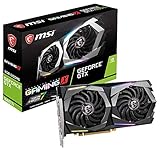
3. MSI GeForce GTX 1660 Ti Gaming X 6G — $399
The GTX 1660 Ti is where 1080p 144Hz gaming stops being a compromise. With 6GB of GDDR6 on a 192-bit bus and MSI’s dual-fan Gaming X cooler, this card handles modern AAA titles at high settings at 1080p and pushes well past 100fps in many, while esports titles max out a 144Hz panel with room to spare. It’s VR-ready, supports DirectX 12, and offers HDMI and DisplayPort outputs. The twin Frozr cooler runs quiet and keeps the card boost-friendly. At $399 it’s the most expensive card here besides the 1080 Ti, but it’s also the most balanced: modern memory, reasonable power draw, and no aging architecture quirks.
- 6GB GDDR6 on 192-bit bus delivers genuine high-refresh 1080p performance
- Dual-fan Gaming X cooler with strong acoustics; VR-ready
- $399 stretches the definition of “budget” for many buyers
Skip it if you only play esports — the $112 RX 550 will get you there for a third of the price.
4. QTHREE GeForce GT 730 4GB — $89.99
The GT 730 is best understood as a display and light-duty card rather than a gaming GPU. This QTHREE low-profile board packs 4GB of DDR3 on a 64-bit bus, runs off PCIe x8 slot power, and offers an unusually generous output stack: two HDMI ports plus DisplayPort and VGA. That makes it excellent for driving multi-monitor office setups, adding outputs to an SFF machine, or breathing life into an older prebuilt — it supports Windows 11. Light and older games (think pre-2015 titles, indie games, andMOBAs) are playable at low settings at 1080p, but modern games won’t run acceptably.
- Two HDMI ports plus DP and VGA — outstanding connectivity for the price
- Low-profile, slot-powered design for SFF and legacy builds; Windows 11 support
- DDR3 memory means modern gaming performance is effectively off the table
Skip it for a gaming build entirely — buy it for displays, media playback, and workstation duties.
5. EVGA GeForce GTX 1050 Ti SSC Gaming ACX 3.0 — $198.99
The GTX 1050 Ti sits in the awkward middle of this list: at $198.99, it costs more than the RX 550 but delivers a meaningful step up. EVGA’s SSC version adds a factory overclock, a dual-fan ACX 3.0 cooler, and EVGA’s PXOC software for on-screen tuning — a nice touch for first-time builders. With 4GB of GDDR5, it handles 1080p gaming at medium settings in many titles and pushes high frame rates in esports games, though consistently hitting 144fps in modern AAA releases isn’t realistic. It draws under 75W from the slot, so it works in systems without dedicated GPU power connectors.
- Factory-overclocked with a quiet dual-fan ACX 3.0 cooler
- PXOC on-screen display support for easy tuning; no external power required
- Pricing makes it hard to justify over cheaper GDDR5 alternatives
Skip it if the price climbs above $200 — at that point, saving toward a 1660 Ti-class card is the smarter move.
6. GeForce GT 610 2GB DDR3 — $49.99
At $49.99, the GT 610 is the cheapest card in this roundup, and its purpose is entirely different from the rest. This is an entry-level, low-profile card with 2GB of DDR3 on PCIe 1.1 x16, offering HDMI and VGA outputs for basic display needs. It will drive a 1080p desktop, handle video playback for an HTPC, and add outputs to a motherboard whose integrated graphics have died. It’s compatible with Windows 11 and runs silently and cool with no external power. As a gaming card, though, it’s not one — even decades-old 3D games will test it.
- Extremely cheap way to add HDMI output or replace failed integrated graphics
- Low-profile, silent, slot-powered — fits anywhere, works with Win11
- PCIe 1.1 and DDR3 make it categorically unfit for modern gaming
Buy it for a media PC or an emergency display fix. Never buy it expecting 144Hz gaming.
7. ASUS ROG Strix GTX 1080 Ti 11GB — $349.99
The GTX 1080 Ti remains one of the great value plays in used and clearance markets, and ASUS’s ROG Strix edition is the version to want: 11GB of GDDR5X, a beefy triple-fan cooler with RGB lighting, and outputs covering HDMI, DisplayPort, and DVI for up to 5K display configurations. At 1080p, the 1080 Ti is massively overqualified — it will max out a 144Hz panel in virtually any game, including demanding AAA titles at ultra settings, and it’s fully VR-ready. At $349.99, it undercuts the 1660 Ti here while offering considerably more raw performance and memory. The tradeoffs are physical: it’s a large, heavy card (roughly 11.7 inches long) that needs a spacious case, real airflow, and adequate PSU headroom.
- Flagship-class performance that genuinely delivers 144fps at 1080p ultra
- 11GB GDDR5X and triple-fan Strix cooling at a midrange price
- Large, power-hungry card — verify case clearance and PSU capacity first
8. Xynsviu Radeon R7 350 2GB — $107.39
The R7 350 is a niche pick with one standout feature: six HDMI outputs on a single low-profile card. That makes it a favorite for digital signage, trading desks, streaming setups, and multi-monitor workstations — scenarios where you need to drive many displays from one PCIe slot. The 2GB of GDDR5 gives it a slight edge over DDR3 budget cards for older games and light 1080p gaming, but with 2GB of memory, modern titles are out of reach and even esports performance will be modest. At $107.39, you’re paying for connectivity, not frame rates.
- Six HDMI outputs in one card — unmatched for multi-display setups
- GDDR5 memory and low-profile design; slot-powered
- Only 2GB of VRAM severely limits its usefulness as a gaming card
Skip it for gaming entirely; buy it if you need to drive four or more displays on a budget.
Buying Guide
What 144Hz at 1080p Actually Requires
Be realistic about the target. Hitting 144fps in esports titles (CS2, Valorant, Rocket League, League of Legends) at 1080p is achievable with modest GDDR5-based cards and a capable CPU. Hitting 144fps in modern AAA games at high settings demands a much stronger GPU — think GTX 1660 Ti class or better, and ideally 6GB or more of VRAM. If your library is mostly competitive shooters, a $110–$200 card may suffice. If you want high refresh in everything, budget $350+ or adjust your in-game settings expectations.
Memory Type and Bus Width Matter More Than Capacity
A card with 4GB of DDR4 or DDR3 on a 64-bit bus will almost always lose to a card with 4GB of GDDR5 on a 128-bit bus, despite identical capacity numbers. GDDR5 and GDDR6 offer several times the bandwidth of system-style DDR3/DDR4 memory, and bandwidth is what feeds frames at 1080p. Check the memory bus (64-bit is budget-tier, 128-bit is respectable, 192-bit and up is performance-class) before checking capacity.
Case Fit, Power, and Connectivity
Most cards in this roundup draw all their power from the PCIe slot (75W or less), which makes them ideal for prebuilt desktops and SFF cases — but verify your case’s max GPU length before buying. Full-size cards like the ASUS Strix 1080 Ti run roughly 11–12 inches long and need two or more expansion slots of clearance plus a quality PSU with headroom. Finally, match outputs to your monitor: a 144Hz display generally needs DisplayPort or a recent HDMI spec, and older cards with only VGA or single-link outputs won’t drive your panel at its full refresh rate.
Our Verdict
For the actual goal — 1080p gaming on a 144Hz monitor — the ASUS ROG Strix GTX 1080 Ti 11GB at $349.99 is the performance pick, delivering flagship-level frame rates that will saturate a 144Hz panel for years. If $350 is too rich, the MSI GTX 1660 Ti at $399 is a more modern, power-efficient alternative, though it costs more for less raw horsepower. For strict budgets focused on esports, the Maxsun RX 550 at $112.99 is the best value on this list — proper GDDR5 memory, a 128-bit bus, and modern outputs at a no-frills price. And if your “gaming PC” needs are really about displays and media, the QTHREE GT 730 at $89.99 handles that job for less.
FAQ
Can a budget GPU really hit 144fps at 1080p?
Yes, but it depends entirely on the game. Esports titles like CS2, Valorant, and Rocket League are CPU-friendly and lightly demanding, so cards like the RX 550 or GTX 1050 Ti can reach 144fps at medium settings. Modern AAA releases at high settings need GTX 1660 Ti-class performance or better, like the 1660 Ti and 1080 Ti in this roundup.
Is 4GB of VRAM enough for 1080p gaming in 2026?
For esports and older titles, yes. For newer AAA games, 4GB is increasingly limiting, and 6GB or more is the safer floor. Note the memory type too: 4GB of GDDR5 (like the RX 550) far outperforms 4GB of DDR4 or DDR3 (like the GT 1030 DDR4 and GT 730) despite matching capacity.
Do these cards need extra power connectors?
Most cards here — the GT 1030, RX 550, GT 730, GT 610, R7 350, and 1050 Ti — draw all power from the PCIe slot, so any working desktop PSU will run them. The MSI GTX 1660 Ti and ASUS Strix 1080 Ti have higher power draw and may require a 6-pin or 8-pin PCIe connector; check your power supply before buying.
Will these cards fit my PC?
Measure first. Low-profile cards like the GT 1030 LP, GT 730, GT 610, and R7 350 are designed for slim SFF cases. The RX 550 ITX and 1050 Ti are compact full-height cards. The MSI 1660 Ti is a standard dual-slot card around 9–10 inches long, and the ASUS Strix 1080 Ti is a large triple-slot-class card of roughly 11.7 inches that needs serious case clearance and airflow.


