
Buying a gaming power supply is one of the few PC purchases where a small mistake can take out other components. The most common errors are buying too little wattage and assuming it will be fine, buying far too much wattage and overpaying for capacity you will never use, trusting the peak wattage number on the box instead of continuous power, and assuming any 80 Plus sticker guarantees quality. A cheap 700W unit with poor protections can be more dangerous than a well-built 550W unit running near its limit, and an old group-regulated design can cause voltage instability even if the wattage math looks correct on paper.
This guide cuts through the marketing to what actually matters for gaming PCs in 2026: correct wattage for your GPU and CPU combination, what efficiency ratings do and do not tell you, which physical and electrical standards determine compatibility, and where your money is best spent across budget, midrange, and premium tiers.
As an Amazon Associate we earn from qualifying purchases at no extra cost to you. Product prices and availability are accurate as of the date shown and are subject to change.


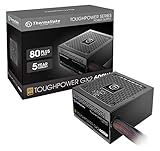

Top 3 picks at a glance
Decide These 3 Things First
Before you compare models, lock in these three decisions. They narrow the field from hundreds of options to a handful that will actually work for your build.
1. Your real wattage requirement. Add the power draw of your CPU and GPU, then add 100 to 150 watts for motherboard, RAM, storage, fans, and cooling, plus another 20 to 30 percent headroom for transient spikes and future upgrades. For a system with an RTX 4060 or RX 7600 and a 65W to 125W CPU, 550W to 650W continuous is usually the sweet spot. For an RTX 4070 Super / 4070 Ti or RX 7900 XT with a high-end CPU, plan for 750W to 850W.
2. Your efficiency and noise priority. Efficiency affects your electricity bill and heat, but not gaming performance. If your PC runs 4 to 6 hours per day, the difference between 80 Plus Bronze and Gold might be $6 to $12 per year. Choose Bronze if budget is tight, Gold if you want lower heat, quieter operation, and slightly lower long-term costs.
3. Your case and cable constraints. Measure your PSU clearance, check whether you need an SFX, SFX-L, or standard ATX unit, and decide if you want non-modular, semi-modular, or fully modular cables. Small form factor cases often limit PSU depth to 140mm to 150mm, while mid-tower ATX cases typically accept 160mm to 180mm units without issue.
Form Factor and Size: Will It Fit Your Case?
Most gaming desktops use an ATX PSU, which measures 150mm wide x 86mm tall x 140mm to 180mm deep. Depth is the critical dimension. A standard ATX mid-tower easily fits a 160mm deep unit, but compact microATX and many ITX cases max out at 140mm to 150mm. Always check your case manual for maximum PSU length, especially if you have a bottom-mounted PSU shroud or a hard drive cage in front of it.
SFX is 125mm x 63.5mm x 100mm and SFX-L is 125mm x 63.5mm x 130mm. These are for mini-ITX builds like the Cooler Master NR200 or Fractal Terra. You can use an SFX unit in an ATX case with an adapter bracket, but not the other way around.
Weight is a rough proxy for internal component quality. A typical 500W to 600W budget unit weighs 3.5 to 4.5 pounds, while a well-built 750W to 850W Gold unit weighs 4.8 to 6.2 pounds due to larger heatsinks, better capacitors, and more robust filtering. If a high-wattage PSU feels unusually light, inspect its protections and reviews closely.
Wattage and Power Delivery: How Much Do You Actually Need?
Focus on continuous power, not peak power. A unit labeled 500W continuous can deliver 500W all day at 40C to 50C. A unit advertising 700W peak might only deliver 550W continuously before voltage ripple increases or protections trip.
Use this practical range for single-GPU gaming systems with one CPU and 2 to 4 storage drives:
- Entry 1080p (RTX 4060, RX 7600, Arc A750): 500W to 600W continuous
- Solid 1440p (RTX 4070, RX 7800 XT): 650W to 750W continuous
- High-end 4K (RTX 4070 Ti Super, RTX 4080, RX 7900 XTX): 750W to 850W continuous
- Enthusiast overclocked (RTX 4090, heavy CPU overclocking): 850W to 1000W continuous
Look at the 12V rail amperage on the label. Multiply volts x amps to get 12V wattage. Modern gaming PCs draw 80 to 90 percent of total power from the 12V rail to feed the CPU and GPU. For example, a 600W unit with 48A on the 12V rail provides 576W on 12V, which is good. A 600W unit with only 36A on 12V provides just 432W on 12V and is a weak design despite the 600W sticker.
Account for transient spikes. GPUs can spike 1.5x to 2x their average power for milliseconds. This is why ATX 3.1 exists. A modern ATX 3.1 PSU is designed to handle up to 200 percent of its rated load for 100 microseconds. Older ATX 2.4 designs may shut down when a new GPU spikes, even if the average wattage seems sufficient.
Efficiency Ratings Explained: What 80 Plus Really Means
80 Plus certification measures how efficiently a PSU converts wall power (AC) to PC power (DC). Waste is released as heat. An 80 Plus rating does not measure voltage stability, ripple, protection quality, or lifespan. It only measures efficiency at 20 percent, 50 percent, and 100 percent load.
- 80 Plus White: 80 percent efficient at 20, 50, and 100 percent load (115V). Budget baseline.
- 80 Plus Bronze: 82 to 85 percent efficient. Good for budget gaming PCs.
- 80 Plus Gold: 87 to 90 percent efficient. Most popular for gaming due to lower heat and noise.
- 80 Plus Platinum: 89 to 92 percent efficient. Diminishing returns unless your PC runs 10 plus hours daily.
- 80 Plus Titanium: 90 to 94 percent efficient. Premium, usually only worth it for high wattage or always-on systems.
Efficiency is highest at about 40 to 60 percent load, which is why oversizing slightly helps. A 650W Gold PSU running a 350W gaming load at 54 percent will run more efficiently and quietly than a 500W White unit running the same load at 70 percent, because the Gold unit loses less energy as heat and its fan can spin slower.
For cost perspective, moving from Bronze to Gold on a 650W system gaming 4 hours per day at $0.15 per kWh saves roughly $5 to $10 per year. The bigger benefit is less heat inside your case, lower fan speed, and often higher-quality capacitors and topology that often come with Gold and above units.
Cables, Connectors and ATX Standards
Cable type affects building ease more than performance. Non-modular units have all cables permanently attached. You will have to hide unused cables, which takes more space but costs $10 to $25 less. Fully modular lets you attach only the cables you need, which improves airflow and looks cleaner, especially in cases with tempered glass. Semi-modular is a middle ground with the 24-pin and EPS cables fixed and PCIe cables modular.
Connector checklist for a modern gaming PC:
- 24-pin ATX motherboard: required on all ATX PSUs
- EPS 4+4 pin CPU: one is enough for most CPUs, two for high-end overclocking boards
- PCIe 6+2 pin: two to three for older GPUs
- 12VHPWR or 12V-2×6 (native PCIe 5.1): one 16-pin connector rated for 300W to 600W on ATX 3.1 units. This replaces multiple 8-pin adapters for RTX 40-series and newer cards. If your PSU is ATX 3.1 with a native 450W PCIe 5.1 connector, you do not need the bulky triple 8-pin to 16-pin adapter that comes with many GPUs.
- SATA and Molex: 4 to 8 SATA for drives and hubs
ATX version matters. ATX 12V 2.3, 2.4, and 2.92 are older standards that still work but are not designed for modern GPU transients. ATX 3.0 and 3.1 require better handling of spikes, tighter low-load efficiency, and the 12VHPWR / 12V-2×6 connector. For any new build with an RTX 40 series or newer GPU, an ATX 3.1 Gold unit is the safest long-term choice. If you keep an older ATX 2.4 unit, ensure it has dedicated PCIe rails with sufficient amperage and not just Molex adapters.
Cooling, Noise and Build Quality
Most 500W to 850W gaming PSUs use a 120mm or 135mm fan. A 120mm fan is standard on units 140mm to 160mm deep, while 135mm fans appear on deeper 160mm to 180mm units. Larger fans can move the same air at lower RPM, so they are often quieter.
Look for these quality indicators: Active PFC, DC-to-DC conversion for 3.3V and 5V rails, LLC resonant topology, Japanese or 105C-rated capacitors, and a complete protection suite including OVP, UVP, OCP, OPP, SCP, and OTP. A unit missing any of these on the spec sheet deserves extra scrutiny.
Zero RPM or Smart Zero Fan modes keep the fan off below about 30 to 40 percent load or below 40C internal temperature. At a 200W to 300W desktop load, the PSU is effectively silent. Once gaming pushes the load past 50 percent, the fan ramps to 800 to 1200 RPM on Gold and Platinum units, typically 18 to 28 dBA, versus 1200 to 1800 RPM and 30 to 38 dBA on White or Bronze budget models.
Price Tiers: What to Expect
PSU pricing is relatively stable after efficiency and wattage are fixed. Use these ranges as a reference for street prices for reliable models from well-known brands:
- $35 to $50: 500W to 600W, 80 Plus White or Bronze, non-modular, ATX 2.3 / 2.4, 120mm fan. Good for entry 1080p builds without GPU upgrades planned. Example range includes 500W White units around $37 to $42.
- $55 to $80: 600W to 750W, 80 Plus Bronze or Gold, non-modular or semi-modular, DC-to-DC, 5-year warranty. The value sweet spot for most 1440p gamers. Example range includes 600W Gold units around $55 to $65 and quality 750W Bronze around $70 to $80.
- $80 to $120: 750W to 850W, 80 Plus Gold, fully modular, ATX 3.1 with native PCIe 5.1 connector, Smart Zero Fan. Ideal for RTX 4070 and above and for quieter builds. Example range includes 850W ATX 3.1 Gold units around $79 to $109.
- $130 to $200 plus: 850W to 1000W, Gold or Platinum, fully modular, 10-year warranty, premium capacitors and 135mm fluid dynamic bearing fan. For 4K, overclocking, and long-term reuse across multiple builds.
Avoid paying a premium for wattage alone. An 850W White unit at $75 is not better than a 650W Gold unit at $79 if your system only needs 500W. Spend for efficiency, protections, and ATX 3.1 compliance first, then wattage headroom.
Warranty, Lifespan and Support
Warranty length strongly correlates with expected lifespan and manufacturer confidence. Budget White and Bronze non-modular units typically carry 3 years. Mainstream Gold units from reputable brands carry 5 to 7 years. Premium Gold and Platinum fully modular units carry 7 to 10 years, with some flagship 1000W models offering 10 to 12 years.
Capacitor temperature rating matters. 85C capacitors age faster; 105C Japanese capacitors are standard in midrange and premium units and handle heat better inside a hot case. A PSU kept below 40C intake temperature, kept free of dust, and loaded at 50 to 70 percent will typically last 5 to 8 years easily, often longer.
Keep your proof of purchase and serial number. Most RMA processes require the original purchase receipt and photos of the label. If a PSU fails, stop using it immediately and do not reuse cables from a different brand or even a different model line, as modular cable pinouts are not standardized and mixing cables can destroy components.
Delivery and Assembly Notes
PSUs are heavy and sensitive to shock. Factory packaging uses molded foam or dense cardboard partitions to protect the transformer and heatsinks. If the box arrives crushed or the unit rattles when shaken, inspect for loose screws or broken fan blades before powering on.
Installation is straightforward in most ATX cases: four screws through the rear panel, fan facing down if your case has a bottom vent and filter, fan facing up only if the PSU sits on carpet or has no bottom ventilation. Leave 15mm to 20mm clearance for the fan intake. Do not mount the PSU with its intake blocked by the case floor.
Plan 20 to 30 minutes for cable routing. For non-modular units, group unused cables with velcro behind the motherboard tray. For fully modular units, connect the 24-pin, EPS, and PCIe cables to the PSU before sliding it into the case, as the connectors become hard to reach once mounted. After first boot, check BIOS voltages: 12V should read 11.8V to 12.2V, 5V at 4.9V to 5.1V, and 3.3V at 3.2V to 3.4V. Significant deviation suggests a cable seating issue or a defective unit.
Spec Checklist
| Spec | Budget | Mid | Premium |
|---|---|---|---|
| Wattage (Continuous) | 500W – 600W | 650W – 750W | 850W – 1000W |
| Efficiency | 80 Plus White / Bronze | 80 Plus Gold | 80 Plus Gold / Platinum |
| ATX Standard | ATX 12V 2.3 / 2.4 | ATX 3.0 / 3.1 | ATX 3.1 |
| GPU Connector | 2x PCIe 6+2 pin | 3x PCIe 6+2 pin or 12V-2×6 (300W) | Native 12V-2×6 450W – 600W |
| Modularity | Non-modular | Semi or Fully modular | Fully modular |
| Fan Size / Mode | 120mm, always-on | 120mm / 135mm, Zero RPM below 30-40% | 135mm FDB, Zero RPM, 18-25 dBA |
| Protections | OVP / UVP / SCP basic | Full suite: OVP, UVP, OCP, OPP, SCP, OTP | Full suite + OCP per rail, inrush limiter |
| Capacitors | 85C / 105C standard | 105C, Japanese primary | All Japanese 105C, LLC + DC-DC |
| Depth | 140mm – 150mm | 150mm – 160mm | 160mm – 180mm |
| Warranty | 3 years | 5 – 7 years | 7 – 10 years |
| Street Price Range | $35 – $50 | $60 – $90 | $100 – $180 |
Red Flags
Skip or investigate further if you see any of these:
- Only a peak wattage number on the box with no continuous rating or no 12V amperage listed. Real wattage is continuous at 40C, not peak at 25C.
- 80 Plus certification that cannot be verified on the official CLEAResult database, or a sticker that says 80 Plus without Bronze, Gold, etc. specified.
- Multiple 12V rails with very low amperage per rail (for example 14A per rail) that forces you to balance connectors manually, or molex-to-PCIe adapters included instead of native PCIe cables.
- Modular cables that are thin 20 AWG instead of 18 AWG or 16 AWG for high-current 12V lines, or cables that feel hot after 15 minutes of gaming.
- No mention of protections, or only short-circuit protection listed. A modern PSU should list at least six protections.
- A 700W plus unit weighing under 3.5 pounds or depth under 125mm without being SFX. Ultra-light high-wattage units often cut corners on filtering and heatsinks.
- Seller claims of silent passive operation with no fan at all in a gaming wattage class. True fanless PSUs exist but are rare, expensive, and limited to 500W to 700W with large external heatsinks.
FAQ
How do I calculate the right wattage without overspending?
Add your CPU TDP and GPU total board power, then add 100 to 150 watts for the rest of the system, then multiply by 1.2 to 1.3 for headroom. For example, a 65W CPU plus a 200W GPU equals 265W, plus 120W for other parts equals 385W, times 1.25 equals about 481W, so a quality 550W continuous unit is correct and a 650W gives extra upgrade room. Do not size to peak or to a calculator that adds 50 percent automatically, or you will pay for unused capacity.
Is 80 Plus Gold worth it over Bronze for gaming?
For pure electricity savings, the payback is slow. On a 350W gaming load, Gold at 90 percent efficiency wastes about 39W as heat versus Bronze at 85 percent wasting about 62W, a 23W difference. At 4 hours per day, that is about 33 kWh per year, or roughly $5 at $0.15 per kWh. The real reasons to choose Gold are lower heat, lower fan speed and noise, and the fact that Gold units more often include DC-to-DC conversion, better capacitors, and ATX 3.1 support, which improve stability regardless of the electricity savings.
Do I need ATX 3.1 and a native 12V-2×6 connector?
You need ATX 3.1 if you use an RTX 40 series, RTX 50 series, or any GPU with a 16-pin 12VHPWR / 12V-2×6 plug, or if you plan to upgrade to one. ATX 3.1 guarantees the PSU can handle GPU transient spikes up to twice its rating for short durations and includes the native cable, which is safer and cleaner than using two or three 8-pin adapters. For older GPUs with standard 8-pin connectors, an ATX 2.4 Gold unit is still fine, but ATX 3.1 is more future proof and now costs only $10 to $20 more in the 750W to 850W class.
Can I reuse my old PSU cables with a new PSU?
No. Never reuse modular cables between brands, and do not assume cables within the same brand are interchangeable. The PSU-side pinout is not standardized, so a cable that fits physically can send 12V to a 5V or ground pin and damage your motherboard, GPU, or drives instantly. Always use only the cables that came in the box with that exact model. If you need longer cables or colored extensions, use extension cables that plug into the original cables, not replacement cables with a different pinout.


