
Top 3 picks at a glance
The Short Answer
For a budget gaming PC, you do not need the fastest RAM on the market. For DDR4 systems, 3200 MHz is the sweet spot for price and performance. For DDR5 systems, aim for 4800 MHz to 5600 MHz. Going higher than that adds cost with very little fps gain on budget CPUs and GPUs. Pair that speed with 16GB of RAM in a 2x8GB dual-channel kit, and you have the ideal setup for 1080p gaming without overspending.
In terms of physical size, most budget gaming PCs are mid-tower desktops measuring about 16 to 18 inches tall, 8 to 9 inches wide, and 16 to 19 inches deep. They weigh 25 to 35 pounds and need about 24 inches of desk depth and 6 inches of clearance on all sides for airflow. If you are tight on space, look for compact or small-form-factor cases under 14 inches tall, but make sure they still fit a full-size graphics card and a standard power supply.
As an Amazon Associate we earn from qualifying purchases at no extra cost to you. Product prices and availability are accurate as of the date shown and are subject to change.
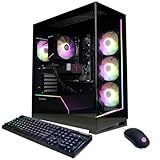


Standard Sizes
Budget gaming PCs use a few standard case sizes. The dimensions below reflect common measurements for prebuilt systems sold in 2026, including the reference models for this guide. Always check the exact listing, as the same internal parts can be shipped in different cases.
| Case Size / Example Model | Height (in / cm) | Width (in / cm) | Depth (in / cm) | Weight (lbs / kg) | Typical Price Range | Power Supply |
|---|---|---|---|---|---|---|
| Small Tower / Compact Budget (e.g., STGAubron Core i5 / RX 560) | 13.5 – 14.5 in / 34.3 – 36.8 cm | 7.0 – 7.5 in / 17.8 – 19.1 cm | 14.0 – 15.5 in / 35.6 – 39.4 cm | 18 – 24 lbs / 8.2 – 10.9 kg | $380 – $550 | 400W – 500W |
| Mid-Tower Standard (e.g., STGAubron Core i5 / RTX 2060, Skytech Shadow) | 16.5 – 18.5 in / 41.9 – 47.0 cm | 8.0 – 8.7 in / 20.3 – 22.1 cm | 16.5 – 19.0 in / 41.9 – 48.3 cm | 26 – 32 lbs / 11.8 – 14.5 kg | $540 – $900 | 500W – 650W Gold |
| Mid-Tower Full Size / High-End Budget (e.g., CyberPowerPC Ryzen 7 8700F / RTX 5060 Ti) | 17.5 – 19.5 in / 44.5 – 49.5 cm | 8.3 – 9.5 in / 21.1 – 24.1 cm | 17.0 – 19.5 in / 43.2 – 49.5 cm | 30 – 38 lbs / 13.6 – 17.2 kg | $1,300 – $1,550 | 600W – 750W Gold |
| Required Desk Space (with airflow clearance) | Allow 6 in / 15.2 cm top clearance | Allow 4 – 6 in / 10.2 – 15.2 cm side clearance | 24 – 30 in / 61 – 76.2 cm desk depth | – | – | – |
RAM itself has a standard physical size. Desktop DDR4 and DDR5 DIMMs are 5.25 inches (133.35 mm) long and about 1.2 inches (30 mm) tall, or up to 1.7 inches (44 mm) with RGB heatsinks. Leave at least 1.5 inches of clearance above the RAM slots if you use a large air cooler.
How to Measure Your Space
Buying by price and specs is not enough. A budget PC that does not fit your desk will run hot, loud, and cluttered. Measure before you buy.
- Measure your desk footprint. Use a tape measure to get the usable width and depth of your desktop, not including any hutch or drawer. Subtract 6 inches from the depth to leave room for cables behind the case. If your desk is less than 20 inches deep, favor a narrow 7 to 8 inch wide case and plan to put the tower on the floor.
- Measure vertical clearance. If the PC will go under a desk, in a cabinet, or on a shelf, measure from the floor or shelf surface to the underside of the desk or shelf above. You need the case height plus 6 inches of top ventilation. Never enclose a gaming PC in a closed cabinet without an open back.
- Check wall and vent clearance. Measure 4 to 6 inches from where the side and rear panels will sit to the nearest wall, monitor, or furniture. Budget PCs with RTX 2060, RTX 3050, or RX 560 cards exhaust hot air from the rear and side panels and will throttle if blocked.
- Map your cable and power zone. Measure the distance from your planned PC location to the wall outlet and to your monitor, router, and peripherals. Budget towers typically need a 3 to 4 foot power cable radius and a 5 to 6 foot reach for HDMI or DisplayPort, Ethernet, and USB. A 650W Gold PSU like the one in the Skytech Shadow includes cables about 18 to 24 inches inside the case, so rear outlet access is essential.
- Confirm door and floor space for moving and cleaning. Measure hallways and doorways you will carry the box through. Shipping boxes add 3 to 4 inches per side. The floor area under or beside the desk should allow you to pull the case out 12 inches for dusting vents and filters monthly.
By Room or Use Case
Small Bedroom or Dorm Desk (Compact Setup)
Choose a compact or small mid-tower no larger than 14.5 inches tall, 7.5 inches wide, and 15.5 inches deep. Systems like the STGAubron with RX 560 or RTX 2060 in a smaller chassis fit well on a 42 inch wide by 20 inch deep desk and leave room for a 24 inch monitor. Use DDR4 3200 MHz 16GB (2x8GB) here, as these Core i5 platforms are DDR4-based and do not benefit from paying extra for higher speeds. Keep the tower on the desk to avoid carpet dust, and use a monitor arm to save 6 to 8 inches of desk depth.
Living Room or Shared Family Space
A standard mid-tower such as the Skytech Shadow at about 17.7 inches tall by 8.3 inches wide by 16.7 inches deep blends better when placed beside a TV stand. You will need a TV stand or console at least 18 inches deep and 36 inches wide to hold the tower vertically with 4 inches of side breathing room. For 1080p gaming on a large TV, 16GB DDR4 at 3200 MHz remains ideal. If the PC offers DDR5, choose 5200 to 5600 MHz, which adds only $15 to $30 over base 4800 MHz kits and is well-priced for budget builds.
Dedicated Gaming Corner or Home Office
If you have a 48 to 60 inch wide gaming desk with 24 to 30 inches of depth, you can accommodate a full-size mid-tower like the CyberPowerPC with Ryzen 7 8700F and RTX 5060 Ti. These taller cases around 18 to 19.5 inches high provide better airflow and easier upgrades. This platform uses DDR5, so select 5200 to 6000 MHz. The performance difference between 5200 and 6000 MHz on a budget GPU is typically only 2 to 5 percent, so put extra budget toward a 1TB NVMe SSD instead of ultra-fast RAM.
Floor Placement and Small Apartment Considerations
On the floor, prioritize stability and dust control. Place the PC on a hard board or low stand at least 0.75 inches off carpet. You need a footprint of about 10 inches by 18 inches, plus 6 inches of rear clearance for the power cable and exhaust. Budget towers weigh 25 to 35 pounds, so avoid tall, narrow cases over 18 inches high if you have pets or foot traffic that could tip them. All reference models in this guide use standard ATX power supplies from 500W to 750W, which need a dedicated outlet strip rated for at least 15 amps and should not share a circuit with a space heater or air conditioner.
Common Sizing Mistakes
Buying RAM speed you cannot use. Many budget motherboards limit RAM speed. A board rated for DDR4 3200 will run a 3600 MHz kit at 3200 unless you enable XMP in BIOS, and some prebuilt boards hide that setting. Check the motherboard spec, not just the RAM label. Do not pay a $40 to $60 premium for 3600 MHz DDR4 or 6400 MHz DDR5 for a budget CPU, the gain is minimal.
Ignoring case depth and GPU length. Budget cards like the RTX 2060 6GB and RTX 3050 6GB are typically 8 to 9 inches long, but compact cases may only support cards up to 9.5 inches with the front fans installed. Always compare the case max GPU length to the card length. A tight fit blocks front airflow and raises temperatures.
Forgetting to leave airflow space. Pushing a tower flush against a wall or inside a desk cubby is the most common cause of thermal throttling and fan noise. Leave 4 to 6 inches behind the case and 4 inches on the vented side. Dust filters need 2 inches of clearance to slide out for cleaning.
Mixing RAM sizes and speeds. Adding a single 16GB stick to a system that came with 2x8GB forces single-channel or mismatched operation and cancels the benefit of faster RAM. For 16GB total, always use a matched 2x8GB kit of the same speed, for example two DDR4 3200 MHz DIMMs. For 32GB, use 2x16GB.
Underestimating desk load and weight. A fully loaded mid-tower with a 650W power supply, 1TB SSD, and glass side panel can reach 32 pounds. Add a 12 to 15 pound monitor and peripherals and a budget particle-board desk may sag. Center the tower over a leg or support, not in the middle of a span.
FAQ
What RAM speed should I choose for a budget gaming PC, DDR4 or DDR5?
Match the RAM to your platform. For budget DDR4 systems with a Core i5 or Ryzen 5 5500, choose DDR4 3200 MHz CL16 in a 2x8GB kit. That is the standard for prebuilts in the $400 to $900 range and offers the best value. For newer DDR5 budget systems with a Ryzen 7 8700F or similar, choose DDR5 5200 to 5600 MHz. Base DDR5 4800 MHz works fine if it saves you $20 or more, while speeds above 6000 MHz are not cost effective for budget gaming.
Is 16GB enough, or do I need 32GB for gaming?
16GB is enough for most 1080p budget gaming in current titles. Games plus background apps like Discord and a browser usually use 10 to 14GB. Upgrade to 32GB (2x16GB) only if you play heavy simulation games, edit video, or like to keep many tabs open while gaming. For RAM capacity, two sticks are better than one, so dual-channel 2x8GB will outperform a single 16GB stick even at the same speed.
Will a budget gaming PC fit on my desk?
Measure your desk against the standard sizes table. Most desks can hold a small tower under 15 inches deep with room to spare. A full mid-tower needs a desk at least 24 inches deep and 36 inches wide to hold the tower plus a 24 to 27 inch monitor and still allow 6 inches of rear ventilation. If your desk is smaller, place the tower on a hard floor stand beside the desk and use longer 6 to 10 foot display and USB cables.
What power supply size do I need for these speeds and sizes?
RAM speed does not change power needs meaningfully, but the graphics card does. For builds with an RX 560 or RTX 2060 and 16GB of RAM, a quality 500W to 550W unit is sufficient. For an RTX 3050 6GB or RTX 5060 Ti 8GB with a Ryzen 5 or Ryzen 7, choose 600W to 650W, preferably 80 Plus Gold for efficiency and quieter operation. The Skytech Shadow includes a 650W Gold PSU, which is a good baseline for any budget to mid-range build and leaves headroom for future storage or fan upgrades.


