
Top 3 picks at a glance
The Short Answer
For a large graphics card like an RTX 4080 Super or RTX 4090 and a tall air cooler, you need a PC case with at least 14.5 inches (37 cm) of GPU clearance length, 6.5 inches (16.5 cm) of GPU width/thickness clearance, and 6.5 inches (16.5 cm) of CPU cooler height clearance. If you are buying a protective carrying case for the graphics card itself, look for an interior of at least 14.2 x 5.9 x 2 inches (36 x 15 x 5 cm) to fit most large triple-fan cards without pressure on the fans or backplate.
Most modern mid-tower ATX cases meet these maximums, but compact Micro-ATX and Mini-ITX cases often do not unless they are specifically designed for long GPUs. Always check three measurements before you buy: maximum GPU length, maximum CPU cooler height, and maximum GPU thickness in slots. For builds in 2026, flagship cards and 160mm+ tower coolers have made those three numbers more important than the overall case height or width.
As an Amazon Associate we earn from qualifying purchases at no extra cost to you. Product prices and availability are accurate as of the date shown and are subject to change.


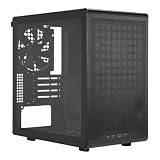
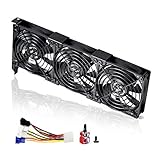
Standard Sizes
PC cases are grouped by the motherboard form factor they support, but their external dimensions and internal clearances vary widely between models. Use this table as a reference for what to expect and what to verify on a spec sheet.
| Case Type | Typical External Dimensions (H x W x D) | Max GPU Length | Max CPU Cooler Height | Best For |
|---|---|---|---|---|
| Mini-ITX (Compact) | 11 – 14 x 6 – 8 x 11 – 15 in 28 – 36 x 15 – 20 x 28 – 38 cm |
10.5 – 13 in 26.5 – 33 cm |
2.6 – 5.3 in 65 – 135 mm |
Small-space builds, short or 2-fan GPUs, low-profile coolers |
| Micro-ATX (Compact Mid-Tower) | 14.5 – 17.5 x 7 – 8.5 x 14 – 16.5 in 37 – 44 x 18 – 22 x 36 – 42 cm |
12.5 – 14.8 in 32 – 37.5 cm |
5.9 – 6.5 in 150 – 165 mm |
Example: Cooler Master Q300L V3 at 15.0 x 9.1 x 15.7 in (38.1 x 23 x 39.9 cm) with 262mm GPU support when front fan installed |
| Mid-Tower ATX (Standard) | 17 – 20 x 8 – 9.5 x 17 – 20 in 43 – 51 x 20 – 24 x 43 – 51 cm |
13.5 – 16.5 in 34 – 42 cm |
6.3 – 6.9 in 160 – 175 mm |
Most RTX 4070 Ti / 4080 Super / 4090 builds with 160mm+ air coolers or 240-360mm radiators |
| Full-Tower ATX | 21 – 27 x 9 – 11 x 21 – 25 in 53 – 69 x 23 – 28 x 53 – 64 cm |
16 – 18 in 40 – 46 cm |
6.7 – 7.5 in 170 – 190 mm |
Extra-long cards, custom cooling, E-ATX boards, maximum airflow |
| Protective GPU Carrying Case | Exterior: ~14.6 x 6.7 x 2.4 in 37 x 17 x 6 cm |
Interior: ~14.2 x 5.9 x 2.0 in 36 x 15 x 5 cm |
N/A | Storage and transport for RTX 4060 through RTX 4090 cards; hard-shell with handle, typically 1.1 – 1.5 lb (0.5 – 0.7 kg) |
For reference, large graphics cards themselves have grown significantly. A typical RTX 4090 Founders Edition is 12.0 x 5.4 x 2.4 in (30.4 x 13.7 x 6.1 cm) and occupies 3 slots, while many partner RTX 4080 Super and RTX 4090 models are 13.2 – 13.8 in long (33.5 – 35 cm), 5.5 – 5.9 in tall (14 – 15 cm), and 2.5 to 3.5 slots thick. Weights range from 2.2 lb (1.0 kg) for an RTX 4060 to 4.8 lb (2.2 kg) for a heavy RTX 4090. Tower air coolers are typically 6.0 – 6.7 in tall (152 – 170 mm). A popular 120mm single-tower cooler is about 6.0 in (154 mm), while a dual-tower 140mm cooler is often 6.5 in (165 mm).
Price expectations as ranges: protective hard cases for GPUs generally run $14 to $28, replacement GPU slot fan coolers like 92mm triple-fan PCI coolers run $20 to $35, Micro-ATX cases run $50 to $90, and standard mid-tower ATX cases run $70 to $150. Cases with tempered glass and high-airflow front panels sit at the higher end of each range.
How to Measure Your Space
Do not rely on external case dimensions alone. Two cases with the same height can have very different internal clearance. Measure in this order:
- Measure your graphics card. Use a tape measure to get length from the rear bracket to the farthest point of the shroud, height from the PCIe connector edge to the top of the backplate or shroud, and thickness in slots. If you do not have the card yet, use the manufacturer’s spec sheet for length, width, and slot count. Add 0.6 in (15 mm) of breathing room to the length for power cables.
- Measure required GPU clearance in the case. Check the case spec for “maximum GPU length” and “maximum GPU thickness.” If the spec lists clearance with and without front fans or radiators, use the smaller number. For thick cards over 2.5 slots, also verify that the case has at least 1.5 in (38 mm) between the card’s fans and the side panel or bottom shroud.
- Measure CPU cooler height clearance. For air cooling, find “maximum CPU cooler height” on the case spec sheet. Measure your cooler from the CPU base to the top of the fan or heat pipes. Leave at least 0.2 in (5 mm) under the limit. If you use an AIO liquid cooler, check radiator support instead: 240mm radiators need about 11 in (279 mm) of mounting length, 360mm need about 15.7 in (400 mm).
- Measure the desk or floor footprint. Measure the width and depth of where the case will sit, then subtract 2 in (5 cm) on each side for ventilation. Most cases need at least 2 in of clearance at the front and rear for intake and exhaust. For floor placement on carpet, add 1 in (2.5 cm) of bottom clearance or use a stand to keep the power supply intake clear.
- Check power and airflow extras. Large cards draw 220W for an RTX 4070 Ti up to 450W for an RTX 4090, so verify that the power supply shroud and cable routing will not push against the card. If you add a PCI slot GPU cooler fan assembly (typically 5.0 x 4.3 x 0.8 in / 12.8 x 11 x 2 cm), confirm you have two to three empty expansion slots and at least 0.8 in (20 mm) of clearance below the graphics card.
By Room or Use Case
Compact Desk Setup or Small Apartment
Choose a Micro-ATX case no deeper than 16 in (40.6 cm) and no wider than 9 in (22.9 cm) to save desk space. Look for at least 13.5 in (34.3 cm) of GPU length and 6.3 in (160 mm) of cooler height so you can still fit an RTX 4070 Ti or RTX 4080 Super with a mid-size tower cooler. Avoid ultra-compact Mini-ITX cubes unless you plan to use an SFX power supply and a GPU under 12 in long. A case with a mesh front panel will perform better in tight corners where side clearance is under 3 in (7.6 cm).
Home Office That Needs Low Noise
Prioritize a mid-tower at 18 – 20 in tall (45.7 – 50.8 cm) with sound-dampened panels and support for 6.5 in (165 mm) coolers. A larger dual-tower air cooler or a 280mm AIO will cool more quietly than a small 120mm cooler pressed against its thermal limit. Make sure the case supports at least 3 x 120mm or 2 x 140mm front fans so you can run fans at lower RPM. For GPU thickness, choose a case that lists 3.5 to 4 slots of GPU clearance so the card is not choked against the glass.
Dedicated Gaming Room or Enthusiast Build
A standard mid-tower or full-tower gives you the most flexibility. Aim for 15.5 – 17 in (39.4 – 43.2 cm) of GPU clearance to handle overclocked RTX 4090 models that reach 13.8 in (35 cm) long, plus 6.7 in (170 mm) cooler height for large dual-tower coolers. Full-towers over 22 in tall (55.9 cm) are best if you want a 360mm radiator on top and a vertical GPU mount while keeping 1.2 in (30 mm) of space between the GPU fans and the side panel.
Transport, Storage, and Workbench Use
If you carry cards between builds, for resale, or to a LAN event, a hard protective case is more practical than the original box. An interior of 14.2 x 5.9 x 2.0 in (36 x 15 x 5 cm) fits nearly all RTX 4060 to RTX 4090 cards, including triple-fan models, with a snug foam insert. The exterior handle and scratchproof shell add protection without adding much weight. For a workshop shelf, keep at least 16 in (40.6 cm) of shelf depth so the case can lay flat without overhang.
Common Sizing Mistakes
The most frequent error is buying based on case type alone. A Micro-ATX label does not guarantee support for a 13.5-inch card, and some Mini-ITX cases support longer GPUs than compact Micro-ATX models. Always read the maximum GPU length line, not the motherboard size.
Another mistake is ignoring power connector clearance. The 12VHPWR or 12V-2×6 connector on large cards needs an extra 1.0 – 1.4 in (25 – 35 mm) in front of the card or a 90-degree adapter. A case that fits the card length exactly may still press the cable against the side panel, which can bend the connector.
People also forget cooler height versus RAM and glass. Tall RAM with large heat spreaders can interfere with front fans on tower coolers, and coolers over 6.5 in (165 mm) will touch tempered glass on many compact cases. If your cooler is 6.5 in or taller, choose a case that explicitly lists 165mm or greater clearance.
Finally, overlooking slot thickness causes thermal problems. A 3.5-slot card like many RTX 4090 partner models needs a case with at least 7 expansion slots and open space below the card if you want good airflow. Mounting a thick card in a case with a solid power supply shroud right under the fans can raise temperatures by restricting intake.
FAQ
What case dimensions do I need for an RTX 4090 and a large air cooler?
Plan for a mid-tower that is at least 18 in tall x 8.5 in wide x 18 in deep (45.7 x 21.6 x 45.7 cm) externally and lists at least 14.5 in (368 mm) GPU length and 6.5 in (165 mm) CPU cooler height. For the biggest partner cards at 13.8 in (35 cm) long, choose a case with 15.5 in (394 mm) or more GPU clearance to leave room for cables. Pair this with a case that has 4 slots of GPU thickness clearance if your card is 3 slots or thicker.
Will a Micro-ATX case fit a large graphics card?
Some will, some will not. Many Micro-ATX cases support 13.5 to 14.8 in (34.3 to 37.5 cm) GPUs, which is enough for an RTX 4070 Ti or RTX 4080 Super, but others max out at 12.5 in (31.8 cm) when a front fan is installed. Check the exact model’s clearance with fans or a radiator installed, and verify CPU cooler height. If you want a large dual-tower cooler over 6.3 in (160 mm), many compact Micro-ATX cases will be too short and you should move to a standard mid-tower.
How do I know if my cooler will fit?
Find the cooler’s height on its spec sheet and compare it to the case’s maximum CPU cooler height. If the cooler is 6.3 in (160 mm) and the case allows 6.5 in (165 mm), it fits with a small margin. For liquid cooling, match radiator size to case support: a 240mm AIO needs a case with 240mm front or top mounting, a 360mm needs 360mm support. Also measure RAM height if your cooler overhangs the memory slots; RAM taller than 1.7 in (44 mm) can conflict with some tower coolers.
What size protective case should I buy to store a graphics card?
Look for a hard-shell case with an interior close to 14.2 x 5.9 x 2.0 in (36 x 15 x 5 cm). That size covers cards from the compact RTX 4060 at about 9.5 in (24 cm) long up to large RTX 4090 models at 13.6 in (34.5 cm) long, with foam that prevents scratching and movement. The exterior will be slightly larger, around 14.6 x 6.7 x 2.4 in (37 x 17 x 6 cm), and the empty case usually weighs 1.1 to 1.5 lb (0.5 to 0.7 kg). Choose a model with a firm handle and zipper closure rather than a soft sleeve if the card will travel.


