
Setting up a functional home office or dedicated gaming hub requires balancing technical performance with interior design. While monitor dimensions, desk depth, and chair ergonomics usually take center stage, the peripheral hardware on your desktop defines your daily workflow and visual order. When evaluating wired vs wireless gaming mouse latency, home setup enthusiasts often find themselves torn between technical precision and a clean, cable-free aesthetic.
For years, the choice was simple: competitive gamers insisted on braided cables to eliminate input lag, while casual users chose cord-free freedom to avoid desktop clutter. Today, advancing transmitter technology, high polling rates, and sleek ergonomics have shifted the equation. A modern mouse setup must not only register clicks instantly during high-stakes gaming sessions, but it must also fit gracefully into your living room, home office, or dual-purpose bedroom desk without adding unwanted cable drag or battery clutter.
As an Amazon Associate we earn from qualifying purchases at no extra cost to you. Product prices and availability are accurate as of the date shown and are subject to change.


Top 3 picks at a glance
Quick Verdict
If your priority is zero signal interference, uninterrupted power, and maximum performance per dollar, a wired gaming mouse remains the standard. It delivers pure plug-and-play responsiveness under 1 millisecond without requiring battery recharging. However, for most home setups, modern 2.4 GHz wireless mice have closed the speed gap entirely. High-performance wireless gaming mice now achieve imperceptible sub-1ms input latency, matching wired speed while eliminating cable friction and keeping your workspace looking pristine. Unless you compete in high-tier esports on a strict budget, a 2.4 GHz wireless mouse offers superior daily comfort and desktop organization.
Side by Side
| Feature Category | Wired Gaming Mouse | Wireless Gaming Mouse |
|---|---|---|
| Response Latency | 0.12 ms to 1.0 ms (Ultra-consistent) | 0.8 ms to 2.5 ms (2.4 GHz dongle) |
| Comfort & Cable Drag | Requires cable bungee; slight drag felt | Zero drag; smooth, unrestricted movement |
| Durability & Lifespan | High (no internal battery wear) | Moderate to High (battery degrades in 3–5 years) |
| Price Range | $15 to $80 | $25 to $160 |
| Maintenance | None (dusting and skate cleaning) | Battery swapping or frequent USB recharging |
| Space Needed & Cable Management | Needs 24–36 inches of free cable path | Minimal footprint; small USB receiver only |
| Visual Look & Desk Aesthetic | Visible cords can disrupt clean desk setups | Sleek, minimalist, modern profile |
| Resale & Long-Term Value | Stable value; timeless hardware connectivity | Slightly lower over time due to battery aging |
| Best For | Budget-focused gamers, fixed desktop stations | Clean setups, flexible workspaces, dual-use desks |
Where Wired Wins
Direct physical connections remain the undisputed benchmark for signal purity and simplicity. In the discussion of wired vs wireless gaming mouse latency, a physical copper connection transmits electrical signals directly to your computer motherboard at speeds ranging from 1000 Hz up to 8000 Hz polling rates. This translates to click responses between 0.125 and 1 millisecond. Because the power and data share a shielded cable, you never experience packet loss caused by household Wi-Fi 6E/7 routers, Bluetooth speakers, or baby monitors operating on the congested 2.4 GHz band.
From a functional maintenance standpoint, wired peripherals eliminate battery management. There are no lithium-ion batteries to recharge overnight and no disposable AA batteries to replace mid-match. This makes wired gear exceptionally long-lasting, often remaining functional for 5 to 10 years until the mechanical switches wear out. It offers the same reliable, zero-latency experience as other classic wired desk accessories, such as plugging in a pair of Apple EarPods Headphones with USB-C Plug around $19 for instant zero-lag audio during work calls.
Wired mice are also notably lighter in physical weight—often weighing between 45 and 65 grams—because they lack internal batteries and receivers. This lightweight profile reduces wrist fatigue during extended work sessions, provided you use a dedicated cord bungee to prevent the cable from snagging on the edge of your desk.
Where Wireless Gaming Mouse Latency Wins
Modern wireless gaming mice have revolutionized desk ergonomics by virtually eliminating the lag penalty. By utilizing low-latency 2.4 GHz radio frequency (RF) dongles rather than standard Bluetooth, manufacturers have compressed click latency down to under 1 millisecond. In real-world gaming and daily productivity, human reaction time (averaging 150 to 250 milliseconds) makes the micro-fraction difference between a modern wireless mouse and a wired connection completely imperceptible.
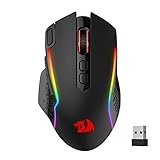
Where wireless truly shines is in spatial freedom and physical movement dynamics. Without a cord dragging across your desk mat or catching on screen mounts, physical mouse tracking feels lighter, smoother, and more precise. You can utilize large desk pads fully without managing cable slack. Highly popular entry-level performance models like the Logitech G305 Lightspeed Wireless Gaming Mouse around $29.99 demonstrate how budget-friendly devices can deliver high-tier wireless responsiveness alongside a clean footprint. Meanwhile, feature-packed options like the Redragon M810 PRO Wireless RGB Gaming Mouse 10000 DPI Remapping Keys around $24.29 show that custom button remapping and vibrant lighting can coexist with low-latency wireless hardware without breaking the bank.
Visually, removing cords instantly elevates your home decor. Minimalist desks, floating wall-mounted workstations, and glass-top tables look significantly tidier when freed from sprawling wires.
Cost Over 5 Years
Evaluating hardware costs over a five-year lifecycle reveals meaningful financial differences between the two formats:
- Wired Mouse Setup ($20 to $90 total): A mid-range wired mouse costs between $20 and $70 upfront. Beyond an optional $10 to $15 cable bungee or $8 replacement PTFE mouse skates after three years, ongoing operational costs are $0. Power consumption from your PC’s USB port is negligible (under 0.5 Watts).
- Wireless Mouse Setup ($35 to $180 total): Initial purchase prices range from $25 for entry-level devices up to $150 for premium rechargeable models. Over five years, battery maintenance adds to the total. Models utilizing replaceable AA/AAA batteries may require $10 to $20 in alkaline or rechargeable battery packs. Built-in lithium-ion batteries experience capacity degradation after roughly 300 to 500 charge cycles, which may prompt a mouse replacement after 3 to 4 years of heavy daily use.
Which One for Your Home
Small Apartment
In compact living spaces where your desk often sits in the main living room or bedroom, visual clutter directly impacts your home environment. A wireless mouse keeps small surface areas organized and easy to clean. You can easily tuck the mouse away into a drawer at the end of the workday to transform your gaming setup back into a clean dining or living space.
Family with Kids/Pets
Homes with pets or young children present unique physical hazards for computer gear. Hanging mouse cords invite cats to swat at them and toddlers to pull down equipment. A wireless mouse removes dangling trip hazards entirely. Furthermore, maintaining an organized desk surface in a busy household—much like storing daily grooming essentials such as a jar of RUSK Designer Collection Wired Flexible Styling Creme 6 Oz 6 Oz around $18.50 neatly inside a vanity drawer—ensures that delicate electronics remain safe from sudden spills and accidental pulls.
Rental Setup
Renters often cannot drill holes into walls or attach heavy adhesive cable raceways to walls and furniture to hide wires. A wireless gaming mouse reduces the number of cords running behind your desk, keeping your rental setup pristine and making teardowns or moves fast and hassle-free.
Long-Term Home Office
In a dedicated home office or custom-built gaming room, entering 2026 with a high-bandwidth workstation allows you to choose based strictly on personal preference. If you have custom grommet holes, drilled monitor arms, and dedicated under-desk cable trays, a high-polling-rate wired mouse fits seamlessly into a clean setup. Conversely, pairing a wireless mouse with a wireless charging desk pad provides ultimate convenience and high-speed input performance without ever needing a plug.
FAQ
Does wireless mouse latency affect casual gaming and daily work?
No. Modern 2.4 GHz wireless mice operate with under 1–2 milliseconds of delay, which is entirely unnoticeable during casual gaming, web browsing, graphic design, and video editing. Only high-level competitive esports players might notice micro-stutters under extreme wireless signal congestion.
How do wireless mice handle Wi-Fi router interference at home?
Most quality wireless gaming mice use adaptive frequency hopping within the 2.4 GHz band. If your home Wi-Fi router or smart home devices create channel interference, the mouse automatically switches to a clearer frequency channel in microseconds without interrupting cursor movement.
What polling rate should I look for in a gaming mouse?
A standard 1000 Hz polling rate (which sends data to your PC once every millisecond) is ideal for almost all users. While some premium wired mice offer 4000 Hz or 8000 Hz polling rates, these high rates require powerful CPU processing and offer diminishing returns on standard 60 Hz to 240 Hz monitors.
Can a wireless gaming mouse be used while plugged in?
Yes, most rechargeable wireless gaming mice include a lightweight braided USB charging cable. Plugging the cable directly into the mouse transforms it into a zero-latency wired device while charging the internal battery, ensuring you never face downtime during long sessions.


