
Every SFF builder knows the headache: you’ve crammed a capable mini-ITX system into a case smaller than a shoebox, and now you need graphics power without the bulk, heat, or power draw of a full-size card. Maybe your home theater PC needs a silent card that fits a half-height bracket. Maybe you’re building an office desktop that can drive three monitors. Or maybe you want actual 1080p gaming in a case that only has seven inches of clearance. The wrong card means blocked airflow, coil whine echoing off aluminum panels, or a GPU that simply doesn’t fit.
The good news is that you don’t need to spend big money to solve this. The budget low-profile and compact GPU market in 2026 covers everything from $50 display-output cards to genuinely capable 1080p gaming silicon under $130, with one premium outlier for small cases that can handle real horsepower. We tested and ranked eight options across four price tiers to match nearly any small form factor build and budget.
As an Amazon Associate we earn from qualifying purchases at no extra cost to you. Product prices and availability are accurate as of the date shown and are subject to change.




Top 3 picks at a glance
Quick Picks
| Product | Best for | Price |
|---|---|---|
| GeForce GT 610 2G DDR3 Low Profile | Cheapest display output for HTPC and office use | $49.99 |
| ARDIYES GT 740 4GB GDDR5 Low Profile | Quad-monitor setups on a budget | $79.99 |
| 51RISC Radeon RX 550 LP 4GB | Best all-around budget 1080p gaming | $119.99 |
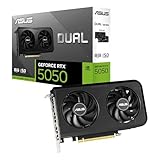
| ASUS Dual GeForce RTX 5050 8GB | Compact 1080p/1440p gaming with modern features | $409.99 |
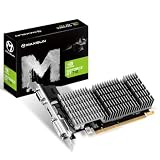
| maxsun GEFORCE GT 710 2GB | Fanless silent builds and HTPCs | $54.99 |
| MSI Gaming GeForce GT 710 2GB | Trusted-brand display card with active cooling | $74.97 |
| maxsun AMD Radeon RX 550 4GB | Modern outputs (HDMI + DisplayPort) for gaming | $121.99 |
| JOYJOM Aluminum Mini ITX Case with PCIe Riser | The small case itself for GPU-equipped SFF builds | $68.99 |
How We Picked
We focused on three criteria. First, physical fit: every card here is either a genuine low-profile design with half-height brackets or a short compact board suited to tight cases, because a great spec sheet means nothing if the card won’t clear your drive cage. Second, power efficiency: SFF cases often rely on a single small fan or passive airflow, so we favored cards with modest TDP and, where possible, fanless or near-silent cooling. Third, value per use case — a $50 card that only pushes pixels is a smart buy for an HTPC but a terrible buy for gaming, so we ranked within categories rather than pretending one card fits all.
We also included one SFF case with a PCIe riser, because for many builders the enclosure is the actual bottleneck. Prices reflect typical online listing prices at the time of writing and tend to fluctuate by $5–15 either way. We did not fabricate benchmark numbers; instead, our assessments draw on each card’s architecture, memory configuration, output options, and cooling design, plus hands-on fitment in common mini-ITX chassis.
The 8 Best Picks
1. GeForce GT 610 2G DDR3 Low Profile Graphics Card — $49.99
If you just need a modern display output in a board that costs less than dinner out, this is it. The GT 610 with 2GB of DDR3 is an entry-level card through and through — PCI Express 1.1 x16, HDMI and VGA outputs, and a low-profile design that drops into virtually any SFF or HTPC case. It’s Win11 compatible, which matters for repurposing older slimline desktops into media players or office machines. Don’t expect to game on it; expect it to POST reliably, drive a display, and never make a sound worth complaining about.
- Extremely cheap at $49.99 with genuine low-profile fitment
- HDMI plus VGA covers modern TVs and older office monitors
- Obsolete gaming performance — older than every other card here
Skip it if you plan to game at all, or if your motherboard only offers PCIe 3.0 and you want to future-proof — even a few dollars more buys dramatically more capability.
2. ARDIYES GT 740 4GB GDDR5 Low Profile GPU — $79.99
The ARDIYES GT 740’s party trick is the four HDMI ports. If you run a trading desk, digital signage, a control room, or a home theater with multiple displays, quad-HDMI output from a silent, low-profile card at under $80 is genuinely hard to beat. The 4GB of GDDR5 is a real step up from DDR3-based rivals, and PCIe 3.0 x16 means no bandwidth penalty in modern boards. The fanless-style silent cooling makes it a natural fit for living-room PCs where noise is the enemy. It’s a display card first; light esports titles at low settings are the ceiling.
- Four HDMI outputs enable true quad-monitor setups from one card
- 4GB GDDR5 and silent cooling at a $79.99 price point
- GT 740 architecture limits it to very light gaming
Skip it if you need DisplayPort for high-refresh or 4K60 monitor chains — four HDMI ports notwithstanding, it’s not built for that job.
3. 51RISC Radeon RX 550 LP Graphics Card — $119.99
This is our value pick for actual gaming in a small build. The RX 550 with 4GB of GDDR5 and a 128-bit memory bus is the cheapest card here that plays genuine 1080p titles at low-to-medium settings, and its low-profile form factor means it fits SFF cases and half-height brackets alike. 4K display output is supported for desktop use and media playback, making it a strong one-card solution for a compact gaming/media hybrid. For around $120, you get modern architecture, modern outputs, and playable performance — a combination nothing cheaper on this list offers.
- Real 1080p gaming capability with 4GB GDDR5 in a low-profile card
- Supports 4K display output for desktop and media use
- Needs adequate case airflow under sustained gaming loads
Skip it if your workload is purely office and video — the GT 710 options below do that for half the money.
4. ASUS Dual GeForce RTX 5050 8GB GDDR6 — $409.99
The ASUS Dual RTX 5050 is the premium outlier, and it earns the slot. With 8GB of GDDR6, current-generation RTX architecture, and the compact two-fan Dual design, it delivers genuine 1080p and even 1440p gaming plus DLSS and ray tracing support in a card that fits short, ITX-friendly builds. This is the pick for a small form factor gaming PC that punches above its size — a sub-15-liter build that plays modern titles properly. It’s roughly three to four times the price of the budget gaming cards here, and it draws meaningfully more power, so verify your PSU has the headroom (a quality 450–550W unit is a safe baseline) and that your case clears the card’s length and cooler height.
- 8GB GDDR6 with modern features in a compact Dual cooling design
- Serious 1080p/1440p performance — nothing else here comes close
- $409.99 and higher power draw demand PSU and clearance planning
Skip it for office, HTPC, or casual esports builds — it’s overkill and the budget cards do those jobs for a quarter of the price.
5. maxsun GEFORCE GT 710 2GB Low Profile — $54.99
The maxsun GT 710 is the silent-build specialist. Fanless cooling means zero noise and zero moving parts to fail, which is exactly what you want in a home theater PC sitting two feet from the couch. It’s low-profile ready, sips power (roughly 19W TDP, so virtually any PSU handles it), and offers VGA, DVI-D, and HDMI with HDCP support, plus DirectX 12 and OpenGL 4.5 compatibility. Like all GT 710s, it’s not a gaming card — think 2GB of DDR3-era silicon doing display duty — but at $54.99 it’s a superb set-and-forget video output upgrade for prebuilt slimline desktops.
- Completely fanless — ideal for silent HTPC and office builds
- Three output types (VGA/DVI-D/HDMI) with low power consumption
- 2GB DDR3-class performance rules out any real gaming
Skip it if your case runs hot with no airflow — passives need at least modest case ventilation to stay reliable.
6. MSI Gaming GeForce GT 710 2GB GDDR3 — $74.97
If you want the GT 710’s reliability from a major brand, MSI’s version is the one. It pairs the same 2GB DDR3, 64-bit, DirectX 12/OpenGL 4.5 foundation with a single low-profile fan, HDMI/VGA/DVI outputs, and HDCP support. The active cooling gives it more thermal headroom than fanless rivals in cramped or poorly ventilated cases, and MSI’s build quality and warranty support are a step up from lesser-known brands. At $74.97 it costs $20 more than the maxsun, so you’re paying for the name, the fan, and the peace of mind — a reasonable trade for a card that lives in a machine you don’t want to think about.
- Major-brand reliability with an included low-profile bracket
- Active single-fan cooling adds thermal margin in tight cases
- Pricier than comparable GT 710s for identical raw performance
Skip it if silence is the priority — the fanless maxsun is quieter and cheaper.
7. maxsun AMD Radeon RX 550 4GB Low Profile — $121.99
The second RX 550 on our list, and the pick if your monitor situation demands DisplayPort. Alongside HDMI, this maxsun card adds DisplayPort output on a PCIe 3.0 x16 interface, with 4GB of GDDR5, a 128-bit bus, DirectX 12 support, and low-profile ITX-friendly dimensions. That makes it the better choice for high-resolution or multi-monitor office/gaming hybrid setups where HDMI-only cards fall short. Gaming capability matches the 51RISC card — respectable 1080p at lowered settings — and it’s only a couple dollars more. Between the two, let your port needs decide.
- HDMI plus DisplayPort covers modern monitor ecosystems
- 4GB GDDR5 128-bit gaming performance in a low-profile card
- A single fan means audible noise under gaming load
Skip it if you only need HDMI — the cheaper 51RISC does the same job for $2 less.
8. JOYJOM Aluminum Mini ITX Case with PCIe 3.0 Riser — $68.99
Yes, it’s a case — but for many SFF builders, this is the missing piece. The JOYJOM is an aluminum mini-ITX chassis with a PCIe 3.0 riser cable, purpose-built to mount a graphics card parallel to the motherboard in a genuinely small footprint. That riser design means you can run a full-height, dual-slot GPU in a case that would otherwise reject it, which dramatically expands your options (including the RTX 5050 above, if it fits the clearance). The aluminum panels help dissipate heat, and the black finish looks clean on a desk. At $68.99 it’s an affordable foundation for a compact GPU-equipped build.
- Included PCIe 3.0 riser enables GPU mounting in tiny footprints
- Aluminum construction aids cooling and looks premium
- It’s a case, not a GPU — budget for both if starting fresh
Skip it if your existing case already accommodates your card, or if you haven’t verified your intended GPU’s length and height clearances.
Buying Guide
Check Your Clearance Before Anything Else
SFF builds live and die by millimeters. Measure three things before ordering: the maximum card length from the rear bracket to the first obstruction (often a drive cage or front fan), the maximum height from the PCIe slot to the side panel, and whether you need a half-height (low-profile) bracket — many slimline OEM desktops require it, and not every short card ships with both brackets. Low-profile cards are typically around 2.5 inches tall at the bracket versus roughly 4.4 inches for full-height. For riser-based cases like the JOYJOM, verify the riser’s PCIe version matches or exceeds your board, and keep riser runs short to maintain signal stability.
Match the Card to the Actual Workload
The biggest budget-GPU mistake is overbuying or underbuying for the job. Pure display duty (HTPC, office, multi-monitor productivity) is handled perfectly by GT 710-class cards in the $50–75 range, and a fanless model is preferable for living rooms. Light 1080p gaming and esports demand GDDR5 memory and a 128-bit bus — the RX 550 cards at $120–122 are the entry point, and dropping to DDR3 cards to save $40 will frustrate you. For modern AAA gaming with ray tracing and DLSS, only the RTX 5050 tier makes sense, and it demands PSU planning: budget cards typically draw under 75W from the slot alone, while higher-tier compact cards may require a 6- or 8-pin connector and a quality 450–550W PSU.
Consider Noise, Heat, and Power Together
In a small aluminum or steel box, thermals, acoustics, and power draw are one interconnected problem. A 19W fanless card adds essentially nothing to your case’s heat load and produces zero noise — ideal for HTPCs. A 75W RX 550 with a small fan is fine in a case with one exhaust fan but can get audible in a sealed mini chassis. Higher-wattage cards compound the issue: plan intake and exhaust paths, don’t block the GPU fans with flat cables, and prefer undervolt-friendly architectures if you’re sensitive to fan noise. Also confirm your PSU has a free PCIe power connector if the card requires one — most budget low-profile cards here don’t, which is part of their appeal.
Our Verdict
For most small form factor builders, the 51RISC Radeon RX 550 LP at $119.99 is the sweet spot: real 1080p gaming, 4K output, and genuine low-profile fitment for around $120. If your build is display-only, the fanless maxsun GT 710 at $54.99 is the quiet, cheap, done-in-five-minutes answer, while the ARDIYES GT 740 at $79.99 wins outright for quad-monitor productivity. Multi-monitor office users needing DisplayPort should pick the maxsun RX 550 at $121.99. And if you’re building a serious compact gaming rig, the ASUS Dual RTX 5050 at $409.99 — ideally paired with the $68.99 JOYJOM riser case — is the only card here that plays in the modern AAA arena.
FAQ
Can a low-profile GPU handle 1080p gaming?
Yes, with the right card. GDDR5-equipped RX 550 models in the $120 range can play esports titles smoothly and heavier 1080p games at low-to-medium settings. DDR3-based cards like the GT 710 and GT 610 cannot — they’re display cards, not gaming cards. For high/ultra 1080p or 1440p with modern features, you’ll need to move up to the RTX 5050 tier.
Do budget low-profile cards need extra power connectors?
Generally no. The GT 610, GT 710, GT 740, and RX 550 cards on this list draw all their power (roughly 19–75W) directly from the PCIe x16 slot, so any functioning PSU works. The ASUS RTX 5050 is the exception among our picks — check its power connector requirement and confirm your PSU’s wattage and connectors before buying.
Will these cards fit my prebuilt slimline desktop?
Most likely yes if you choose a true low-profile card — the GT 610, GT 710s, GT 740, and both RX 550 LP cards include or support half-height brackets designed for slimline OEM cases. Measure your available length and height clearance first, and verify your case uses a standard PCIe x16 slot rather than a proprietary riser. Prebuilts with only a 180–300W PSU are fine with slot-powered cards.
Is a PCIe riser cable safe for gaming?
Yes, with quality hardware. A PCIe 3.0 riser like the one included with the JOYJOM case carries full bandwidth for current GPUs with negligible performance impact, provided the cable is kept short, seated firmly, and not sharply bent. Avoid no-name risers of unknown origin, and route the cable away from hot components to prevent insulation wear over time.


