
The best ghillie suits for hunting and airsoft are lightweight, breathable 3D systems with enough local foliage attachment points to match your terrain—not necessarily the heaviest, fullest suit available.
A good suit must hide your outline without turning every movement into a noisy, exhausting struggle. The right choice depends on whether you hunt from a fixed position, move through woodland with an airsoft rifle, or need one setup that works across several seasons. Compare camouflage pattern, fabric weight, ventilation, sound, coverage, mobility, and how easily the suit can be customized before choosing.
As an Amazon Associate we earn from qualifying purchases at no extra cost to you.
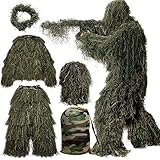


Our Top Picks


Top 3 picks at a glance
Quick comparison: which ghillie suit style fits your use?
| Situation | Best suit style | Useful target specification | Main compromise |
|---|---|---|---|
| Stationary woodland hunting | Full 3D leafy suit or heavy jute-style suit | 2.5–4.5 kg; hood, rifle cover, and leg coverage | Hotter and slower to move in |
| Mobile airsoft in woodland | Lightweight 3D oversuit | 0.9–1.8 kg; reinforced knees; ventilated jacket | Less dense concealment |
| Open grassland or farmland | Grassland or wheat-pattern 3D suit | Muted tan, straw, and olive tones; 1–2 kg | Performs poorly in dark forest |
| Wet, cool weather | Water-resistant oversuit over quiet base layers | Coated outer fabric; breathable vents; 1.5–3 kg | Coatings can increase heat and rustling |
| Mixed terrain and travel | Modular jacket-and-trouser system | Removable hood, mesh construction, attachment loops | Usually needs added local vegetation |
What makes the best ghillie suits effective?
Camouflage pattern and three-dimensional breakup
Colour matching is only the starting point. A flat green or brown fabric can still reveal the human shape, especially at the shoulders, head, elbows, and rifle barrel. Leaf-shaped strips, netting, burlap fibres, or synthetic vegetation interrupt those familiar edges.
Choose a pattern based on the dominant background at the distance where you expect to be seen:
- Temperate woodland: mixed olive, brown, grey, and subdued green is more versatile than bright leaf-green fabric.
- Conifer forest: darker green, charcoal, and brown usually work better than warm tan patterns.
- Dry grassland: straw, khaki, faded olive, and light brown reduce contrast against dead grass.
- Brush and scrub: a neutral base with removable local foliage is preferable to a highly specific printed pattern.
- Airsoft fields: woodland, flecktarn-inspired, and leaf-style patterns can work, but match the actual field rather than the name of the pattern.
Shiny synthetic strands are a warning sign. Even a good colour pattern can fail when smooth fibres reflect sunlight. Matte materials and irregular texture are more useful than excessive density.
Fabric weight versus mobility
Heavy jute and burlap suits create excellent visual texture and can be repaired or dyed, but they absorb water and add drag. Lightweight synthetic 3D suits are easier to wear for a full day and are usually the better choice for airsoft movement.
As a practical rule, every additional kilogram becomes noticeable when climbing, crouching, crawling, or carrying a rifle and hydration. A 1.2 kg oversuit may remain comfortable with a 6–8 kg loadout; a 3.5 kg suit can make the same load feel substantially more tiring, particularly in warm weather.
For hunting from a blind or static hide, extra weight matters less than coverage and texture. For a mobile player, prioritize a suit that leaves the knees, elbows, shoulders, and rifle controls usable.
Breathability and heat management
Mesh-backed jackets, ventilated hoods, and separated 3D panels allow more airflow than solid synthetic fabric. Look for underarm openings, side vents, and a hood that can be worn over a cap without sealing around the face.
A ghillie suit is an outer camouflage layer, not a replacement for a moisture-wicking base layer. In warm conditions, wear a lightweight synthetic or merino base layer beneath it and avoid cotton, which stays wet after sweating. In cold weather, leave enough space for insulation without compressing the suit against your body.
Dark, dense material can become uncomfortably hot in direct sun. If the suit will be used in summer, a lighter mesh platform with attachable vegetation is normally more adaptable than a fully packed design.
Noise is as important as visual concealment
Some suits look convincing but announce movement through stiff plastic leaves, crinkly coatings, or dry fibres rubbing together. Noise is especially important for hunting and for close-range airsoft play where players move slowly through vegetation.
Before using a new suit outdoors, perform a simple noise check:
- Put on the complete suit with your normal clothing and equipment.
- Have another person stand 10–15 metres away with their eyes closed.
- Walk, crouch, kneel, shoulder your rifle, and crawl several metres.
- Identify which movement produces the loudest sound.
- Trim loose strands, cover hard contact points, or replace noisy panels.
Do not rely on washing to remove all noise. Some waterproof coatings and plastic foliage remain loud even after breaking in.
Coverage and mobility: the details that decide whether you keep wearing it
A full suit should cover the torso, arms, legs, neck, and head, but “full coverage” does not mean every part should be equally dense. Dense material around the shoulders can snag on branches and interfere with a sling. Excess material around the knees can catch when kneeling. A hood that hangs over the eyes can obscure safe movement and target identification.
- Hood: choose an adjustable hood that fits over head protection or a cap without blocking peripheral vision.
- Hands: separate camouflage gloves are often better than permanently attached sleeves because they preserve trigger and magazine access.
- Rifle coverage: use a removable rifle wrap or sleeve that does not obstruct the muzzle, optic, bolt, safety, or magazine.
- Knees: reinforced panels or room for low-profile kneepads are valuable for both hunting and airsoft.
- Fastening: zippers can be quick but noisy; quiet toggles and hook-and-loop closures are easier to repair in the field.
- Attachment points: elastic loops and netting let you add local grass, leaves, and branches without permanently altering the suit.
Never attach foliage so densely that it blocks vision, catches on the trigger area, covers safety equipment, or creates a muzzle hazard. For airsoft, follow the field’s rules on muzzle visibility and player identification.
Best options by suit type
Lightweight 3D leafy oversuit
This is the strongest all-round choice for most airsoft players and mobile hunters. It usually consists of a jacket, trousers, and hood made from mesh or lightweight fabric with sewn-on leaf panels. It offers good three-dimensional breakup while keeping weight near the 1–2 kg range.
Choose one with reinforced stress points, spacious arm openings, and a cut that accommodates a chest rig or hunting pack. It is especially suitable for woodland, scrub, and mixed terrain where you can add a few local pieces of vegetation.
Traditional jute or burlap ghillie suit
Traditional suits offer dense texture and excellent customization. Jute can be dyed, trimmed, and rearranged to match a specific hide. They are most useful when you spend long periods in one area and can build the suit around the exact background.
The drawbacks are substantial: jute holds water, dries slowly, can snag easily, and is often heavier than a synthetic 3D oversuit. It also requires more maintenance after use in wet vegetation.
Modular 3D camouflage system
A modular system with a jacket, trousers, hood, rifle cover, and removable foliage panels is the most flexible option for changing conditions. It lets you remove excess material in hot weather or add texture when moving into a denser background.
Modularity is worth paying for when one suit must cover spring woodland, summer scrub, and autumn grassland. Check that the panels are actually replaceable rather than merely decorative.
Camouflage poncho or concealment cape
A poncho is useful for static hunting, observation, photography, and quick concealment over normal clothing. It packs smaller than a full suit and is cooler in warm weather. However, it leaves the legs and often the arms exposed, so it is less suitable for crawling or active airsoft.
Customization: make a good suit fit the terrain
Start with a neutral base colour, then add material from the immediate environment. Attach only what is common within a few metres of your position; a suit covered in bright green leaves looks artificial in a field of dry grass.
Use thin elastic loops or mesh pockets rather than permanently sewing fresh vegetation into the fabric. Replace wilted foliage regularly, and remove it before storing the suit to prevent mould. Keep the lower body slightly less bulky than the torso so it remains possible to walk, kneel, and crawl.
A useful approach is a three-layer camouflage plan:
- Base: a matte colour that broadly matches the terrain.
- Structure: sewn or printed 3D panels that break up the body outline.
- Local detail: removable grass, leaves, or small branches for the exact position and season.
Buying checklist
- Measure the suit over your normal clothing and protective equipment.
- Confirm the packed size if you must carry it to a hunting position or airsoft field.
- Check total weight, not just the jacket weight.
- Inspect stitching at cuffs, crotch, shoulders, and attachment loops.
- Look for matte fibres and avoid loud plastic foliage.
- Confirm whether the hood, rifle cover, gloves, and storage bag are included.
- Choose washable or easily cleanable materials if you regularly use wet ground.
- Test access to magazines, binoculars, rangefinders, and pockets before modifying the suit.
The best ghillie suits balance concealment with the movement you actually need. For most mobile users, a breathable 3D oversuit weighing roughly 1–2 kg is the safest starting point; static hunters can justify a heavier, denser jute or modular system. Match the base pattern to the dominant terrain, reduce noise before the first outing, and use removable local vegetation to finish the camouflage rather than buying the heaviest suit possible.
Frequently asked questions
Can I wear a ghillie suit over a chest rig or hunting pack?
Yes, a lightweight 3D leafy oversuit can accommodate a chest rig or hunting pack when it has spacious arm openings and a suitable cut. Check that the added equipment does not compress the camouflage, restrict movement, or create snag points. The suit should still allow access to rifle controls, magazines, safety equipment, and any hydration you carry.
Should I wear a ghillie suit directly against my skin?
No, a ghillie suit should be used as an outer camouflage layer over a moisture-wicking base layer. Lightweight synthetic or merino fabric is preferable in warm conditions, while cold-weather users should leave room for insulation. Avoid cotton because it stays wet after sweating. The outer suit should not be treated as a substitute for normal clothing layers.
How should I prepare a new ghillie suit before using it outdoors?
Perform a noise check before using it outdoors. Wear the complete suit with your normal clothing and equipment while another person stands 10–15 metres away with their eyes closed. Walk, crouch, kneel, shoulder your rifle, and crawl several metres. Then identify loud panels or loose strands, trim them, cover hard contact points, or replace noisy sections.
Can I add natural vegetation to a synthetic ghillie suit?
Yes, elastic loops and netting allow you to add local grass, leaves, and branches to many synthetic suits. Add only enough material to match the immediate terrain, since excessive foliage can block vision, catch on the trigger area, cover safety equipment, or create a muzzle hazard. A neutral base with removable local foliage is particularly useful in brush and scrub.
What should I look for if I need a ghillie suit for several seasons?
Choose a modular jacket-and-trouser system with a removable hood, mesh construction, attachment loops, and replaceable foliage panels. This lets you remove excess material in hot weather and add texture for denser backgrounds. A modular setup can adapt across spring woodland, summer scrub, and autumn grassland, although it usually requires adding local vegetation to match each setting.


