
The best lithium RV batteries for reliable off-grid power in 2026 are 12V 100Ah LiFePO4 models with a built-in 100A BMS for most weekend and week-long campers, while full-time off-grid setups benefit more from 270Ah+ GC3-size batteries or 48V server-rack style systems for higher usable capacity and lower wiring losses.
As an Amazon Associate we earn from qualifying purchases at no extra cost to you.


Our Top Picks
 ECO-WORTHY EnergyRock 12V 280Ah Metal Case LiFePO4 Lithium12.8V 280AH8.64 x 16.54 x 9.65 inchesCheck on Amazon
 ECO-WORTHY 12V 314AH LiFePO4 Lithium Battery Bluetooth with12.8V 314Ah16.3 x 8.5 x 10.2 Inches60.4 poundsCheck on Amazon
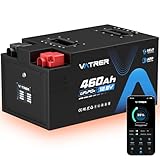
 VATRER POWER 12.8V 460Ah Self-Heating LiFePO4 RV Battery12V 460Ah heating18.78 x 10.75 x 9.92 inches104.7 PoundsCheck on Amazon
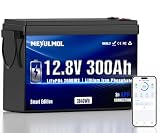
 MEYULMOL 12.8V 300Ah LiFePO4 Lithium Battery1PC 12.8V300Ah 15.13×7.64×9.8515.16 x 7.8 x 9.92 inches59.5 PoundsCheck on Amazon
Top 3 picks at a glance
How to Choose the Right Lithium RV Battery: 7 Decision Criteria
Lithium iron phosphate (LiFePO4) has replaced lead-acid as the default for RV house batteries because it delivers more usable energy, charges faster, and lasts 3-5x longer. Unlike lead-acid where you should only use 50% of rated capacity, LiFePO4 lets you use 90-100% without damage, weighs about half as much, and holds voltage steady until almost empty. The right choice comes down to matching these seven factors to how you camp.
1. Usable Capacity vs. Rated Capacity
Rated amp-hours are misleading. A 100Ah lead-acid battery gives you only 50Ah usable. A 100Ah LiFePO4 battery gives you 90-100Ah usable and maintains 12.8-13.2V for most of its discharge curve, so your inverter and 12V appliances run efficiently to the end.
For sizing, build a power budget first. Add up watt-hours (Wh) you need per day, then convert to amp-hours at 12.8V, then add a 20% buffer for inverter losses and future needs.
2. Voltage: 12V, 24V, or 48V
12V is the standard for RVs and is directly compatible with existing 12V lights, water pumps, fans, and slide motors. Stay with 12V if you are replacing one or two lead-acid batteries and have a 12V inverter.
24V or 48V makes sense only for large off-grid builds with a 3000W+ inverter, residential fridge, and heavy solar. Higher voltage reduces current, so you can use thinner wire and lose less energy as heat. You will need a DC-DC converter to feed your 12V systems if you go this route.
3. Battery Management System (BMS)
The BMS is the brain that keeps lithium safe. Never buy a lithium RV battery without an integrated BMS. Look for these protections:
- Continuous discharge rating of 100A for a 100Ah battery (lets you run a 1000-1200W inverter), 200A for 200Ah+ models
- Over-charge, over-discharge, short-circuit, and over-temperature cutoffs
- Cell balancing to keep all cells at the same voltage for longevity
- Bluetooth monitoring or CAN/RS485 communication on premium models for state-of-charge, voltage, and temperature visibility
- Low-temperature charge cutoff as a minimum, ideally self-heating
4. Charging Compatibility
LiFePO4 requires a 14.2-14.6V absorption voltage. Most modern converters and solar controllers have a lithium profile, but older single-stage converters made for lead-acid will only charge to 13.6V and leave you at 70-80% capacity. Check three charge sources:
- Converter/charger: Needs a LiFePO4 or user-custom profile. Brands like Progressive Dynamics and WFCO now offer lithium switch models.
- Solar charge controller: MPPT is preferred. Set absorption to 14.4V and float to 13.6V if you can customize, or select LiFePO4 preset.
- Alternator charging: Requires a DC-DC charger (e.g., 30A or 60A) to regulate current and prevent alternator overheating. Do not connect lithium directly to the alternator without one.
5. Cold-Weather Protection
You can discharge LiFePO4 down to -20C, but you should never charge below 0C (32F) or you will cause permanent lithium plating. If you camp or store your RV where temperatures drop below freezing, you need either:
- Low-temp charge cutoff: BMS blocks charging when cells are below 0C. This protects the battery but leaves you without charging until it warms.
- Self-heating function: The battery uses incoming charge current to warm itself to ~5C before accepting charge. This is essential for four-season, truck camper, or underbelly installations without heated basements.
6. Weight and Installation Space
A 100Ah LiFePO4 weighs 24-31 lbs versus 63-70 lbs for a 100Ah lead-acid. That weight saving matters for tongue weight and cargo capacity. Measure your battery compartment carefully. Group 24 and Group 27 are the most common replacements. GC3 (270Ah) and 300Ah models are taller and longer but replace two to three Group 27s in one case, simplifying wiring and saving floor space. All LiFePO4 can be mounted on their side except where the manufacturer prohibits it, but upright is best for heat dissipation.
Worked Example: Sizing Your Battery Bank for Off-Grid Camping
This calculation shows how usable capacity translates to real runtime. Adjust the numbers to your own appliances.
Scenario: A couple camping off-grid for 2 days without hookups wants to run a 12V compressor fridge, lights, water pump, Starlink/router, and a laptop.
| Appliance | Power Draw | Hours Per Day | Daily Energy (Wh) |
|---|---|---|---|
| 12V Compressor Fridge (40W avg.) | 40W | 24 (33% duty cycle ~ 8h run) | 320 |
| LED Lights + Water Pump + Fans | 30W avg. | 5 | 150 |
| Starlink + Router | 45W | 8 | 360 |
| Laptop Charging via Inverter (65W) | 65W | 3 | 195 |
| Inverter Idle Loss (15W) | 15W | 10 | 150 |
| Total Daily Need | 1,175 Wh |
Convert to amp-hours at 12.8V: 1,175 Wh / 12.8V = 91.8Ah per day. For two days without recharging, you need 183.6Ah usable.
A single 100Ah LiFePO4 (90Ah usable) = 0.98 days of runtime. Two 100Ah LiFePO4 in parallel (180Ah usable) = 1.96 days. For a buffer and to account for cloudy solar days, a 200Ah bank (usually two 100Ah or one 200Ah) or a single 270Ah GC3 is the right fit here. With 400W of solar producing roughly 1200-1600Wh on a good sun day, that same 200Ah bank can be recharged daily for indefinite off-grid stays.
Comparison Table: Common Lithium RV Battery Classes in 2026
Use this to map real product classes to your needs. Specs are typical for each category; always check the specific data sheet.
| Battery Class | Rated / Usable Capacity | Weight | Continuous BMS Discharge | Cold-Weather Feature | Best For |
|---|---|---|---|---|---|
| 12V 100Ah Group 24 (e.g., Battle Born BB10012, Renogy RNG-BATT-LFP-12-100, LiTime 12V 100Ah) | 100Ah / 90-95Ah | 26-31 lbs | 100A | Low-temp cutoff; heated versions available | Drop-in replacement for 1 lead-acid; weekenders, Class B/C |
| 12V 100Ah Self-Heating (e.g., Battle Born Heated BB10012, Epoch 12V 105Ah Heated) | 105Ah / 95Ah | 29-33 lbs | 100A | Self-heating to 5C before charging | Four-season camping, exterior compartments |
| 12V 200-206Ah (e.g., SOK 206Ah, Epoch 300Ah is similar class) | 206Ah / 185Ah | 48-60 lbs | 100-200A | Varies by model | Replaces two batteries; dry camping 3-4 days |
| 12V 270Ah GC3 (e.g., Battle Born GC3, Epoch 300Ah GC2 size) | 270Ah / 243Ah | 78-84 lbs | 200-300A | Heated + Bluetooth standard | Large Class A, fifth wheel, full-time off-grid, 3000W inverter |
| 48V 100Ah Server Rack | 5120Wh / 4600Wh usable | 85-100 lbs | 100A at 51.2V (5120W) | Heated optional, CAN comms | High-capacity builds with 48V inverter, residential fridge, heavy solar |
Decision Matrix: Which Battery Fits Your RV Setup
| Your Situation | Recommended Choice | Why |
|---|---|---|
| Replacing single Group 24/27, occasional boondocking, budget priority, mild climate | 12V 100Ah standard LiFePO4 | Lowest cost (usually $300-$500 range), lightest, direct fit, adequate for 1-2 days |
| Winter camping, ski trips, battery in unheated compartment | 12V 100Ah self-heating with low-temp cutoff | Prevents charge damage below freezing, avoids being stranded without charge (usually $400-$650 range) |
| Running 2000W inverter, microwave, or induction cooktop | 2x 100Ah in parallel or single 200Ah+ with 200A BMS | A 100A BMS will trip at ~1200W; you need 200A continuous for 2000W+ loads |
| Full-time off-grid, residential fridge, wants minimal wiring | Single 270Ah GC3 or 300Ah class | One BMS, one case, fewer connections, higher surge for large inverters (usually $900-$1,500 range) |
| Building new system with 2000W+ solar and 3000W+ inverter | 48V system with DC-DC converter for 12V loads | halves current, thinner cables, higher efficiency for large loads |
Installation and Charging Settings That Extend Life
To get 3000-5000 cycles from LiFePO4 instead of 300-500 from lead-acid, apply these settings:
- Set absorption/bulk to 14.2V-14.4V and float to 13.5V-13.6V. Holding at 14.6V constantly is not needed and adds stress.
- Set low-voltage disconnect at 11.5V-12.0V on your inverter to let the BMS handle final cutoff cleanly.
- Use Class T or ANL fusing within 7 inches of the positive terminal. Lithium can deliver huge short-circuit current.
- Do not mix lithium and lead-acid in the same bank. Their charge voltages conflict.
- Torque terminals to manufacturer spec (usually 80-100 in-lbs for M8) and use dielectric grease to prevent corrosion.
- If storing for months, leave at 50-70% state of charge and disconnect parasitic loads. Self-discharge is only 2-3% per month.
What to Expect for Lifespan and Cost
A quality LiFePO4 RV battery is usually $300-$600 for a standard 100Ah, $500-$800 for a heated/Bluetooth 100Ah, and $900-$1,600 for a 270-300Ah GC3 size. Though upfront cost is higher than lead-acid, cost per usable cycle is far lower. A 100Ah lead-acid costing $120 that lasts 300 cycles at 50Ah usable costs about $0 per kWh cycled, while a $400 LiFePO4 lasting 3000 cycles at 90Ah usable costs about $0 per kWh. Warranties of 8-11 years are common from established brands like Battle Born, Renogy, and SOK in 2026, which reflects expected calendar life of 10 years when kept below 95% average state of charge and below 35C.
FAQ
Can I drop a lithium battery into my RV without changing anything else?
Sometimes. If your converter has a lithium switch and you do not charge from the alternator, a drop-in works. If your converter is older than about 2018 and has only a fixed 13.6V output, you will not fully charge lithium and may need a new converter. You always need a DC-DC charger for alternator charging.
How many lithium batteries do I need to replace two 6V golf cart batteries?
Two 6V 225Ah golf cart batteries in series give you 12V 225Ah rated but only ~112Ah usable. A single 12V 100Ah lithium gives you ~90Ah usable, so one is close but two 100Ah lithiums give you more usable power than the pair of golf carts with half the weight and no maintenance.
Will a lithium battery work with my existing battery monitor?
Voltage-only monitors will not work well because LiFePO4 voltage stays flat from 30% to 80%. You need a shunt-based battery monitor that counts amp-hours, or use the Bluetooth BMS app, to get an accurate state of charge.


