
The best multi position ladders for most home projects are 17 to 22-foot convertible models with Type IA (300 lb) ratings, triple-locking hinges, and a folded length under 5.5 feet, because they cover stepladder, extension, and stairwell configurations without requiring a separate ladder for second-story eaves.
As an Amazon Associate we earn from qualifying purchases at no extra cost to you.
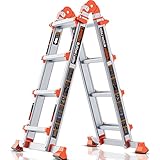
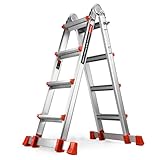


Our Top Picks
 LANBITOU Ladder A Frame Extension Multi Position Telescoping14FT29 x 4.99 x 47 inchesCheck on Amazon
 Wolec 17FT Multi-Position Telescoping Ladder17 FT7.87 x 4.99 x 61.22 Inches31.46 PoundsCheck on Amazon
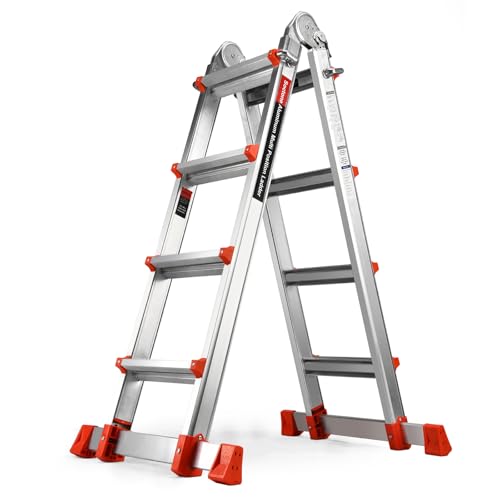
Top 3 picks at a glance
How Multi-Position Ladders Work and When You Need One
A multi-position ladder combines stepladder, extension, stairwell, and scaffold configurations in one frame using articulating hinges and telescoping side rails. Unlike a single fixed stepladder or a straight extension ladder, one unit can stand as a 4 to 7-foot A-frame for interior painting, extend to 15 to 22 feet for gutter cleaning, and offset its legs to work safely on stairs.
They make sense if you have limited storage and handle varied tasks like changing light fixtures, painting stairwells, trimming trees, and accessing a roof edge. If you only need a kitchen stepladder or you regularly work above 20 feet, a dedicated stepladder or a full-size fiberglass extension ladder will be more stable and lighter for that one job.
Selection Criteria That Matter for Home Use
1. Height Range and True Reach
Listed height is not working height. Manufacturers list the total extended length, but OSHA and ANSI prohibit standing on the top three rungs of an extension ladder or the top cap of a stepladder. Your safe standing height is about 3 to 4 feet below the top.
To estimate usable reach, add your height plus an arm reach of about 2 feet to the highest safe standing rung:
Worked calculation: A 22-foot multi-position ladder in extension mode has a maximum standing height of approximately 18 feet (22 ft – 4 ft safety margin). For a 5 ft 9 in person, safe reach = 18 ft + 5.75 ft + 2 ft arm extension = ~25.75 feet. In A-frame mode the same ladder gives a 9-foot A-frame height, with a standing height of ~6 feet and a reach of ~13.75 feet. If your gutters are at 18 to 20 feet, you need at least a 17-foot convertible model; a 13-foot model will only safely reach 16 to 17 feet.
2. Configurations You Will Actually Use
- A-Frame / Stepladder: Essential for all models. Look for dual-sided rungs so both sides are climbable.
- Extension: Requires interlocking side rails. Check if it requires two people to extend past 15 feet.
- Stairwell / 90-Degree: One side telescopes shorter than the other. Critical if you have an entryway staircase or sloped ground.
- Scaffold: Requires a separate plank (usually sold separately). Hinges lock at 180 degrees to create a straight scaffold base. Useful for drywall or long hallway painting, but adds weight and setup time.
Most homeowners use A-frame 70% of the time and extension 25% of the time. Do not pay extra for a dedicated scaffold plank unless you do large ceiling projects.
3. Weight Rating: Type I vs IA vs IAA
- Type I – 250 lb: Adequate for users under 200 lb carrying light tools. Usually aluminum and lighter.
- Type IA – 300 lb: The sweet spot for home projects. Accounts for user + paint bucket + tools. Most 17 to 22-foot aluminum convertibles fall here.
- Type IAA – 375 lb: Heavier duty, often fiberglass. Needed if you are over 250 lb or carry heavy materials like shingles.
Weight rating includes you plus everything you carry. A 210 lb person with a 25 lb tool belt and 10 lb paint can needs at least a 250 lb ladder, but a 300 lb rating provides a meaningful safety margin and less flex.
4. Hinge and Lock Design
Hinges determine both safety and setup frustration. Avoid single-pin hinges on tall models.
- Push-pin / Spring-loaded J-locks: Found on budget steel models. Simple but require good alignment and can be stiff with gloves.
- Triple-locking hinges with rock locks: Used on Little Giant Velocity and Werner MT series. Three contact points and a visible lock indicator. More secure against twist when in extension mode.
- Palm-button hinges: Used on Gorilla Ladders MPX series. One-handed operation is faster for switching between A-frame heights, but check that buttons fully recess when locked.
Any hinge should audibly click and show a locked indicator. If you have to force a rail to telescope, clean the locks and check for bent tabs.
5. Folded Size, Weight, and Storage
Aluminum multi-position ladders are heavy for their size. A 22-foot aluminum model usually weighs 42 to 47 lb and folds to about 5 ft 6 in long x 24 in wide x 9 in deep. A 13-foot model weighs 29 to 34 lb and folds to about 3 ft 8 in. If you must carry it through a house or store it in an apartment closet, the 17-foot class is often the limit for one person to maneuver comfortably.
Fiberglass models with the same ratings add 8 to 12 lb but are required if you work near electrical lines or service panels. For purely indoor use, aluminum is preferable.
Comparison Table: Common Spec Classes in 2026
| Spec Class / Example Model | A-Frame Height | Extension Length | Weight Rating | Approx. Weight | Folded Dimensions (L x W x D) | Key Feature |
|---|---|---|---|---|---|---|
| 13-Foot Compact (e.g., Werner MT-13, Little Giant Velocity 13) | 3 – 5 ft | 11 – 13 ft | 300 lb (Type IA) | 30 – 34 lb | 3’8″ x 21″ x 8″ | Lightest, fits in sedan, max safe reach ~16 ft |
| 17-Foot Mid-Size (e.g., Little Giant Velocity 17, Gorilla Ladders MPX17) | 4 – 7 ft | 15 – 17 ft | 300 lb (Type IA) | 36 – 41 lb | 4’6″ x 24″ x 9″ | Best balance for single-story homes |
| 22-Foot Full-Size (e.g., Little Giant Velocity 22, Werner MT-22) | 5 – 9 ft | 19 – 22 ft | 300 lb (Type IA) | 42 – 47 lb | 5’6″ x 24″ x 9″ | Reaches second-story eaves, heaviest |
| 22-Foot Fiberglass (e.g., Little Giant Dark Horse 2.0 17/22) | 5 – 9 ft | 19 – 22 ft | 300 lb (Type IA) non-conductive rails | 50 – 58 lb | 5’6″ x 28″ x 10″ | Electrical safety, heavier and wider |
Decision Matrix: Match Your Home to the Right Ladder
| Your Situation | Recommended Class | Why |
|---|---|---|
| Apartment / condo, 8-9 ft ceilings, light bulb and closet access only | 13-foot Type IA aluminum | Stores in closet, light enough to carry upstairs, no need for extension beyond 13 ft |
| Single-story ranch, gutters at 10-12 ft, interior painting | 17-foot Type IA aluminum | 7 ft A-frame covers interiors, 17 ft extension safely reaches gutters with margin |
| Two-story colonial or split-level, gutters at 18-22 ft, stairwell work | 22-foot Type IA aluminum | Only class that gives 18 ft standing height for second-story eaves and stairwell offset |
| Any work within 10 ft of power lines, meter, or service drop | 17 or 22-foot fiberglass Type IA / IAA | Non-conductive rails required; aluminum should not be used near electricity |
| Must be lifted by one person over 60 or with limited strength | 13 or 17-foot aluminum, or consider two separate ladders | 22-foot models exceed comfortable one-person carry weight for many users |
Stability and Safety Tips Specific to Multi-Position Ladders
- On hard floors, fully engage the rubber feet and lock spreader braces. On soft ground, use the integrated spike feet if equipped, and do not exceed a 4:1 extension angle (1 foot out for every 4 feet up).
- Do not use the top cap or the top 3 rungs in extension mode. If your eyes are above the gutter line, you are too high.
- After any hinge adjustment, tug-test each side rail. A properly locked hinge does not wiggle or show a red unlocked indicator.
- For stairwell mode, always place the shorter side downhill and have the hinge locks on the lower side double-checked. The ladder should not rock when you put weight on the first rung.
- Store folded vertically against a wall with the hinges locked, not leaning horizontally where rails can bow. Keep locks clean and lightly lubricated with dry silicone, not oil that attracts grit.
What to Expect to Pay
In 2026, aluminum multi-position ladders in this category usually fall into general market ranges of $180 to $280 for 13-foot models, $220 to $350 for 17-foot models, and $280 to $450 for 22-foot aluminum models. Fiberglass versions of the same heights typically run $100 to $200 higher due to material and weight rating. Accessories like a platform plank, wall standoff, or leg levelers are usually sold separately for $30 to $90 each.
FAQ
Can a multi-position ladder replace both my stepladder and extension ladder?
Yes for most homes under two stories, but with trade-offs. It will be heavier than a dedicated 6-foot stepladder and less rigid than a single-piece 24-foot extension ladder at full height. If you only do one type of work, a single-purpose ladder is lighter and faster to set up.
What height do I need to clean second-story gutters?
Measure from ground to gutter, then add 4 feet. For gutters at 20 feet, you need a ladder rated to extend to at least 24 feet if it is a straight extension ladder, or a 22-foot multi-position model which gives an 18-foot standing height and about 25 feet of reach. A 17-foot model will be too short.
Are aluminum multi-position ladders safe on stairs?
Only if the model explicitly lists a stairwell configuration and has independently telescoping sides with locking tabs. Set the shorter side on the higher step, ensure all four feet are flat and all locks are engaged, and maintain three points of contact. If the ladder rocks at the base, it is not level and should not be climbed.


