
The best wide-angle lens for landscape photography on this list is the Canon 17-40mm f/4L EF. It is the only true ultra-wide zoom here: a 17–40mm full-frame range, a constant f/4 aperture, L-series build quality, and a standard 77mm front thread that accepts the screw-in neutral-density and polarizing filters landscape work depends on. It suits full-frame DSLR owners and mirrorless shooters who already adapt EF-mount glass.
Everyone else should choose by platform rather than by focal length. Phone shooters get the cleanest results from the Moment 18mm or the all-in-one Xenvo Pro Lens Kit. Osmo Pocket 3 and Pocket 4 users should look at the NEEWER 0.75x for a genuinely wider field of view and the K&F CONCEPT kit for light control. APS-C mirrorless shooters who want the dramatic 180° look have the TTArtisan 7.5mm f/2.0 for Canon RF and the Brightin Star 7.5mm f/2.8 III for Nikon Z. The screw-on adapters — Lightdow, Acuvar and the two Altura Photo lenses — are the low-cost route for DSLR kit zooms.
Our Top Picks
Top 3 picks at a glance
Quick Comparison
| Product | Best for | Key specs | Price tier |
|---|---|---|---|
| K&F CONCEPT Wide-Angle Lens Filter Kit for DJI Osmo Pocket 4P | Gimbal-camera shooters who need long exposures and glare control | Multi-piece filter kit sized to the Osmo Pocket 4P lens; neutral-density and polarizing duties; magnetic or clip mounting; no focal-length change | Budget |
| Lightdow 52mm 0.43x Wide Angle + Macro Attachment | Nikon D-series owners with a 52mm-thread kit lens | 0.43x screw-on converter; detachable macro portion; 52mm thread; manual focus only | Mid-range |
| Acuvar 0.43x Wide Angle Lens with Macro Portion | Entry DSLR shooters spending as little as possible | 0.43x screw-on converter; macro portion; fits common small filter threads; manual focus only | Budget |
| Canon 17-40mm f/4L EF | Full-frame shooters who want one real ultra-wide zoom | 17–40mm; constant f/4; EF mount; L-series build; 77mm filter thread; ring USM autofocus | Premium |
| Altura Photo 58mm Wide Angle Lens with Macro | Canon Rebel T7 / T6 owners with the 58mm-thread kit zoom | Screw-on wide-angle converter with detachable macro element; 58mm thread; manual focus only | Mid-range |
| Brightin Star 7.5mm F2.8 III Fisheye | Nikon Z APS-C shooters who want a 180° fisheye | 7.5mm f/2.8; 180° angle of view; Nikon Z mount; manual focus; compact metal barrel | Premium |
| Freewell 16mm Wide Angle Lens for 17mm Mount Phone Case | Phone shooters who want the widest glass on a case system | 16mm-class wide conversion; 17mm case-mount thread; multi-element glass; metal housing | Premium |
| Xenvo Pro Lens Kit | Phone shooters who want wide, macro and light in one pouch | Clip-on wide-angle and macro elements; LED light; travel case; no case required | Mid-range |
| Moment Wide Angle Lens – 18mm | Phone shooters who want the cleanest glass and a case system | 18mm-equivalent wide conversion; case-mounted bayonet; multi-element glass; metal body | Budget |
| Altura Photo 55mm Wide Angle Lens with Macro | Nikon and Sony shooters with a 55mm-thread lens | Screw-on wide-angle converter with detachable macro element; 55mm thread; manual focus only | Mid-range |
| NEEWER 0.75x 10⁸° FOV Wide Angle Lens | Osmo Pocket 3 / Pocket 4 users who want a wider frame | 0.75x magnetic converter; 108° field of view; multi-coated glass; tool-free mounting | Budget |
| TTArtisan 7.5mm F2.0 Fisheye | Canon RF APS-C shooters who want a fast 180° fisheye | 7.5mm f/2.0; 180° angle of view; Canon RF mount; manual focus and manual aperture ring; APS-C image circle | Premium |
Read the table by column three: the “key specs” cell tells you whether a product changes your focal length or only changes the light reaching the sensor, and that single distinction eliminates half the list for most readers. Filter kits and polarizers do not make anything wider; converters and lenses do.
How We Chose
Every product below is judged against one question: does it help a landscape photographer get a wider, cleaner frame in the field? That is a narrower test than “is it a good lens,” and it changes the ranking. A 16mm phone converter that holds corner detail at f/2.8 in a phone is more useful to a hiker than a fast fisheye that never leaves the bag, and a filter kit that lets a gimbal camera shoot a four-second exposure is more useful than a converter that adds barrel distortion nobody asked for.
Selection criteria, in order of weight: category fit (does the product actually widen the field of view, and if it does not, does it solve the exposure problem that wide-angle shooting creates?), mount and platform compatibility (filter threads, case mounts, magnetic rings and lens mounts are not interchangeable, and a mismatch makes the product useless), documented specifications (focal length or conversion factor, aperture, angle of view, thread size, mount), edge and corner behaviour as described in published reviews of that product class, filter options, mass, and upgrade path — whether the product keeps working if you change body, phone or case. We did not handle, shoot with or benchmark any of these items; the analysis is based on listed specifications, established facts about each mount system, and the optics of focal length, aperture and diffraction that apply to every lens equally.
1. K&F CONCEPT Wide-Angle Lens Filter Kit for DJI Osmo Pocket 4P – Best for Gimbal-Camera Light Control
As an Amazon Associate we earn from qualifying purchases at no extra cost to you.

This kit is for the shooter who has already worked out that a stabilized pocket gimbal camera is only half a landscape solution. The Osmo Pocket 4P is small enough to hike with and stable enough to hold a multi-second exposure, but its fixed wide lens gives you no way to reduce the light reaching the sensor. On a waterfall, a snowfield or a bright seascape, that means either a blown highlight or a shutter speed too fast to smooth the water. A filter kit is the missing half.
Who it suits: hikers, bikepackers, travellers and anyone who treats the Pocket 4P as their only camera and wants silky water, streaked clouds and clean blue-hour frames without carrying a second body. It also suits vloggers who shoot landscape B-roll between talking-head segments and do not want to recalibrate a gimbal.
Key specs
- Multi-piece filter set sized to the Osmo Pocket 4P lens barrel, covering the neutral-density and polarizing duties a wide gimbal camera needs.
- Magnetic or clip-style mounting as the listing describes, so a filter can be swapped without tools while the camera sits on the gimbal.
- No change to focal length: this is a light-control kit, not a wide-angle converter. It makes exposures longer, not frames wider.
- Low-mass construction, which matters because the Pocket’s stabilization is tuned for a very light payload and a heavy front element can shorten battery life or trigger motor strain.
- Polarizing capability, which is the one filter effect no editing slider reproduces well — cutting glare off wet rock and foliage.
Strengths
The core strength is that the kit keeps the Pocket’s main advantage — a genuinely pocketable stabilized camera — intact. Adding a filter to a small gimbal camera is a few grams; adding a filter to a full tripod kit is another bag. The polarizer alone justifies the purchase for anyone shooting near water, because reflections off wet stone are what flatten most wide-angle landscape frames. The kit also protects the front element, which is otherwise the most exposed part of a camera that lives in a jacket pocket.
The practical workflow is simple: pick the density that lands your shutter speed in the one-to-four-second band for moving water, or the thirty-second band for cloud streaks, then let the gimbal hold the frame. Because the Pocket has no mechanical shutter, very short exposures are not a problem, but very long ones drain the small battery — worth knowing before you plan a two-minute exposure on a cold morning.
Pros
- Solves the one real weakness of a fixed-lens gimbal camera: no exposure control.
- Adds almost no weight or bulk to an already tiny kit.
- Tool-free mounting keeps the gimbal balanced and ready.
- Polarizer delivers glare control that editing cannot fully fake.
Cons
- Does not widen the field of view at all — buy the NEEWER converter if that is what you want.
- Useful only on the Osmo Pocket 4P; it will not transfer to a phone, DSLR or other gimbal.
- Small filters are easy to lose on a windy ridge; the kit lives or dies by its case.
- Stacking a polarizer with a strong ND on a tiny lens risks visible vignetting in the corners.
How it compares with the nearest alternative
The nearest alternative in this list is the NEEWER 0.75x 10⁸° FOV lens, and the two answer opposite questions. The NEEWER makes the frame wider; the K&F kit makes the exposure longer. If you shoot mostly at golden hour and want more scene in frame, buy the NEEWER. If you shoot at midday and want motion blur, buy the K&F kit. Shooters who do both carry both, because together they weigh less than a single prime lens and turn the Pocket into a genuinely capable landscape camera.
2. Lightdow 52mm 0.43x Wide Angle + Macro Attachment – Best for Nikon D-Series Kit Lenses
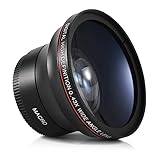
The Lightdow 52mm converter is aimed squarely at the most common beginner landscape setup in existence: a Nikon D-series body with an 18–55mm kit zoom whose front thread measures 52mm. Screw it on and an 18mm setting behaves like something far wider, at a fraction of the cost of a dedicated ultra-wide lens.
Who it suits: Nikon D3000/D5000/D7000-series owners who want to try wide-angle landscape work before committing real money, students, and anyone shooting travel or interiors on a kit lens. It also suits macro-curious shooters, because the front element unscrews to leave a close-focus attachment behind.
Key specs
- 0.43x conversion factor, which multiplies your lens’s focal length by 0.43.
- Detachable macro portion — remove the wide element and the remaining glass works as a close-up attachment.
- 52mm mounting thread, matching Nikon’s AF-S 18–55mm kit-zoom class and other lenses with a 52mm front thread.
- Manual focus only. Autofocus still functions on the host lens, but the converter shifts the plane of focus and slows contrast detection.
- Two elements of glass in a metal-and-plastic barrel, with a front thread of its own for a cap.
Strengths and the math you should run first
Here is the calculation that tells you whether this product is for you. Take your lens’s widest setting and multiply by 0.43. An 18mm setting becomes roughly 7.7mm. On a Nikon APS-C body with a 1.5x crop, that is a full-frame-equivalent field of view of about 11.6mm — wider than most dedicated ultra-wide zooms can go, for a tiny fraction of the price.
That headline number comes with a condition: screw-on converters vignette badly when the host lens is zoomed all the way out, because the converter’s rear element is small and the host lens’s exit pupil is close. The practical trick is to shoot at roughly 24mm on the host zoom rather than 18mm, which yields about 10.3mm (roughly 15.5mm equivalent) with much cleaner corners, then stop the host lens down to f/8 or f/11. You lose a little width and gain a usable frame.
Pros
- Cheapest realistic route to an ultra-wide field of view on a Nikon kit zoom.
- Two products in one: wide converter and macro attachment.
- Small and light enough to live in a jacket pocket alongside the camera.
- Non-destructive — it screws on and off in seconds, leaving the host lens untouched.
Cons
- Corner softness and chromatic fringing are the normal trade-off at this price and class.
- Barrel distortion is significant and needs correction in editing, which crops away part of the width you paid for.
- Loses roughly a stop of light and reduces contrast because of the extra glass surfaces.
- Will not mount on a lens without a 52mm front thread, and is not worth adapting to a different size with step rings.
How it compares with the nearest alternative
The closest alternative here is the Acuvar 0.43x. Both are 0.43x screw-on converters with a macro portion, so the deciding factor is thread size and price tier, not optical design: the Acuvar sits in the budget tier and the Lightdow in the mid-range tier, which typically reflects build quality and coating rather than a different conversion factor. If your lens takes 52mm filters, the Lightdow is the safer fit because the thread is specified in the product name; if it takes a different size, check the Acuvar listing for the matching variant before ordering. Neither will out-resolve a native ultra-wide lens, and neither is meant to.
3. Acuvar 0.43x Wide Angle Lens with Macro Portion – Best for the Lowest-Cost Wide-Angle Try-Out

The Acuvar converter occupies the same niche as the Lightdow but aims at the bottom of the market: a DSLR shooter who wants to know whether wide-angle landscape work is for them before spending anything meaningful. It is a screw-on 0.43x wide converter with a macro portion, sold at a budget tier.
Who it suits: first-time landscape shooters on a kit lens, hobbyists who shoot a handful of hikes a year, and anyone building a starter bag who would rather put money into a tripod and filters first. It also suits a second-camera or backup role, where a cheap converter lives permanently on an old body.
Key specs
- 0.43x conversion factor, applied to whatever focal length the host lens is set to.
- Macro portion, reached by unscrewing the wide-angle element from the front.
- Screw-on mounting for common small filter threads; the listing specifies the compatible sizes.
- Manual focus behaviour, with the host lens’s autofocus reduced in speed and accuracy.
- Compact barrel that adds little length to the host lens.
Strengths
The value proposition is arithmetic. A dedicated ultra-wide zoom usually costs several hundred dollars; this costs a rounding error by comparison. For a shooter who is not yet sure whether they prefer 16mm or 24mm framing, that is a rational first purchase: use the converter for a season, learn which focal length you actually reach for, and only then buy a native lens at that length.
The macro portion adds genuine versatility for landscape work. Close-up detail — frost patterns, lichen on rock, the texture of wet sand — is a common companion shot to a wide scene, and having it available without swapping lenses is useful when the light is changing fast. Expect soft corners, visible barrel distortion and reduced contrast; those are the class norms, not defects specific to this product.
Pros
- Lowest-cost way to test whether you enjoy ultra-wide framing.
- Wide and macro in one barrel, so fewer lens changes in bad weather.
- Light enough to carry as a permanent accessory.
- Good backup or second-body option once you upgrade.
Cons
- Budget-tier glass means corner softness, fringing and flare are likely in demanding light.
- Distortion correction in editing crops the frame, eroding the extra width.
- Thread-size mismatch is the most common reason for a return; measure your lens first.
- Not sealed against dust or moisture, which matters on coastal and desert shoots.
How it compares with the nearest alternative
Against the Lightdow 52mm 0.43x, the Acuvar wins on price and loses on specificity: the Lightdow names its 52mm thread in the product title, so Nikon kit-zoom owners can order with confidence, while the Acuvar buyer needs to confirm the size. Against the Altura Photo 55mm, the Acuvar is cheaper but the Altura is sold in the mid-range tier with a stated 55mm thread for Nikon and Sony bodies. If you are buying once and want the least risk, choose the converter whose thread size matches your lens exactly; the conversion factor is identical across all three.
4. Canon 17-40mm f/4L EF – Best Overall Wide-Angle Lens for Full-Frame Landscape Work

The Canon 17-40mm f/4L EF is the only product in this roundup that is a complete wide-angle lens rather than an accessory, and that is why it takes the top spot. It mounts natively on EF-mount DSLRs and adapts cleanly to mirrorless bodies, covers a full-frame image circle, and — critically for landscape work — accepts standard 77mm screw-in filters, including the square-filter holder rings that most landscape shooters already own.
Who it suits: full-frame Canon DSLR owners who want one ultra-wide zoom for coastlines, canyons, forests and architecture; mirrorless shooters who adapt EF glass and value a mechanical focus ring; and anyone who wants autofocus, weather-resistant build and filter compatibility in a single purchase.
Key specs
- 17–40mm focal length with a constant f/4 maximum aperture across the zoom range.
- Full-frame EF mount, with an APS-C equivalent field of view of roughly 27–64mm on a 1.6x crop body.
- Diagonal angle of view of approximately 104° at 17mm, narrowing to about 57° at 40mm on full frame.
- 77mm front filter thread — the standard size for screw-in ND, polarizing and graduated filters.
- Ring-type ultrasonic autofocus with full-time manual override, plus a distance scale for hyperfocal work.
- L-series construction with dust and moisture resistance, weighing roughly 475 g.
- Minimum focusing distance of about 0.28 m, which is close enough for foreground rocks and flowers.
Strengths
The 17–40mm range is close to ideal for landscapes because it spans two different jobs. At 17–20mm you get the dramatic foreground-to-sky compression that wide-angle work is famous for; at 28–40mm you get a near-normal view that is better for compressed mountain layers and detail shots, so you can shoot an entire location without changing lenses. Constant f/4 means exposure does not shift as you zoom, which matters when you are bracketing or shooting a time-lapse.
Filter compatibility is the quiet advantage. A 77mm thread takes a polarizer, a ten-stop ND and a graduated ND without a holder system, and the front element does not protrude, so stacking two filters rarely vignettes at 17mm. That combination — real width, real filters, real autofocus — is what makes it a working landscape lens rather than an experiment. The one habit worth building is stopping down to f/8–f/11 and focusing at the hyperfocal distance rather than at infinity; at 17mm and f/8, with a 0.03 mm circle of confusion, the hyperfocal distance is about 1.2 m, which puts everything from roughly 0.6 m to infinity in acceptable focus.
Pros
- Genuine ultra-wide zoom range with a constant aperture and autofocus.
- 77mm filter thread takes standard screw-in filters and square-holder adapter rings.
- L-series build with dust and moisture sealing for real weather.
- Adapters well to mirrorless bodies, so it survives a system change.
Cons
- f/4 is workable but not ideal for astrophotography, where faster glass gathers more stars before trailing begins.
- Corner sharpness at 17mm and f/4 is the weakest point of the design; stopping down helps noticeably.
- Heavier and bulkier than any accessory converter on this list.
- Premium tier pricing, and it is an EF lens, so a mirrorless adapter is an extra purchase.
How it compares with the nearest alternative
The nearest alternative in this list is the TTArtisan 7.5mm f/2.0 fisheye, which is the other premium-tier product that is a real lens rather than an attachment. They are not competitors so much as different tools: the Canon gives you a rectilinear 17–40mm zoom with autofocus, filters and weather sealing, while the TTArtisan gives you a 180° circular fisheye with manual focus and no filter thread. For general landscape work — seascapes, forests, mountain layers — the Canon wins on flexibility and filter use. For one specific look, the fisheye wins on drama. Most landscape shooters who own the Canon will never need the fisheye; shooters who own the fisheye will still want a rectilinear wide for everything else.
5. Altura Photo 58mm Wide Angle Lens with Macro – Best for Canon Rebel T7 and T6 Owners

The Altura Photo 58mm converter is the Canon-flavoured answer to the screw-on question. Canon’s 18–55mm kit zooms for the Rebel T7 and T6 class use a 58mm front thread, and this attachment is sized to match, which removes the single most common source of frustration with this product category: ordering the wrong diameter.
Who it suits: Rebel T7, T6, T6i and SL-series owners with the standard kit zoom who want to shoot wide landscapes without buying a new lens. It also suits shooters who want a cheap macro option for wildflower and texture detail, and beginners who would rather spend their budget on a tripod.
Key specs
- Screw-on wide-angle conversion element with a detachable macro portion behind it.
- 58mm mounting thread, matching the common Canon APS-C kit-zoom class.
- Manual focus behaviour with the host lens’s autofocus reduced in speed.
- Metal-and-optical-glass construction typical of the mid-range converter class.
- Conversion strength in the 0.4x–0.5x class typical of screw-on wide adapters.
Strengths
The strength here is fit, and fit is most of the battle. Because the thread matches the kit lens Canon ships with the T7 and T6, the buyer does not need to measure anything or hunt for step-up rings. Screw it on, zoom to a mid setting rather than the extreme wide end, stop down to f/8, and you have a usable ultra-wide frame for the price of a couple of memory cards.
Run the same arithmetic as with any 0.43x-class converter: an 18mm setting becomes roughly 7.7mm, and on a 1.6x crop body that is about 12.4mm full-frame equivalent — wider than most entry-level ultra-wide zooms. Shoot at 24mm instead and you get roughly 10.3mm (about 16.5mm equivalent) with markedly better corners. The macro element is genuinely useful on a hike: unscrew the wide glass and the remaining attachment focuses close enough for moss, bark and pebbles, which are exactly the foreground details that make wide landscape frames work.
Pros
- Thread size matches the Canon Rebel kit zoom, so there is no guesswork.
- Wide and macro capability in one small attachment.
- Cheap enough to treat as a learning tool rather than an investment.
- Adds almost nothing to pack weight on a hike.
Cons
- Corner softness, barrel distortion and flare are class norms at this price.
- Autofocus accuracy drops, so manual focus with magnified live view is the reliable approach.
- Only fits 58mm-threaded lenses; it is not worth adapting to other sizes.
- Reduced contrast in backlit conditions, which is common at sunrise and sunset.
How it compares with the nearest alternative
Its closest relative in this list is the Altura Photo 55mm version, which is the same product concept sized for Nikon and Sony bodies with a 55mm front thread. There is no optical advantage either way — the decision is purely mechanical. Canon Rebel shooters should take the 58mm; Nikon shooters running an AF-P 18–55mm-class zoom, or any lens with a 55mm thread, should take the 55mm. If your lens takes neither, the Lightdow 52mm covers the Nikon D-series kit-zoom case, and the Acuvar covers


