
The best travel compact camera for most trips is the Sony RX100 VII. Its 1.0-type stacked sensor, 24–200mm equivalent zoom and genuinely pocketable body make it the only camera on this list that handles wide street scenes, mid-range portraits and distant landmarks without a lens change — which is the exact problem a travel camera exists to solve. It suits travelers who will carry a camera every day and want files that survive cropping and evening light.
If that budget is out of reach, the Duluvulu 4K is the strongest value pick for daylight stills and casual video, the Ploomen 4K adds a flip screen for roughly the same money, and the AUREAPIX 8K sits in the middle for vloggers who want Wi-Fi transfer and a large rear screen. The Kodak PIXPRO FZ45 is the one to choose if you want AA batteries and no charging routine at all, while the Kodak PIXPRO FZ55 is the slimmest body here. Everything below compares those six on pocketability, zoom range, sensor size, battery life and weather protection.
Our Top Picks
 KODAK PIXPRO FZ45 16MP Compact Digital Camera3.66 x 2.37 x 1.12 inches3.66 x 2.37 x 1.13 inches0.3 poundsCheck on Amazon


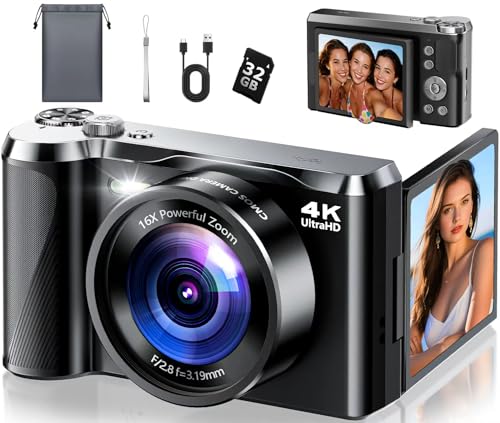

Top 3 picks at a glance
Quick Comparison
Every camera in this roundup, sorted by what it is actually good at. Price tiers are relative bands within this list rather than fixed figures, because listing prices move constantly.
| Camera | Best for | Key specs | Price tier |
|---|---|---|---|
| Sony RX100 VII | Best overall for everyday travel and low light | 1.0-type stacked CMOS (~20MP class), 24–200mm equivalent f/2.8–4.5 zoom, pop-up OLED viewfinder, 3-inch tilting screen, 4K video, proprietary lithium-ion battery | Premium |
| Kodak PIXPRO FZ55 | Slimmest everyday carry | 16MP 1/2.3-inch class CMOS, 5x optical zoom (~28–140mm equivalent), 2.7-inch fixed LCD, 1080p video, rechargeable lithium-ion battery | Premium |
| Kodak PIXPRO FZ45 | AA-battery travel and backup duty | 16MP class sensor, 4x optical zoom (~27–108mm equivalent), 1080p video, 2.7-inch LCD, runs on AA cells | Mid-range |
| AUREAPIX 8K | Hybrid video and stills for vloggers | 96MP-class interpolated stills, 8K-class video mode, Wi-Fi transfer, 3.5-inch 180° flip screen, autofocus | Mid-range |
| Duluvulu 4K | Budget first camera | 48MP-class interpolated stills, 4K video, autofocus, vlogging form factor, memory card included in the kit | Budget |
| Ploomen 4K | Budget flip-screen vlogging | 56MP-class interpolated stills, 4K video, autofocus point-and-shoot, 3-inch 180° flip screen | Budget |
How We Chose
Selection started from the five variables that actually change how a trip feels: how the body carries, how much zoom the itinerary needs, how large the sensor is, how long the battery lasts away from a wall socket, and how the camera behaves in rain, sand and cold. Pocketability was judged on body class and control layout — a camera with a deep grip and a protruding lens barrel is a different object in a jacket pocket than a flat-bodied point-and-shoot. Zoom was assessed in full-frame equivalent terms, because “5x” and “8x” mean nothing without a starting point.
Sensor size was weighted heavily, since it drives low-light performance and how much you can crop. Battery was judged on the charging strategy rather than a single runtime figure: a proprietary pack means you carry spares and a charger, while AA cells mean you can resupply anywhere but carry more weight. Weather protection was assessed by what the category realistically offers, and the recommendations assume an unsealed body unless stated otherwise. Finally, each pick had to have a clear upgrade path or a clear reason to stay — a camera that is a dead end for the traveler who outgrows it is a bad recommendation.
1. Kodak PIXPRO FZ55 – Best for Slim Everyday Carry
As an Amazon Associate we earn from qualifying purchases at no extra cost to you.

The PIXPRO FZ55 is for the traveler who wants a camera that disappears into a pocket and never becomes a decision. It is a flat-bodied 16MP point-and-shoot with a 5x optical zoom, a fixed 2.7-inch rear screen and 1080p video, and it runs on a rechargeable lithium-ion pack rather than AA cells. If your travel photography is daylight architecture, markets, coastlines and the occasional group shot, and you want optical zoom rather than a phone’s digital crop, this is the simplest way to get there.
Who it suits most precisely: the carry-on-only traveler, the day-tripper who shoots twenty to sixty frames a day, and anyone upgrading from a phone who is not ready to manage lenses, manual exposure or RAW files. It also suits a secondary role — a camera that lives in a bag pocket as a backup for a main body — because the slim chassis takes up almost no room.
Key specs
- Sensor: 16MP, 1/2.3-inch class CMOS — the same size class used across budget and mid-range point-and-shoots
- Lens: 5x optical zoom, roughly 28–140mm in full-frame equivalent terms, so it covers wide street scenes and a moderate telephoto pull
- Display: 2.7-inch fixed rear LCD, no touch and no articulation
- Video: 1080p Full HD, which is enough for social clips and casual sharing
- Battery: rechargeable lithium-ion pack; charging method depends on the specific kit, so confirm whether a wall charger is included
- Media: SD-family memory card
- Body: slim polycarbonate shell with a built-in flash and a mode dial plus scene modes
What it does well
The zoom range is the headline. A 28–140mm equivalent lens covers the two things phones are worst at on a trip: compressing a distant skyline and pulling a subject out of a crowded street without walking into it. Because the zoom is optical, the detail at the long end holds up far better than a phone’s digitally cropped telephoto, especially in good light. The 16MP file size is also a practical advantage — you can shoot several thousand frames on a single memory card, which matters when you are away for two or three weeks.
Handling is deliberately simple. Scene modes handle sunset, backlight, portrait and night settings without you thinking about exposure, and the slim body means there is no negotiation about whether the camera comes along. For travelers whose main frustration with a phone is reach rather than image quality, the FZ55 solves exactly one problem very cleanly.
The rechargeable battery is the right call for a slim body — AA cells would add bulk and weight — but it means you need to plan charging. A small power bank plus the correct cable covers an evening charge in a hotel room or a hostel bunk.
Pros
- Genuinely slim and light, so it actually gets carried
- 5x optical zoom gives real reach where a phone falls apart
- 16MP files are small enough to shoot freely for weeks
- Simple menus and scene modes suit first-time camera owners
- Rechargeable battery avoids the cost of buying AA cells on the road
Cons
- Small 1/2.3-inch class sensor struggles indoors and after sunset — expect to stay near ISO 100–400 for clean output
- No weather sealing, so rain, sea spray and fine sand are real risks
- Fixed rear screen means no low-angle or selfie framing
- 1080p video only, which is fine for sharing but limiting if you want 4K timelines
- JPEG-only workflow is typical of this class, so there is little room to recover a badly exposed frame
- No electronic viewfinder, so bright sunlight makes framing harder
How it compares with the nearest alternative
The closest alternative in this list is the Kodak PIXPRO FZ45. Both are 16MP-class Kodak point-and-shoots, but they pull in different directions. The FZ55 is the slimmer, more modern-feeling body with a slightly longer 5x zoom and a rechargeable lithium-ion battery, and it sits in the premium tier of this comparison. The FZ45 gives up a little zoom reach (4x, roughly 27–108mm equivalent) and runs on AA cells instead.
Choose the FZ55 if you want the smallest possible carry, a rechargeable battery and a touch more reach. Choose the FZ45 if you are travelling somewhere you cannot reliably charge a battery, or if you want a camera that can be fed with cells bought from any convenience store. Neither has the low-light headroom of the Sony RX100 VII, and neither is meant to — the Sony’s 1.0-type sensor has roughly four times the light-gathering area of a 1/2.3-inch class chip, which is the difference between a usable dusk shot and a smeared one.
2. Duluvulu 4K – Best for Budget First Camera

The Duluvulu 4K is aimed at the traveler buying their first dedicated camera, or at a younger shooter who wants something better than a phone for daylight stills and YouTube-style clips without spending much. It is a 4K-capable compact with autofocus, a vlogging-friendly body and a memory card bundled in the kit, and it is pitched as a 48MP stills camera. If you want to learn framing, exposure compensation and the difference an optical lens makes, this is the lowest-risk entry point in this roundup.
Who it suits: students and first-time buyers, parents buying a camera for a teenager before a trip, and travelers who mostly shoot daylight video for social platforms and stills for a shared album. It also suits anyone who wants the card included so the camera works out of the box.
Key specs
- Stills: 48MP-class output, achieved in this price class through interpolation rather than a physically 48MP sensor — treat it as a small-sensor camera with a marketing multiplier
- Video: 4K recording, plus lower resolutions for longer clips and easier sharing
- Focus: autofocus, which is a real step up from fixed-focus budget compacts
- Form factor: vlogging-oriented body with a rear screen and a control layout aimed at one-hand use
- Media: a memory card is included with the camera, so no separate purchase is needed to start shooting
- Battery: rechargeable pack charged in-camera over USB
What it does well
The value proposition is straightforward: 4K capture and autofocus at a budget-tier price, with the card included. Autofocus matters more than the megapixel claim for a beginner, because it is the difference between a clip where the subject stays sharp as they move and one where the camera hunts and breathes. For talking-head videos, market walk-arounds and daylight travel clips, that alone justifies the price of entry.
Because the files are JPEGs at modest real resolution, a single 64GB card holds an enormous number of stills and a solid amount of 4K footage, which keeps the whole kit cheap and simple. The USB charging also means one cable and one power bank can keep both your phone and your camera alive, which is a genuinely useful travel simplification.
Pros
- Lowest barrier to entry here — card included, 4K video, autofocus
- Autofocus makes handheld vlogging far more forgiving than fixed-focus rivals
- Light and small enough to live in a day bag
- USB charging pairs naturally with a travel power bank
- Simple menus suit a first camera or a gift purchase
Cons
- The 48MP figure is interpolated; real detail is closer to what a small sensor can resolve, so do not expect phone-beating pixel-level sharpness
- Low-light performance is limited — plan on daylight and well-lit interiors
- No weather sealing, and budget bodies are less tolerant of sand and moisture
- Build quality and controls are basic compared with mid-range and premium options
- Image stabilisation is limited, so handheld 4K needs a steady hand or a small tripod
How it compares with the nearest alternative
Its direct rival is the Ploomen 4K, the other budget-tier camera here. They overlap heavily on price band, 4K video and autofocus, and the differences come down to packaging and framing rather than image quality. The Duluvulu bundles a memory card, so the out-of-box cost is effectively lower, and it leans into a vlogging-first body. The Ploomen counters with a 3-inch 180° flip screen and a higher interpolated stills figure (56MP class).
If you want the simplest possible start and you value the included card, take the Duluvulu. If you plan to film yourself and need to see your framing while recording, the Ploomen’s flip screen is the more useful feature, and no megapixel number makes up for not being able to frame a shot. Against the Kodak PIXPRO FZ55, the trade is different again: the Kodak has a longer optical zoom and a more established brand behind it, while the Duluvulu gives you 4K and autofocus. For daylight video, take the Duluvulu; for reach and stills, take the Kodak.
3. Kodak PIXPRO FZ45 – Best for AA-Battery Travel

The PIXPRO FZ45 is the camera for travelers who do not want a charging routine. It is a 16MP compact with a 4x optical zoom and 1080p video, and it runs on AA cells — the same batteries sold in every supermarket, petrol station and village shop on the planet. That single design decision makes it the most resilient camera in this roundup for long treks, remote regions and multi-week trips where a wall socket is a luxury rather than a given.
Who it suits: trekkers, overlanders, cyclists, backpackers on long-haul routes, and anyone who has ever had a camera die at the worst possible moment because the charger was left in a hotel. It also suits a backup role, because AA cells stored in a bag do not self-discharge into uselessness the way an uncharged lithium pack can.
Key specs
- Sensor: 16MP class, 1/2.3-inch class CMOS
- Lens: 4x optical zoom, roughly 27–108mm equivalent — a modest wide-to-short-tele range
- Power: AA batteries, which is the defining feature of this model
- Video: 1080p Full HD
- Display: 2.7-inch fixed rear LCD
- Media: SD-family memory card
- Body: compact polycarbonate chassis with a built-in flash and simple mode dial
What it does well
Resupply is the whole point. A rechargeable camera ties you to a USB port, a plug adapter and a power bank; the FZ45 ties you to nothing. Two spare AA cells weigh almost nothing and can be bought in a village shop for the price of a coffee. On a trek where you are rationing power for a phone, a headlamp and a GPS, moving the camera off the electrical budget entirely is a genuine logistical win.
The zoom range covers the essentials — a 27mm equivalent wide end for landscapes and interiors, and a 108mm equivalent telephoto for compressing hills, monuments and street details. The 16MP files stay small, so a single card lasts an entire trip, and the menus are simple enough that you will not lose shots fumbling with settings while a bus is leaving.
One practical note that matters more than any spec: use rechargeable NiMH cells rather than alkaline. Alkaline AA batteries fall off badly under the continuous load a camera puts on them, so their usable capacity is far lower than the label suggests, and they end up in landfill by the handful. A set of NiMH cells plus a small solar or USB charger gives you the resupply flexibility of AA with much better runtime per charge — and a rough rule of thumb is that a couple of NiMH cells will get you through a few hundred frames, while the same alkalines may manage only a fraction of that in cold conditions.
Pros
- AA power means you can always find batteries, anywhere
- Removes the camera from your trip’s charging schedule entirely
- Light, cheap to run and simple to operate
- 4x optical zoom covers wide through short telephoto
- Small files and low cost make it a sensible second body
Cons
- AA cells add weight and bulk compared with a lithium pack, and you need spares
- Alkaline performance is poor under load; NiMH rechargeables are effectively mandatory
- Small sensor limits low-light shooting to roughly ISO 100–400 for clean results
- No weather sealing
- 1080p video and a fixed screen are basic by current standards
- Shortest zoom range of the Kodak pair — 4x versus the FZ55’s 5x
How it compares with the nearest alternative
Against the Kodak PIXPRO FZ55, the decision is almost entirely about power and size. The FZ55 is slimmer, has a slightly longer 5x zoom and a rechargeable lithium-ion pack, and it is the more modern-feeling object to carry around a city. The FZ45 is the more rugged choice in practice, not because it is sealed but because it cannot be stranded by a dead proprietary battery.
If your trip involves reliable hotel power, take the FZ55 for the slimmer body and extra reach. If your trip involves long distances from mains electricity, take the FZ45 and a set of NiMH cells. Neither competes with the Sony RX100 VII on image quality or with the AUREAPIX 8K on video features — they compete on never leaving you without a working camera, which is a different and sometimes more valuable promise.
4. Sony RX100 VII – Best Overall for Serious Travel

The RX100 VII is the camera to buy if you want one pocketable body that handles everything a trip throws at it. It pairs a 1.0-type stacked CMOS sensor of roughly 20MP with a ZEISS Vario-Sonnar T* 24–200mm equivalent f/2.8–4.5 zoom, a pop-up OLED electronic viewfinder, a tilting 3-inch screen and 4K video. In this roundup it is the only model with a sensor large enough to shoot confidently after sunset, and the only one with a viewfinder that works in harsh midday sun.
Who it suits: travelers who shoot seriously and want their camera with them at all times, parents photographing fast-moving kids on holiday, street and documentary shooters, and anyone who has outgrown a phone camera and does not want to carry an interchangeable-lens system. It is also the strongest pick for a traveler who wants one camera for both stills and video rather than two devices.
Key specs
- Sensor: 1.0-type stacked CMOS, roughly 20MP class — about four times the light-gathering area of the 1/2.3-inch class sensors used elsewhere in this list
- Lens: 24–200mm equivalent, f/2.8–4.5, an 8.3x optical range covering wide through long telephoto
- Viewfinder: pop-up OLED electronic viewfinder, a feature no other camera here offers
- Screen: 3-inch tilting touchscreen, useful for low angles and overhead crowd shots
- Video: 4K recording with fast, reliable autofocus; expect to rely on the built-in microphones for audio
- Speed: very fast continuous shooting with blackout-free framing, which is what makes it good at action and children
- Battery: proprietary NP-BX1-class pack, rated in the region of 250–270 shots per charge under standard CIPA testing
- Weather protection: not officially sealed — treat it as vulnerable to rain and sand despite the metal body
What it does well
The sensor is the reason to pay. Moving from a 1/2.3-inch class chip to a 1.0-type sensor is roughly a two-stop improvement in light gathering, which translates directly into usable evening and indoor shots. Where a budget compact is producing smeared detail at ISO 1600, the RX100 VII is still producing presentable files, and you can crop a 20MP frame meaningfully rather than watching it fall apart.
The 24–200mm range is the other half of the argument. Twenty-four millimetres covers interiors, narrow streets and group shots; 200mm pulls a detail off a cathedral roof or compresses a mountain ridge. Carrying that range in a body that fits a jacket pocket removes the single biggest friction point of travel photography: deciding which lens to bring and then changing it in the wind.
The pop-up viewfinder sounds like a gimmick until you shoot at noon on a white sand beach. Every rear screen on this list washes out in direct sun; the RX100 VII gives you a real eyepiece that does not. The tilting screen handles the opposite problem — shooting over a crowd or down at a market stall without kneeling.
Battery life needs planning rather than panic. A CIPA figure in the 250–270 shot range assumes standard temperatures and flash off, and cold weather can cut effective runtime by a third to a half, so a winter trip might yield only 130–170 shots per charge. Carry two or three spare packs, or a power bank that can charge the camera in-body between outings.
Pros
- 1.0-type sensor gives roughly two stops of low-light advantage over 1/2.3-inch class rivals
- 24–200mm equivalent zoom covers wide to long telephoto in one pocketable body
- Pop-up OLED viewfinder is genuinely usable in bright sunlight
- Very fast autofocus and continuous shooting make it reliable with moving subjects
- Strong 4K video for a compact, with the same sensor advantage in dim light
- Premium build and controls that reward a traveler who wants to learn manual exposure
Cons
- Highest cost tier in this roundup, and the accessories add up
- No official weather sealing, which is a real limitation for a premium travel camera
- Proprietary batteries mean you must carry spares and a charger
- Small controls and a dense menu system take time to learn
- No microphone input on the body, so audio is limited to the built-in mics unless you record separately
- Overkill if you only ever shoot daylight snapshots for a shared album
How it compares with the nearest alternative
The nearest alternatives here are the two Kodak PIXPRO models, because they are the other cameras with an optical zoom in a body you can pocket. The comparison is not close on image quality: the RX100 VII’s 1.0-type sensor has roughly four times the area of a 1/2.3-inch class chip, which is the difference between a dusk street scene that works and one that does not. It also adds a viewfinder, a tilting screen, far better autofocus and a longer 200mm-equivalent reach.
Against the AUREAPIX 8K, the Sony gives up a large flip screen and Wi-Fi convenience, and it gives up the headline megapixel and video-resolution claims. What it does not give up is real optical quality: the AUREAPIX’s 96MP-class and 8K-class figures are interpolation-driven marketing numbers for a small sensor, whereas the Sony’s advantage is physical. If your priority is self-filming with a big screen at a mid-range price, the AUREAPIX is the sensible buy. If your priority is the best stills you can get from a pocket camera, the RX100 VII is the pick and nothing else here is close.
5. Ploomen 4K – Best for Budget Flip-Screen Vlogging

The Ploomen 4K is a budget-tier compact built around one feature that genuinely changes how you shoot: a 3-inch screen that flips a full 180 degrees so you can see yourself while recording. It combines that with 4K video, autofocus and a 56MP-class stills claim. For a traveler who wants to film themselves in front of a landmark, in a market or on a train, this is the cheapest way in this roundup to get correct framing every single take.
Who it suits: solo travelers and vloggers, couples who want to film each other, and anyone producing short-form travel video who has been frustrated by guessing whether they are in frame. It also suits a family buying a first video-capable camera for a teenager who wants to post clips.
Key specs
- Stills: 56MP-class output, interpolated in this price class rather than a true 56MP sensor — expect real detail closer to a small-sensor compact
- Video: 4K recording, plus lower resolutions for longer clips
- Screen: 3-inch 180° flip screen, the defining feature for self-filming
- Focus: autofocus for point-and-shoot simplicity
- Form factor: compact point-and-shoot body with a one-hand-friendly layout
- Power: rechargeable pack charged over USB
- Media: SD-family memory card
What it does well
The flip screen is worth more than any megapixel number on the box. Recording yourself without one means either guessing your framing or burning takes, and on a short trip you cannot reshoot a sunrise. Flipping the screen forward means you see exactly what the camera sees, so you can check your head is not cut off, that the landmark is behind you and that the light is on your face rather than behind your head.
The 4K mode plus autofocus covers the basics of travel video: walking shots, talking-head pieces to camera and detail cutaways. Autofocus keeps you sharp as you move toward or away from the lens, which is exactly where fixed-focus budget cameras fail. USB charging keeps the kit to a single cable and a power bank.
Like every budget camera here, this one is a daylight machine. Plan your shooting around the light: morning and late afternoon for exteriors, and windows rather than overhead bulbs for interiors. A tiny tripod or a flexible grip transforms the output more than any setting change, because it removes the handheld wobble that makes budget 4K look budget.
Pros
- 180° flip screen makes self-filming reliable instead of a guessing game
- 4K video and autofocus at a budget-tier price
- Light and small enough to carry every day
- USB charging keeps travel power simple
- Straightforward menus suit a first-time video shooter
Cons
- The 56MP stills figure is interpolated; do not judge it against a genuine high-resolution sensor
- Small sensor limits low-light stills and video — expect noise after sunset
- No weather sealing, and budget plastics are less tolerant of knocks and sand
- Image stabilisation is basic, so handheld 4K needs a steady grip or support
- No viewfinder, and the screen is hard to read in direct sun
- Audio is limited to built-in microphones, which pick up wind
How it compares with the nearest alternative
The direct comparison is the Duluvulu 4K, the other budget-tier camera here. Both offer 4K, autofocus and USB charging in a light body, and the real differentiator is the screen. The Ploomen’s 3-inch 180° flip screen is a working tool for solo shooters; the Duluvulu’s advantage is that a memory card comes in the kit, so the true out-of-box cost is lower, and its stills claim is more modest and therefore less misleading.
Choose the Ploomen if you will film yourself and want to see your framing. Choose the Duluvulu if you mostly shoot stills and occasional clips and would rather have the card included. Against the AUREAPIX 8K, the Ploomen is the cheaper, smaller option with a similar flip-screen concept but a smaller display and lower video claims — the AUREAPIX is the step up if you want the bigger screen and Wi-Fi transfer. And against the Sony RX100 VII, the Ploomen wins only on price and screen size; on sensor size, low-light quality, autofocus speed and stills detail the Sony is in a different class entirely.
6. AUREAPIX 8K – Best for Hybrid Video and Stills

The AUREAPIX 8K is the mid-range option for travelers who want to film and photograph with one device and who value convenience features over ultimate image quality. It combines 4K-and-above video capability, Wi-Fi transfer, a large 3.5-inch 180° flip screen, autofocus and a 96MP-class stills claim. The big screen and wireless transfer are what separate it from the budget tier — you can frame yourself properly and get clips onto a phone without hunting for a card reader.
Who it suits: vloggers and content creators who post while travelling, travelers who want a larger screen for framing and playback, and anyone who would rather send files to a phone over Wi-Fi than carry a laptop. It also suits a household buying one camera that does both video and stills at a middle price.
Key specs
- Stills: 96MP-class output — in this class that figure comes from interpolation rather than a physically 96MP sensor, so judge it on real detail, not the number
- Video: 8K-class mode alongside 4K and lower resolutions; treat the top mode as an upscaled convenience setting rather than true 8K capture
- Screen: 3.5-inch 180° flip screen, the largest display in this roundup
- Connectivity: Wi-Fi for transferring photos and clips to a phone or tablet without a card reader
- Focus: autofocus
- Form factor: vlogging-oriented compact with a one-hand layout
- Power: rechargeable pack, USB charging
What it does well
Wi-Fi transfer is the sleeper feature. On a trip, the difference between posting a clip the same evening and posting it three weeks later is usually the friction of getting files off a card. Wireless transfer removes that step entirely: shoot, send to phone, edit in an app, post. For creators who publish while travelling, this single feature is worth more than a resolution bump.
The 3.5-inch flip screen is the largest here, which matters more than it sounds. Bigger screens make framing easier at arm’s length, make it simpler to check focus and exposure before you commit, and make reviewing footage on the road far less squinty. Combined with the 180° articulation, it covers self-filming and low-angle and overhead shots with equal ease.
Be realistic about the headline numbers. A camera at this price cannot genuinely resolve 8K from a small sensor; the 8K and 96MP figures are interpolated outputs designed for marketing and for convenience when you need a large file. Record at 4K for the best real detail and treat the higher modes as optional extras. Understanding that will make you much happier with the results than expecting true 8K sharpness.
Pros
- Largest flip screen in this roundup at 3.5 inches, excellent for framing
- Wi-Fi transfer lets you post from the road without a card reader
- Autofocus and 4K video cover the practical vlogging basics
- Mid-range positioning means better features than the budget tier without premium pricing
- USB charging simplifies travel power
- One device for both stills and video, so less to carry
Cons
- The 96MP stills and 8K video claims are interpolated, not native sensor capability
- Small sensor means low-light performance is far behind the Sony RX100 VII
- No weather sealing
- No viewfinder, and a large screen is still hard to read in direct sunlight
- Image stabilisation is limited; 4K handheld needs care or support
- Wi-Fi transfer can be slow for long clips compared with a card reader
How it compares with the nearest alternative
Its closest competitor is the Ploomen 4K, one tier below. Both use the 180° flip-screen concept and both target self-filming travelers, but the AUREAPIX gives you a bigger 3.5-inch screen, Wi-Fi transfer and higher video and stills claims, at a mid-range price rather than a budget one. If you post while travelling, the Wi-Fi alone justifies the step up. If you are happy to transfer files when you get home, the Ploomen does the same core job for less.
Against the Sony RX100 VII, the trade is clarity versus convenience. The Sony has a far larger sensor, a real viewfinder, a longer zoom and much better low-light results, but no flip screen and no Wi-Fi convenience in the same package. If you shoot stills first and video second, the Sony wins on every image-quality measure. If you film yourself constantly and want to publish from the road, the AUREAPIX’s screen and wireless transfer are the more useful features, and its image quality is entirely adequate in good light.
How to Choose
Five variables decide this, and they interact. Work through them in order and you will land on one camera rather than a shortlist you cannot resolve.
1. Start with sensor size, not megapixels
The single biggest determinant of image quality in this list is the physical size of the sensor, not the number printed on the front. A 1/2.3-inch class sensor measures roughly 6.2 x 4.6mm — about 28 square millimetres. A 1.0-type sensor measures roughly 13.2 x 8.8mm — about 116 square millimetres. That is a fourfold difference in area, which translates to roughly two stops of light gathering.
In practice: at ISO 1600, a 1/2.3-inch class compact is producing heavy noise reduction and smeared detail, while a 1.0-type sensor is still producing a presentable file. That is the difference between shooting a lantern-lit street at dusk and putting the camera away. It is also why a 16MP 1/2.3-inch camera and a 20MP 1.0-type camera are not comparable despite similar numbers — the Sony RX100 VII’s 20MP files will crop better and clean up better than any 48MP or 96MP interpolated claim in this list.
Interpolated resolution deserves a plain explanation. When a budget camera claims 48MP, 56MP or 96MP, it is capturing at the sensor’s native resolution and upscaling the file, often with sharpening applied. The file is bigger; it does not contain more detail. A 48MP interpolated JPEG from a small sensor will not out-resolve a genuine 20MP file from a 1.0-type sensor. Treat these numbers as file-size options, not quality claims.
2. Match zoom range to your itinerary
Zoom is where compact cameras still beat phones outright, because optical reach cannot be faked. But how much you need depends entirely on where you are going.
- Cities, markets and interiors: a 24–28mm equivalent wide end matters more than telephoto reach. You will shoot in narrow streets and small rooms constantly.
- Landscapes and mountains: you want both ends — a wide for the vista and 100mm-plus to compress ridges and isolate peaks.
- Wildlife, boats and stadiums: reach is everything, and 200mm equivalent is the practical minimum from a pocket body. This is the Sony RX100 VII’s territory.
- People and street portraits: 70–135mm equivalent gives flattering compression without you having to stand in someone’s face.
In this list, the Sony RX100 VII covers 24–200mm, the Kodak FZ55 covers roughly 28–140mm, the Kodak FZ45 roughly 27–108mm, and the budget and mid-range 4K/8K models are best treated as fixed-wide-to-modest-zoom point-and-shoots. If your trip is defined by distant subjects, that ranking is your shortlist.
3. Decide whether pocketability or grip matters more
A camera you leave in the hotel room takes no photographs. Pocketability is a functional spec, not a luxury. Flat-bodied cameras like the Kodak PIXPRO FZ55 and the budget 4K models slip into a jeans pocket or a small crossbody bag. The Sony RX100 VII is pocketable in a jacket or a slightly larger pouch. Larger-screened vlogging bodies with 3.5-inch displays are the least pocketable here, though still small enough for a day bag.
If you carry a bag anyway, the pocketability penalty costs you nothing. If you travel with a phone, a wallet and keys and nothing else, choose the flattest body you can live with, because that is the one that will actually come out at the viewpoint.
4. Budget battery runtime like you budget money
Battery is the most commonly underestimated travel spec. Here is a worked estimate you can adapt.
Assume a camera rated around 260 shots per charge under standard CIPA testing. That rating assumes roughly 23°C and flash off. Cold weather is the killer: at freezing point and below, effective runtime commonly drops by a third to a half. So budget 130–170 shots per charge for a winter trip.
Now estimate your shooting rate. A careful traveler shoots perhaps 80–150 frames a day; a prolific one shoots 300 or more. At 150 frames a day on a ten-day trip, you are shooting around 1,500 frames total. At 150 usable shots per charge in the cold, that is ten charges across the trip — one per day. Two spare batteries plus an evening charging routine covers it comfortably; one battery does not.
For AA cameras, the arithmetic is different but the conclusion is similar. Two NiMH cells at roughly 2,000mAh and 1.2V hold about 4.8 watt-hours between them. A compact drawing roughly 1 watt on average while powered on will run for about four to five hours of on-time, which in bursty shooting translates to a few hundred frames — so carry four to eight charged cells for a week and top them up whenever you find power. Alkaline cells under the same load will deliver a fraction of that and should be treated as emergency backup only.
Whatever you choose


