
The best extendable dining tables are the ones that fit your room when closed, reach the seating capacity you need when open, and still leave roughly 36 inches of walking clearance around the table; for most small homes, a gateleg or compact round table is the safest choice, while larger rooms can justify a rectangular table with one or two stored leaves.
As an Amazon Associate we earn from qualifying purchases at no extra cost to you.

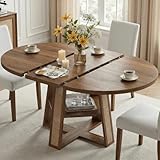


Our Top Picks
 41 in-78 in Extendable Dining Room Table for41"-78" Extendable Round Oval41.73 x 78.74 x 29.53 inches116 PoundsCheck on Amazon
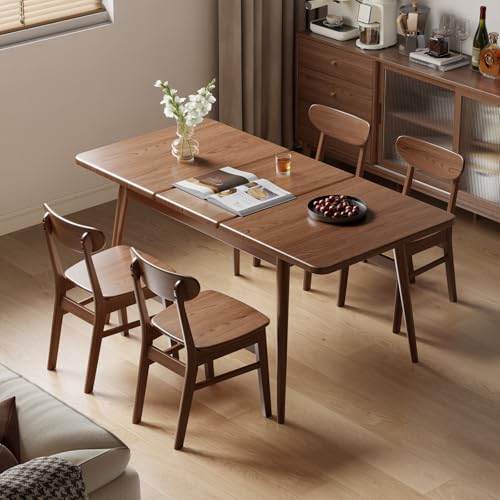 Muwuele 47"-63" Solid Wood Extendable Dining Tables for31.5"D x 63"W x 29.5"H31.5 x 63 x 29.5 inches76 poundsCheck on Amazon
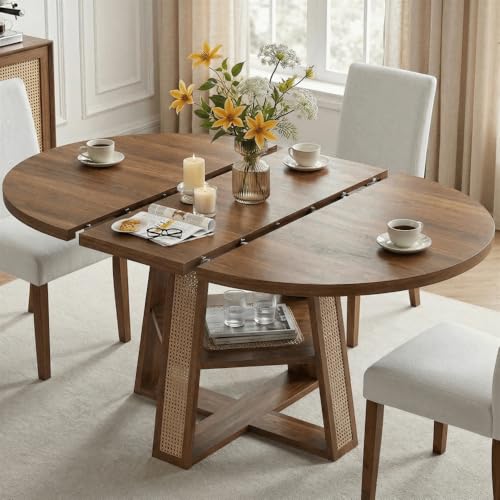

Top 3 picks at a glance
Best extendable dining tables by room and use
| Room or priority | Best table type | Typical closed size | Typical extended size | Usual seating | Why it works |
|---|---|---|---|---|---|
| Small apartment or breakfast nook | Gateleg or drop-leaf | 26–36 in. wide, 26–48 in. long | 36–44 in. wide, 60–90 in. long | 2–4 closed, 4–6 open | Very compact footprint between meals |
| Small dining room | Round or oval pedestal | 42–48 in. diameter | 54–72 in. long | 4 closed, 6–8 open | No sharp corners and easier circulation |
| Everyday family dining | Rectangular table with one center leaf | 60–72 in. long | 78–96 in. long | 6 closed, 8–10 open | Good balance of daily comfort and hosting capacity |
| Large dining room | Two-leaf rectangular table | 72–84 in. long | 96–120 in. long | 6–8 closed, 10–14 open | Supports large gatherings without a permanently oversized table |
How to choose the right size before buying
Start with the room’s usable dimensions, not the advertised seating count. Measure the clear floor area after accounting for sideboards, radiators, door swings, and the backs of nearby chairs. A dining table generally needs at least 36 inches of clearance on every frequently used side. Allow 42–48 inches where people need to walk behind seated diners or where chairs must be pulled out often.
For a quick calculation, subtract 72 inches from both the room length and width to estimate the largest comfortable table footprint. In a 10-by-12-foot room, that leaves a practical maximum of about 48 by 72 inches. A 60-inch table may fit physically, but once chairs are occupied it can make the room feel congested. If the table extends to 96 inches, the room will need a different arrangement, such as placing one short end closer to a wall during meals.
For seating, budget approximately 24 inches of table edge per adult. A 72-inch table can therefore accommodate three diners per side, or six before adding end seats. Wider chairs, armchairs, and bulky table legs reduce that number. A table advertised for eight may seat six comfortably if every guest uses an armchair.
Closed versus extended: the trade-off that matters most
Gateleg and drop-leaf tables
These are usually the strongest candidates for compact rooms. With the leaves folded down, the table can be only 12–30 inches deep; with both sides raised, it becomes a conventional dining surface. IKEA Norden is a well-known gateleg example, with multiple folding sections and storage built into the base. Its compact mode suits occasional dining, while its open mode is better for a small group than for a large dinner party.
The compromise is leg position. Supporting legs often swing outward when the leaves are raised, which can interfere with knees or chair placement. Check the distance between the legs, not just the tabletop dimensions. Gateleg mechanisms also reward careful leveling because a slightly uneven floor can make a raised leaf feel unstable.
Round and oval extending tables
Round tables make small rooms easier to navigate because they eliminate corners. An extending round design typically becomes oval, adding length while retaining a relatively narrow width. IKEA INGATORP is an example of this category, extending from a compact round format to a longer oval surface.
Pedestal bases are especially useful because chairs can be positioned anywhere around the perimeter. However, the central pedestal must be wide and stable enough to prevent wobble, and some designs provide less legroom than four-corner tables. Measure the base at floor level before deciding whether your chairs will tuck in.
Rectangular tables with center leaves
These provide the most predictable seating and are usually the best choice for families who use the table every day. The closed configuration often seats six, while one inserted leaf adds two seats or occasionally four. A synchronized opening mechanism can make expansion easier, but heavier solid-wood leaves may still require two people.
Look for a leaf that matches the tabletop’s grain, sheen, and edge profile. Tables with self-storing leaves are convenient, but the storage compartment adds weight and can limit how slim the table base is. Removable leaves offer more flexibility but need a dry, level storage location where they will not warp.
Leaf storage: built-in convenience versus flexibility
- Self-storing leaves: Fastest to use and least likely to be misplaced, but the table may be heavier and more expensive.
- Butterfly leaves: Fold in half beneath the top, saving storage space; inspect the hinge and support structure for smooth operation.
- Separate leaves: Often give a cleaner tabletop and more extension options, but they require a closet, under-bed space, or a protected vertical rack.
- Drop leaves: Excellent for narrow rooms, though the unsupported edge may feel less solid than a fully framed extension.
Store wooden leaves flat if the manufacturer recommends it, away from heat vents and damp exterior walls. Keep the table’s original alignment markings and hardware together. A leaf that is stored in a different humidity level can change size slightly, so forcing it into the opening is a warning sign rather than a normal part of setup.
Materials and construction
Solid wood
Solid oak, rubberwood, ash, and acacia can be repaired or refinished more readily than thin veneers. They also expand and contract with seasonal humidity, so small gaps or tight joints may occur. Choose a solid-wood table when long service life and repairability matter more than a perfectly uniform surface.
Wood veneer and engineered wood
Quality veneer over a stable engineered core can resist seasonal movement and keep extension joints aligned. It is often lighter and less expensive than thick solid wood. Check whether the leaf’s top surface is also veneered and whether the edge is sealed; unprotected edges are more vulnerable to moisture and impact.
Glass, stone, and ceramic surfaces
These materials can look visually light, but they may make the table considerably heavier. Extension hardware must support the surface without flexing, and replacement leaves can be difficult to source. They are best for buyers who prioritize stain resistance and appearance over easy relocation or simple refinishing.
Assembly and mechanism checks
Assembly quality affects how well an extendable table performs. Before buying, check whether the table arrives in several heavy sections, whether the extension rails are metal or wood, and whether the instructions require two people. A table can be correctly assembled yet still feel unstable if the floor is uneven, so adjustable feet are a useful feature.
- Open and close the table several times during assembly rather than tightening every screw immediately.
- Confirm that both halves remain parallel as the tabletop separates.
- Insert each leaf fully and check that the locking pins or latches engage.
- Run a hand across the joint; a small seam is normal, but a height difference suggests misalignment.
- Test the extended table with light pressure near the center and both ends; do not lean your full body weight on it.
A practical decision matrix
| If your situation is… | Choose… | Avoid… |
|---|---|---|
| You have less than 36 inches of spare depth beside the table | Gateleg, drop-leaf, or compact round model | Fixed-width rectangular tables |
| You host six people several times a month | 48–60 inch closed table extending to at least 72 inches | A table that reaches its maximum size only with two difficult leaves |
| You need eight seats every day | 72-inch rectangular table with one easy-to-use leaf | A compact table that is permanently extended |
| You use armchairs at the ends | Pedestal or trestle base with generous end clearance | Thick corner legs placed close to the seating positions |
| You move frequently or live upstairs | Modular, lighter construction with removable leaves | Very heavy stone or one-piece solid-wood designs |
Price and value in 2026
Compact engineered-wood and basic rubberwood tables commonly fall around $200–$500. Better-finished veneer or solid-wood extendable tables are often $500–$1,200, while premium hardwood, ceramic, and designer mechanisms can exceed $1,500. Pay for the features that affect daily use: a stable base, smooth rails, a matching leaf, replaceable hardware, and dimensions that work both closed and extended.
Frequently asked questions
Can an extendable dining table stay against a wall when it is not in use?
Yes, placing one end closer to a wall can make an extended table work in a room that cannot provide full clearance on every side. This arrangement is more practical during meals than as a permanent setup, because chairs need space to be pulled out and people may need to walk behind seated diners.
Will an extendable table work with armchairs?
Yes, but armchairs may reduce the number of people who can sit comfortably. Budget about 24 inches of table edge per adult, then account for the chairs’ width and the position of the table legs. A table advertised for eight may accommodate six comfortably when every guest uses an armchair.
How can I tell whether a table will wobble?
Check the stability of the base, the floor-level footprint, and whether the table has adjustable feet. A wide pedestal can prevent wobble, but it may reduce legroom. During assembly, confirm that both tabletop halves remain parallel, the leaves lock correctly, and the extended surface does not shift under light pressure.
Where should separate table leaves be stored?
Store separate leaves in a dry, level, protected location such as a closet, under-bed space, or vertical rack. Keep them away from heat vents and damp exterior walls when the manufacturer recommends flat storage. Retain the original alignment markings and hardware, and avoid forcing a leaf that has changed size with humidity.
Are extension joints supposed to be completely invisible?
No, a small seam at an extension joint is normal. After inserting a leaf, run a hand across the joint to check for a height difference, which can indicate misalignment. The leaf should also match the tabletop’s grain, sheen, and edge profile as closely as possible for a more consistent appearance.
Final recommendation
For the smallest rooms, choose a gateleg or drop-leaf table that is no deeper than the available clearance when closed. For a compact dining room, a round-to-oval pedestal table usually gives the best circulation. For a family room, select a rectangular table that seats your normal household without a leaf and reaches the required guest count with one simple extension. In every case, compare the complete closed and extended dimensions, confirm where the leaves are stored, and reserve at least 36 inches for chairs and movement before placing an order.


