
Top 3 picks at a glance
The Short Answer
For most gamers in 2026, 16GB of RAM is the practical floor, 32GB is the sweet spot, and 64GB is overkill unless you stream, edit video, or run heavy simulation titles alongside your game. RAM capacity doesn’t affect your desk space at all — but the physical size of the modules, their heatspreaders, and any RGB lighting can matter in a cramped case or under a large CPU air cooler. Plan on modules that are roughly 5.25 inches (13.3 cm) tall for low-profile sticks, up to 2.3 inches (5.8 cm) wide, and about 0.3 inches (0.8 cm) thick. A dual-module 32GB kit weighs between 3 and 7 ounces (85–200 g) depending on the heatspreader design.
Here’s the capacity guidance in one line: 8GB will bottleneck modern games, 16GB handles nearly every game at 1080p and 1440p, 32GB future-proofs you and covers streaming, and 64GB is only for content creators who happen to game.
As an Amazon Associate we earn from qualifying purchases at no extra cost to you. Product prices and availability are accurate as of the date shown and are subject to change.


Standard Sizes
Desktop RAM follows a single physical standard — the DIMM form factor — so “sizes” for gaming RAM mostly refer to capacity tiers and module heights. All standard desktop DIMMs are about 5.25 inches (13.3 cm) long and mount into slots spaced 0.55 inches (1.4 cm) apart on your motherboard.
| Capacity | Typical Configuration | Module Height | Kit Weight | Typical Price Range |
|---|---|---|---|---|
| 16GB | 2 x 8GB DDR4 or DDR5 | 1.3–2.0 in (3.3–5.1 cm) | 2–4 oz (57–113 g) | $45–$110 |
| 32GB | 2 x 16GB DDR4 or DDR5 | 1.3–2.3 in (3.3–5.8 cm) | 3–7 oz (85–200 g) | $90–$280 |
| 64GB | 2 x 32GB or 4 x 16GB | 1.5–2.3 in (3.8–5.8 cm) | 6–12 oz (170–340 g) | $180–$520 |
| 128GB | 4 x 32GB | 1.5–2.3 in (3.8–5.8 cm) | 12–24 oz (340–680 g) | $400–$900+ |
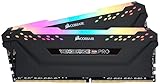
Note the wide height range: low-profile modules like the CORSAIR Vengeance LPX sit at about 1.3 inches (3.3 cm) tall, while tall RGB heatspreaders such as the Vengeance RGB PRO reach roughly 2.3 inches (5.8 cm). That difference matters if a CPU air cooler overhangs your first RAM slot.
How to Measure Your Space
- Check your motherboard’s RAM slots. Count them (most consumer boards have 2 or 4) and note whether your CPU cooler overlaps the first slot. Measure the clearance from the top of the slot to the bottom of the cooler shroud with a ruler — you need at least 0.2 inches (5 mm) more than your module’s listed height.
- Measure cooler clearance if you use a tower air cooler. Popular dual-tower coolers like the Noctua NH-D15 or be quiet! Dark Rock Pro 4 can overhang RAM slots. If your clearance is under 1.6 inches (4 cm), choose low-profile modules around 1.3 inches (3.3 cm) tall.
- Check your case’s CPU cooler height limit. This indirectly affects RAM because it determines which coolers fit. If you’re tight on space, a lower-profile cooler frees you to use taller RGB modules.
- Confirm your memory type. DDR4 and DDR5 modules are physically similar (both about 5.25 inches long) but have different notch positions and are not cross-compatible. DDR4 runs at 1.2–1.35V; DDR5 typically runs at 1.1–1.35V stock, with overclocked kits drawing a bit more.
- Plan your slot population. For a dual-channel kit, install modules in slots 2 and 4 (usually the second and fourth from the CPU). Leave empty slots adjacent to tall heatspreaders so nothing blocks airflow or future upgrades.
- Verify power supply headroom. RAM itself draws very little — roughly 3–5W per module — so no PSU upgrade is needed. Your GPU and CPU dominate power draw.
By Room or Use Case
Living Room Gaming PC / Couch Gaming
Small-form-factor builds under 20 liters dominate the living room, and space is at a premium inside them. Go with 16GB (2 x 8GB) if you play esports and indie titles, or 32GB (2 x 16GB) if you want headroom. Choose low-profile modules around 1.3 inches (3.3 cm) tall to avoid clearance issues with compact coolers. Expect to pay $45–$120 for DDR4 16GB kits or $100–$250 for DDR5 32GB kits.
Desk Setup for Competitive and AAA Gaming
This is where 32GB earns its keep. Modern AAA releases with high-resolution texture packs routinely push past 16GB of system memory, and having 32GB means background apps — Discord, Chrome, a launcher or two — never force your game to swap. A kit like the CORSAIR Vengeance LPX 32GB (2 x 16GB) DDR4 at 3200MHz runs about $249.99, while RGB-trimmed equivalents such as the Vengeance RGB PRO 32GB hover around $258.43. On newer DDR5 platforms, a 32GB kit at 6000MHz — the current sweet spot for AMD and Intel — runs roughly $300–$510 depending on lighting and binning.
Streaming and Content Creation Rig
If you stream while gaming, run OBS, and keep a browser with chat open, 32GB is the minimum; 64GB is the comfortable target. Encoding is CPU- and GPU-bound, but running out of RAM mid-broadcast causes stutters no encoder setting can fix. Budget $180–$520 for a quality 64GB DDR4 or DDR5 kit, and stick to two modules (2 x 32GB) rather than four to keep signal integrity clean at high speeds.
Home Office That Doubles as a Gaming Station
A hybrid work-and-play machine benefits most from 32GB: video calls, spreadsheets, and dozens of browser tabs by day, then games at night. Standard-height RGB modules are fine here since these builds usually use stock or low-profile coolers with plenty of clearance. A 16GB DDR5 starter kit such as the Corsair Vengeance RGB RS 16GB (2 x 8GB) at 6000MHz lists around $285.99, but stepping up to the 32GB version at roughly $505.99 is usually the better long-term buy if your workload is memory-hungry.
Common Sizing Mistakes
- Buying 8GB to save money. You’ll save $40–$60 up front and lose far more in stutters and texture pop-in on modern titles. Treat 16GB as the absolute floor.
- Buying four modules instead of two. A 2 x 16GB kit outperforms and outlasts a 4 x 8GB setup at the same capacity — fewer slots populated means better overclocking headroom and an easier upgrade path.
- Ignoring module height. A 2.3-inch (5.8 cm) tall RGB heatspreader under a tower cooler simply won’t fit in some builds. Measure before you buy.
- Mixing DDR4 and DDR5. They look similar but have different notches and voltages. Check your motherboard spec sheet — DDR4 boards cannot accept DDR5 modules and vice versa.
- Chasing extreme speeds over capacity. Going from 5200MHz to 7200MHz DDR5 yields small gains in most games; going from 16GB to 32GB can eliminate stutter entirely. Capacity first, then speed.
- Forgetting dual-channel. A single 32GB stick performs worse than a 2 x 16GB kit. Always buy matched pairs for gaming.
FAQ
Is 32GB of RAM overkill for gaming?
Not anymore for most players. Esports-only gamers can stay at 16GB, but modern AAA games plus a browser, Discord, and a launcher routinely exceed 16GB of usage. At $90–$280 for a 32GB DDR4 kit, the price premium over 16GB is small enough that 32GB is the smarter buy for a new build.
Does RAM speed matter more than capacity?
Capacity matters more up to about 32GB. Below that, running out of memory causes far bigger performance drops than any speed difference. Once you have enough capacity, speed helps — especially on AMD Ryzen systems, where DDR5 at 6000MHz with tight timings is a well-matched pairing.
How tall are RAM sticks, and will they fit under my cooler?
Standard desktop DIMMs are 5.25 inches (13.3 cm) long. Heights range from about 1.3 inches (3.3 cm) for low-profile sticks to 2.3 inches (5.8 cm) for tall RGB heatspreaders. Measure the clearance from your motherboard’s first RAM slot to your cooler; if it’s under 1.6 inches (4 cm), buy low-profile modules.
Should I buy DDR4 or DDR5 in 2026?
If you’re building a brand-new system, choose DDR5 — it’s the current platform standard and DDR5 kits at 6000MHz are now affordably priced. If you’re upgrading an existing DDR4 motherboard, a 32GB DDR4 3200MHz kit remains excellent value, and there’s no reason to replace a working platform just for DDR5.


