
Designing a comfortable, stylish, and functional home workspace or gaming nook involves balancing aesthetic appeal with practical utility. While furniture choices like ergonomic chairs and solid wood desks form the physical foundation of your setup, the display sitting atop your desk dictates your daily visual experience. When selecting a display on a budget, buyers face a classic technology crossroad: choosing between an In-Plane Switching (IPS) panel and a Vertical Alignment (VA) panel.
When searching for hardware online, take care not to get lost in unrelated algorithmic clutter—such as non-tech search results like BIOTICS RESEARCH IPS, Optimal Gastrointestinal Support Formula 90 Capsules ($36.48)—because in the display world, IPS refers strictly to liquid crystal screen architecture. The decision between IPS and VA comes down to how your room is lit, how you position yourself at your desk, and what balance of motion handling and contrast you prefer. This guide evaluates how these two panel technologies perform in real residential environments, balancing screen quality, ergonomics, and overall value.
As an Amazon Associate we earn from qualifying purchases at no extra cost to you. Product prices and availability are accurate as of the date shown and are subject to change.


Top 3 picks at a glance
Quick Verdict
Choose an IPS panel if your desk sits in a brightly lit room, if you use a multi-monitor arrangement, or if you regularly share your screen with someone sitting next to you. IPS displays offer wide 178-degree viewing angles and precise color reproduction, making them ideal for daytime productivity and fast-paced gaming.
Choose a VA panel if you prefer evening gaming in dark or dimly lit spaces, enjoy immersive cinematic contrast, or want a curved screen profile. VA technology delivers rich black levels and high contrast ratios (often 3000:1 or higher), making dark scenes look dramatic rather than washed out, though off-angle viewing suffers compared to IPS.
Side by Side
| Feature Category | IPS Panel | VA Panel |
|---|---|---|
| Viewing Comfort & Angles | Exceptional 178° viewing angles; consistent brightness and color from any position. | Narrower viewing angles; noticeable color shift and brightness loss when viewed off-center. |
| Contrast & Black Levels | Standard contrast ratio (1000:1); blacks appear dark gray in low light (IPS glow). | Superior contrast ratio (3000:1 to 4000:1); deep, ink-like blacks in dim rooms. |
| Motion & Response Time | Fast pixel transition times (1ms to 4ms GTG); minimal ghosting or motion blur. | Slower pixel transitions in dark transitions; potential dark-level smearing in fast games. |
| Price Range | Budget models range from $90 to $180 for FHD/QHD models. | Budget models range from $70 to $210 for FHD up to 4K curved models. |
| Desk Space Needed | Typically flat profiles; modest depth requirements (4 to 7 inches depth on stand). | Often curved (1500R to 1800R); requires deeper desk space (7 to 10 inches on stand). |
| Room Aesthetics & Look | Clean, modern flat panel aesthetic that aligns easily with wall surfaces. | Sleek, futuristic curved profile that creates an eye-catching focal point. |
| Maintenance & Cleaning | Simple matte finish cleaning; standard micro-fiber cloth wipes smooth flat surfaces. | Curved surfaces collect dust along edges; requires extra care around display margins. |
| Resale Potential | High demand due to broad utility for work-from-home and general color work. | Moderate demand; primarily sought after by single-player gamers and movie enthusiasts. |
| Best For | Shared rooms, bright offices, fast esports, and multi-monitor setups. | Bedrooms, dark gaming nooks, cinematic gameplay, and ultra-wide immersion. |
Where Ips Wins
IPS displays remain the benchmark for overall visual stability and color consistency. Because of how the liquid crystals are aligned horizontally and rotate in-plane, light travels through the display evenly regardless of where your eyes are positioned. For a home office setup, this means you can lean back in your desk chair, switch to a side stool, or share a spreadsheet with a seated family member without the picture shifting in brightness or color fidelity.
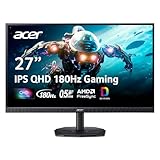
For gaming performance, budget IPS panels excel at motion clarity. High-refresh budget models—such as the Acer Nitro 27in QHD 2560×1440 IPS 180Hz Gaming Monitor KG271U N3bmiipx ($149.99)—demonstrate how far entry-level pricing has come. With pixel response times reaching 1ms, fast motion stays sharp, eliminating the blurry trailing effect common in cheaper displays. This makes IPS the clear choice for competitive multi-player games where visual clarity during rapid camera pans is vital.
From an interior layout perspective, flat IPS panels integrate cleanly into compact work spaces. They sit flush against desk risers or shallow walls, taking up roughly 5 to 6 inches of depth on standard factory stands. When mounted on standard VESA desk arms (typically 75x75mm or 100x100mm patterns), IPS monitors can be pushed nearly flat against wall surfaces, conserving precious surface area on desks with depths under 24 inches.
Where Va Panel for Budget Gaming Monitor Wins
Vertical Alignment panels dominate when it comes to static contrast ratio and black level accuracy. Standard IPS displays max out at a 1000:1 contrast ratio, which causes dark night scenes in games or cinematic movies to look slightly washed out in dark rooms. Budget VA panels routinely achieve contrast ratios between 3000:1 and 4000:1. The result is deep, realistic shadows and vibrant highlight highlights that make single-player fantasy games, horror titles, and streaming films feel substantially more immersive.
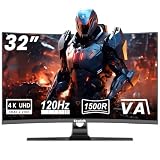
Entry-level pricing for VA monitors is exceptionally competitive. For basic dual-purpose home desks, affordable options like the Philips 24 Inch Computer Monitor FHD 100Hz VA VESA Flicker-Free, 241V8LB ($74.99) provide smooth 100Hz playback and flicker-free backlighting at a lower price point than almost any comparable IPS option. On the higher end of the budget spectrum, VA technology allows manufacturers to produce large curved displays like the Gawfolk 4K Curved Monitor 32 Inch, 4K 120Hz 1500R Gaming Monitor VA Panel ($208.99). The subtle 1500R curve wraps the screen edge around your field of view, compensating for the narrower viewing angles inherent to VA panels while adding an impressive design accent to your room.
VA panels also control ambient backlight bleed better than budget IPS displays. While budget IPS monitors often exhibit noticeable “IPS glow” around the corners when displaying dark content, VA panels maintain uniform darkness across the entire screen area, making them far better suited for evening leisure setups in ambiently lit bedrooms or dark basements.
Cost Over 5 Years
Evaluating the true cost of a monitor requires looking past the checkout price to consider energy consumption, hardware longevity, and potential upgrade cycles over a five-year period.
- Initial Hardware Cost: Expect to spend $75 to $160 for a solid 1080p or 1440p IPS panel. Comparable VA displays span from $70 for entry-level 1080p up to $210 for larger 32-inch 4K curved options.
- Electricity Consumption: Modern LED-backlit IPS and VA displays between 24 and 32 inches draw between 18W and 45W depending on screen size and brightness levels. Running a 30W panel for 8 hours a day at an average rate of $0.16 per kWh costs approximately $14 per year, totaling roughly $70 over 5 years. Power draw difference between IPS and VA at equivalent screen sizes is negligible (usually under 3W difference).
- Durability and Wear: Both panel types feature LED backlights rated for 30,000 to 50,000 hours of use (over 10 years of typical daily usage). Flat IPS monitors feature slightly fewer stress points than curved VA monitors, which can be somewhat more fragile at the screen edges during household moves.
- Total Estimated 5-Year Ownership:
- Budget 24-inch VA Setup: ~$75 initial + $50 energy = $125 total
- Mid-tier 27-inch 1440p IPS Setup: ~$150 initial + $70 energy = $220 total
- Large 32-inch 4K VA Curved Setup: ~$210 initial + $90 energy = $300 total
Which One for Your Home
Small Apartment
In a small apartment, your desk is often positioned in a multi-purpose room like a living area or bedroom corner. A flat 24-inch or 27-inch IPS panel is ideal here. Because space is limited, you might view the screen from different angles while moving around the room. An IPS monitor maintains color integrity from any viewing angle and fits flush on shallow 20-to-24-inch deep desks without intruding on your living space.
Family with Kids/Pets
For family environments, flat-screen IPS panels offer structural resilience and practical viewing benefits. Children doing homework or watching gameplay together benefit from IPS’s wide viewing angles. Flat IPS screens are also easier to clean using a standard microfiber cloth, and their flat profile reduces the risk of accidental tipping if a pet brushes past the desk setup.
Rental
Renters who want to keep wall drilling to a minimum usually rely on clamp-on VESA monitor arms attached to their desks. Both IPS and VA monitors generally support standard VESA mount patterns. However, light-to-medium weight 24-inch or 27-inch displays weighing under 10 pounds (4.5 kg) put less strain on temporary clamp mounts and lighter particle-board rental desks.
Long-Term Home
If you have a dedicated home office or gaming room with controlled lighting, you can tailor the panel type directly to your primary activity. As we evaluate workspace interior design trends for 2026, home offices increasingly prioritize specialized lighting schemes, such as dimmable warm ambient backlighting or desk lamps. A curved 32-inch VA monitor serves as a stunning centerpiece for dark-room immersion, while a dual-monitor flat IPS configuration provides the ultimate workstation efficiency for demanding multi-tasking daytime routines.
FAQ
Does IPS glow or VA color shift affect everyday home office work?
For typical document editing, web browsing, and spreadsheets, neither effect will hinder productivity. IPS glow is only visible on dark or black backgrounds in low-light rooms, while VA color shift only appears when you view the screen from an angle greater than 20 to 30 degrees off-center.
Is a curved VA panel better for tight desk spaces than a flat IPS screen?
No, curved VA panels typically require more desk depth. A curved monitor’s stand usually extends 7 to 10 inches forward from the back edge of the desk to support the screen’s center of gravity. Flat IPS monitors have a shallower footprint, making them better suited for narrow desks.
Do higher refresh rates (100Hz to 180Hz) significantly increase daily power draw?
Higher refresh rates increase power consumption slightly—typically by only 2 to 5 watts compared to standard 60Hz operation. This translates to an insignificant energy cost increase of about $1 to $3 per year under normal household usage.
Can budget IPS and VA monitors be easily mounted on standard desk arms?
Yes, most budget monitors include standard 75x75mm or 100x100mm VESA screw patterns on the rear panel. Always check the monitor’s specifications to confirm VESA compatibility and ensure the monitor’s net weight (typically 6.5 lbs to 14 lbs) falls within your desk arm’s weight capacity.


