
The Short Answer
It depends, but for most buyers, an extended warranty is not worth it for a budget graphics card unless the warranty costs less than 15% of the card’s price and you plan to keep the card for more than two years. For a card like the QTHREE GeForce GT 210 at $37.99 or the ZOTAC GeForce GT 730 Zone Edition at $88.33, a typical $15 to $25 extended plan often costs 25% to 65% of the hardware itself, which wipes out the value. If you can get coverage for $5 to $10 and you rely on the PC daily for work or school with no backup graphics option, it can make sense. Otherwise, you are better off putting that money toward a replacement fund.
Budget GPUs are inexpensive to replace, relatively reliable when used within spec, and often become obsolete before they fail. That math changes only when downtime would cost you more than the card.
As an Amazon Associate we earn from qualifying purchases at no extra cost to you. Product prices and availability are accurate as of the date shown and are subject to change.

What You Actually Get
A budget graphics card is designed to handle basic display output, light media playback, and older or less demanding games, not heavy 3D workloads. Understanding what an extended warranty actually covers helps you decide if it adds real protection.
Most manufacturer warranties for cards in this class last one to two years and cover defects in materials and workmanship — things like a dead-on-arrival card, artifacting caused by faulty VRAM, or a fan that fails in the first few months. A retailer or third-party extended warranty typically picks up after that period ends and extends coverage for an additional one to three years.
What is covered is usually narrow: mechanical or electrical failure during normal use. What is not covered is broader: damage from improper installation, power surges without a surge protector, overclocking, mining, physical damage, dust buildup from lack of cleaning, or driver and software issues. Many plans also require you to ship the card at your own expense for inspection, and the remedy is often a refund of the purchase price or a replacement with a comparable refurbished model, not necessarily the exact same card.
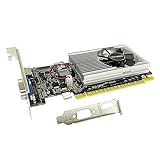
For context on the hardware itself, these cards are small and low power. The QTHREE GT 210 is a low-profile, single-slot card measuring about 5.9 x 2.7 inches, weighing roughly 0.3 to 0.4 pounds, and drawing only about 30 to 31 watts, so it can run without an extra power connector. The ZOTAC GT 730 Zone Edition is also low-profile and passively cooled, measuring about 5.7 x 4.4 x 0.6 inches, weighing about 0.6 to 0.7 pounds, and drawing around 49 watts. Both use PCI Express 2.0 x16 interfaces and are designed for small form factor (SFF) office PCs and home theater PCs. Because they run cool and have no or minimal moving parts, especially the passive GT 730, the failure rate from thermal stress is lower than with high-wattage gaming cards that pull 150 to 350 watts.
As of 2026, most budget cards in the $35 to $90 range are still treated as consumable components by manufacturers, which is why replacement stock is limited after 18 to 24 months and warranty fulfillment often becomes a store credit.
Pros
- Protection against early failure after the factory warranty ends: If a capacitor or memory module fails at month 18, a plan that cost $8 to $12 can save you from paying $38 to $88 again. This matters most if your PC has no integrated graphics fallback.
- Peace of mind for daily-use PCs: For a home office, point-of-sale system, or family computer used for schoolwork where any downtime means lost productivity, the predictability of a replacement or refund has value even if the dollar amount is small.
- Simple replacement process with retail plans: Some retailer plans offer an immediate replacement or gift card in-store without waiting weeks for manufacturer RMA inspection, which can mean one day of downtime instead of two to three weeks.
- Coverage for fan failures on actively cooled budget cards: The QTHREE GT 210 uses a small 40mm to 50mm fan that can wear out after 15,000 to 20,000 hours. An extended plan that covers fan and heatsink assembly failure can extend the usable life of the card without a DIY repair.
- Hedge against rising low-end prices: Even budget cards fluctuate between $35 and $110 depending on supply. Locking in replacement value at today’s price protects you if equivalent cards cost $15 to $30 more a year from now.
- Transferable value for refurbished replacements: If the plan refunds your purchase price as store credit, you can put that $38 to $88 toward a newer, more efficient low-profile card instead of being locked into the same old model.
Cons
- Poor cost-to-coverage ratio: A $19.99 two-year plan on a $37.99 card is 52% of the purchase price. You could buy a second QTHREE GT 210 as a cold spare for less than the cost of two warranty renewals.
- Exclusions eliminate common real-world failures: Most failures users attribute to the card — black screens from driver conflicts, HDMI handshake issues, or system instability from a weak 250 to 300 watt power supply — are not covered because they are not hardware defects.
- Depreciation makes refund less useful over time: After two years, a $88.33 GT 730 Zone Edition is often worth $40 to $60 used, so a refund of the original price sounds good on paper but you may have already outgrown the card’s performance for newer displays or 4K video decoding needs.
- Claims process can cost time and shipping: Third-party plans often require you to pay $10 to $15 for insured shipping each way, plus 10 to 20 business days for evaluation. For a card you need tomorrow, that delay negates the benefit.
- Overlapping protection you already have: Many credit cards automatically extend manufacturer warranties by up to one year at no cost, and some retailers allow 30-day returns or exchanges. An extra paid plan may duplicate that coverage.
- Low failure rate under intended use: When run at stock settings in a clean case with a decent 300 watt or higher power supply and temperatures under 75 degrees Celsius, these low-power cards have relatively low annual failure rates. Paying for insurance against a 3% to 7% risk is statistically a losing bet across multiple purchases.
Who Should Buy It
You should consider the extended warranty if you check most of these boxes. First, the cost is genuinely low — $7 to $13 for two years, or under 15% of what you paid. Second, you do not have backup graphics. Many office desktops with Intel Core i3 or AMD Athlon systems from the last decade do have integrated graphics, but if yours does not, or if you disabled it, losing the card means losing the whole PC.
It also makes sense if you use the PC to earn income and cannot afford a day without it, if you are buying the card for a remote location where shipping a replacement quickly is difficult, or if you are outfitting multiple small office PCs and want predictable replacement budgeting. For a charity, school lab, or small business deploying five to ten ZOTAC GT 730 cards at $80 to $90 each, a bulk warranty plan with advance replacement can be operationally valuable even if it is not financially optimal per unit.
In short, buy the coverage when the price is low, downtime is expensive, and you plan to keep the card installed for 30 to 48 months.
Who Should Skip It
Skip the extended warranty if the plan costs more than $15 on a sub-$50 card or more than $20 on a sub-$90 card. At that point, self-insuring is cheaper. Put $10 to $20 into a savings envelope or set aside the card’s original box — in 18 months that money plus a small top-up will buy you a newer GT 1030-class or used GTX 1050-class low-profile card that outperforms both the GT 210 and GT 730.
You should also skip it if your CPU has integrated graphics (Intel UHD 610 or better, AMD Radeon Vega 3 or better), if you have a spare card in a drawer, if you upgrade frequently, or if you are comfortable buying used. The used market for these cards is strong between $25 and $55, and a replacement can arrive in two days from most major retailers. Gamers, even casual ones, should also skip it — you will likely want to replace a 1GB DDR3 or 4GB DDR3 card for performance reasons long before a warranty would pay out.
Finally, skip third-party plans that require you to mail the card to a depot and do not offer instant store credit. The shipping cost and wait time often exceed the value of the card.
Cheaper Alternatives
If you want protection without paying for a full extended warranty, these options give you most of the benefit for less money.
| Option | Cost | Trade-off |
|---|---|---|
| Self-insure with a replacement fund | $0 upfront, save $10 to $20 | You cover the full cost if it fails early, but you keep the money if it does not fail, which is the most common outcome |
| Use credit card extended warranty benefit | $0 if card offers it | Usually adds 1 year only and requires proof of purchase; reimbursement can take 2 to 4 weeks |
| Buy a cold spare budget card | $35 to $55 used, $38 to $88 new | Immediate swap with zero downtime, but you pay upfront and need to store the spare properly |
| Rely on CPU integrated graphics as backup | $0 | Performance may drop for multi-monitor or HDMI audio setups, but system remains usable for web, office, and 1080p video |
| Retailer 30-day return plus manufacturer warranty | Included in purchase | Covers the highest-risk period for defects; no protection after month 12 to 24 |
FAQ
How long does a budget graphics card typically last without an extended warranty?
Under normal desktop use — 6 to 10 hours per day, clean case, 65 to 75 degrees Celsius max load — most low-power cards like the GT 210 and GT 730 last 4 to 7 years. Fan-bearing wear is the usual first failure point on actively cooled models after 3 to 5 years, while passively cooled cards like the ZOTAC Zone Edition often last longer because there is no fan to fail. Capacitors and solder joints age more slowly at 30 to 49 watts than at 150 watts and above.
Will an extended warranty cover my card if I use it in a small form factor PC with limited airflow?
Only if the failure is deemed a manufacturing defect. If the warranty provider determines the card failed due to sustained overheating from blocked vents, dust, or operating above the rated 0 to 35 degrees Celsius ambient temperature, they can deny the claim as improper environment or lack of maintenance. Keep vents clear, clean dust every 3 to 6 months, and ensure your case has at least one exhaust path to avoid disputes.
Is it better to extend the warranty or just buy a slightly better card?
For the same $15 to $25 a plan costs, you are often halfway to the price difference between a $38 GT 210 and a $65 to $85 GT 1030 or used low-profile GTX 750 Ti, which uses 30 to 75 watts and offers substantially better 1080p video acceleration. If your current card still meets your needs, save the money. If you were already on the edge of needing more performance for dual 1080p monitors or light photo editing, put the warranty money toward the upgrade instead.
What should I check before buying any extended warranty for a GPU?
Check four things: the exact coverage window and whether it starts after the manufacturer warranty or on day one, the remedy offered (repair, comparable replacement, or purchase-price refund), who pays shipping and how long the turnaround is, and the exclusion list for overclocking, commercial use, and physical damage. Compare the total plan price to the card’s street price. If the plan is more than 15% of the card’s price, if it requires you to pay freight both ways, or if it only offers a prorated refund, consider skipping it.


