
Choosing a new gaming monitor usually comes down to two philosophies: do you want the screen to react to you faster than you can think, or do you want every frame to look like a photograph? That is the practical difference between a 1440p 165Hz panel and a 4K 60Hz panel. One gives you fluidity — up to 165 frames per second, with motion so smooth that competitive shooters and racing games feel physically different. The other gives you density — 8.3 million pixels pushing razor-sharp detail in slow, cinematic single-player games, and making spreadsheets, video editing, and 4K streaming look superb during the day job.
Neither choice is wrong. The honest answer depends on the games you play, the graphics card you own (or plan to buy), and how much of your day the monitor spends on non-gaming work. Below is a practical breakdown to help you decide.
As an Amazon Associate we earn from qualifying purchases at no extra cost to you. Product prices and availability are accurate as of the date shown and are subject to change.



Top 3 picks at a glance
Quick Verdict
Get a 1440p 165Hz monitor if: you play competitive or fast-paced games (Valorant, Apex Legends, Counter-Strike 2, Rocket League), you own a midrange GPU like an RTX 4060 or RX 7700 XT class card, and you want the best price-to-performance ratio. Excellent 27-inch 1440p high-refresh panels now start around $150.
Get a 4K 60Hz monitor if: your gaming leans toward single-player epics, strategy titles, and sims; you also watch a lot of 4K film and TV; or your monitor doubles as a workspace for photo editing or productivity where pixel density matters more than motion. Budget 4K 60Hz panels start near $190, and 4K with a modest refresh bump to 120Hz runs around $270.
If you genuinely split your time 50/50 between esports and cinematic games, note that the 4K tier now includes compromise options — the Dell S2725QS, for example, is a 4K IPS panel with 120Hz and FreeSync Premium at $268.99, which covers a surprising amount of both worlds. But for pure competitive value, 1440p high refresh still wins on raw frames per dollar.
Side by Side
| Factor | 1440p 165Hz | 4K 60Hz |
|---|---|---|
| Resolution / pixel density (27in) | 2560×1440 (~109 PPI) — crisp at typical desk distance | 3840×2160 (~163 PPI) — extremely sharp, ideal for close-up work |
| Motion / refresh rate | Up to 165-180Hz; very low perceived motion blur | 60Hz standard; some models (e.g., Dell S2725QS) reach 120Hz |
| GPU requirement | Midrange cards can push 144+ fps in esports titles | 60 fps at 4K demands a high-end GPU; many buyers use it for non-gaming tasks |
| Typical price range | $130-$250 for 27in IPS models | $190-$350 for 32in curved or 27in flat panels |
| Space needed | 27in models: roughly 24 x 8-18 x 16-20 in; sit comfortably on 47-55 in desks | Often 32in curved: roughly 28 x 8-19 x 17-21 in; needs deeper desk clearance for curve radius |
| Weight | 27in IPS: roughly 9-14 lb with stand | 32in panels: roughly 14-18 lb with stand — check wall-mount rating |
| Power draw | Typically 25-40W in use, under 0.5W standby | Typically 35-55W in use at full brightness; built-in speakers add a little |
| Maintenance | Microfiber cloth and occasional dusting; no special care | Same, plus curved screens need a wider wipe arc; avoid pressure on the panel |
| Look | Thin-bezel flat IPS; blends into minimalist setups | Curved 32in makes a visual statement; immersive for media |
| Resale value | Strong — high-refresh 1440p remains the most-traded tier | Good — 4K holds appeal, but 60Hz-only units date faster as refresh expectations climb |
| Best for | Competitive gamers, esports, fast shooters, budget builds | Cinematic gamers, console-style play, media rooms, hybrid work setups |
Where 1440p 165hz Wins
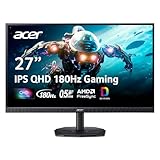
Competitive performance per dollar. At around $149.99, the Acer Nitro KG271U N3bmiipx delivers a 2560×1440 IPS panel with a 180Hz refresh rate — comfortably above the 165Hz baseline most gamers target. At $159.99, the AOC Q27G41ZE pushes to a 260Hz overclocked IPS panel with NVIDIA G-SYNC compatibility. At these prices, no 4K display comes close to this frame-rate class.
Realistic GPU demands. Rendering 1440p at 165 fps takes roughly one-third the GPU work of rendering 4K at 60 fps. A midrange graphics card can genuinely saturate a 1440p high-refresh panel in esports titles, while the same card would struggle to hold 60 fps at native 4K in demanding games.
Lower input lag and better responsiveness. At 165Hz, each frame is displayed for about 6 milliseconds versus about 16.7 milliseconds at 60Hz. That adds up in aiming precision, reaction timing, and the general “connected” feel of mouse movement.
Easier on smaller desks. A 27-inch 1440p monitor weighs less, needs less depth, and pairs well with monitor arms rated for lighter loads — useful in apartments and dorms.
Where 4k 60hz Gaming Monitor Wins
Image sharpness. 4K packs four times the pixels of 1440p. In a 32-inch curved panel like the Gawfolk UHD monitor ($189.99), text is crisper, textures resolve more detail, and slow-paced games — Red Dead Redemption 2, Baldur’s Gate 3, flight and truck sims — look stunning even at 60 fps.
Media and hybrid use. 4K is the native resolution of modern streaming, Blu-ray, and console ecosystems. A 4K monitor is also a superior photo- and video-editing surface, and a 32-inch screen with built-in speakers can replace a small TV in a bedroom or studio apartment.
Cinematic gaming without esports pressure. Many single-player games are enjoyed perfectly well at 60 fps. If competitive advantage isn’t your priority, the sharpness dividend is worth more than refresh rate.
Optional middle ground. If 60Hz feels limiting, the Dell S2725QS ($268.99) offers 4K IPS at 120Hz with FreeSync Premium — a compelling hybrid for buyers who want both density and decent motion, at a price still below many premium 4K 144Hz panels.
Cost Over 5 Years
Monitors are low-maintenance purchases, so the five-year cost is mostly purchase price plus modest electricity, with a realistic consideration of resale.
- 1440p 165Hz path: $130-$250 upfront. Power draw of roughly 30W used 6 hours daily works out to about 33 kWh per year, or roughly $4-$5 annually at typical U.S. rates — around $20-$25 over five years. Expect to recoup $50-$90 reselling a working high-refresh panel. Five-year net: roughly $85-$225.
- 4K 60Hz path: $190-$350 upfront. At roughly 45W for the same usage, figure about 50 kWh per year, or $6-$7 annually — around $30-$35 over five years. Resale on 60Hz-only panels is softer; expect $60-$120 back. Five-year net: roughly $105-$325.
Neither tier involves consumables beyond, at most, a replacement cable ($10-$20). The real five-year variable is satisfaction: a high-refresh buyer who later craves 4K sharpness, or a 4K buyer who discovers esports, may end up buying twice. Choose honestly based on how you actually play.
Which One for Your Home
Small apartment or studio
A 27-inch 1440p high-refresh monitor is the smarter fit. It weighs under 15 pounds, mounts easily, leaves desk depth for a keyboard and dinner leftovers, and draws less power if your electricity is bundled into rent caps. If the monitor must double as your TV, though, a 32-inch 4K curved panel with built-in speakers — like the Gawfolk at $189.99 — earns its footprint by replacing two devices.
Family with kids or pets
Durability here is about placement and stand stability more than panel spec. A 27-inch flat monitor on a wide, weighted base is harder to knock over and cheaper to replace if disaster strikes. Keep any screen out of paw and claw reach; IPS panels are scratch-resistant but not scratch-proof. For shared family gaming — party games, Minecraft, couch-adjacent consoles — the sharper 4K picture at 32 inches is friendlier to multiple viewers, since no one sits close enough to notice 60 fps versus 165.
Rental you may leave within a few years
Optimize for resale and portability. High-refresh 1440p monitors hold value better and sell faster on the used market because demand for competitive-grade 1440p remains constant. A 27-inch panel is also a one-person move; a 32-inch curved 4K display is bulkier to pack and more prone to transit damage. If you move frequently, weight and box size matter.
Long-term home or dedicated gaming room
This is where you invest. A 4K panel at 120Hz, like the Dell S2725QS, is a set-and-forget choice for the next five-plus years — sharp enough for work, smooth enough for games, and generous for movie nights. If your dedicated room is strictly for gaming and your GPU is up to the task, pair a premium 4K display with a high-end card. If the room is esports-first, a 260Hz-class 1440p panel like the AOC Q27G41ZE will outlive your interest in anything slower.
FAQ
Can a 4K 60Hz monitor display 1440p content well?
Yes. Since 1440p is exactly one-quarter of 4K, it scales cleanly with no odd artifacts. Games rendered at 1440p on a 4K panel look noticeably softer than native 4K but still better than 1080p stretched to either size.
Is 165Hz noticeable over 60Hz for casual gaming?
For most people, yes — even in slow games, mouse movement and scrolling feel dramatically smoother. Whether it’s worth the trade-off in resolution is personal, but the motion difference is not subtle.
Do I need an expensive GPU for 1440p 165Hz?
Not necessarily. Esports titles like CS2, Valorant, and Rocket League reach 165+ fps on midrange and even some budget GPUs. Demanding AAA games at 165 fps require a high-end card, but adaptive sync (G-SYNC/FreeSync) makes fluctuating frame rates tolerable.
Is 4K 60Hz a bad buy heading into 2026?
Not at all — 60Hz 4K panels remain excellent for cinematic gaming, media, and productivity, and hybrid options like 4K at 120Hz are now affordable. It becomes a poor buy only if competitive gaming is your primary use, where the refresh ceiling will frustrate you long before the resolution impresses you.


