
Choosing between a 650 watt and 750 watt power supply for gaming is not just about hitting a minimum wattage number. The real decision is how much headroom you want for your current build, how much you want to future-proof for GPU upgrades, and how much efficiency and noise matter in the room where you actually game. Both capacities can run a powerful mid-range to high-end gaming PC in 2026, but they serve slightly different buyers. A 650W unit keeps upfront costs low and fits perfectly for streamlined 1080p and 1440p builds, while a 750W unit gives you breathing room for more power-hungry graphics cards, overclocking, and the next generation of components without swapping the PSU.
Top 3 picks at a glance
Quick Verdict
For most gamers building with a single GPU like an RTX 4060 Ti, RTX 4070, or RX 7700 XT paired with a modern 65W to 125W CPU, a quality 650W power supply is enough and saves you $15 to $40 upfront. If you are running an RTX 4070 Super, RTX 4070 Ti, RX 7900 GRE or higher, plan to overclock, or want a PSU that will comfortably handle your next GPU upgrade in the next three to five years, a 750W power supply is the smarter long-term buy. It runs quieter under load, stays in its peak efficiency sweet spot more often, and costs only a little more over its lifespan.
As an Amazon Associate we earn from qualifying purchases at no extra cost to you. Product prices and availability are accurate as of the date shown and are subject to change.
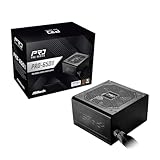


If your budget is tight and your build is locked in, go 650W. If you can stretch to around $55 to $90 and value upgrade flexibility, go 750W.
Side by Side
| Feature | 650 Watt Power Supply | 750 Watt Power Supply |
|---|---|---|
| Comfort (Noise & Heat) | Quiet at idle and moderate gaming loads; fan ramps up sooner when pushed near 500-600W. Typical 120mm fan designs like those on the ASRock PRO-650B stay low-noise up to about 60% load. | More comfortable under sustained load; larger headroom means fan often stays at lower RPM. 120mm low-noise fans on 750W Gold units run quieter at 400-550W gaming loads. |
| Durability | Excellent lifespan when not consistently maxed out. Bronze units typically carry 3 to 5 year warranties, such as the 3-year warranty on the ASRock PRO-650B and 5-year warranty on the MSI MAG A650BN. | Often built with higher-grade capacitors and protections for higher sustained loads. Gold units like the MSI MAG A750GL PCIE5 offer up to a 10-year warranty, while the ASRock PRO 750G offers 3 years. |
| Price Range | $44.99 to $59.73 for quality Bronze non-modular models. Best value for budget-conscious builds. | $54.99 to $89.99 for Gold and PCIe 5.1 ready models. Fully modular options cost more but simplify builds. |
| Maintenance | Non-modular cables require more dust management and cable tying. Clean dust filter every 2-3 months. | Fully modular designs like the MSI MAG A750GL PCIE5 let you use only the cables you need, improving airflow and making cleaning easier. |
| Space Needed | Compact ATX standard: typically 150 x 140 x 86 mm. Easy fit in mid-tower and compact ATX cases. Non-modular requires extra space behind motherboard tray for cable bundle. | Same ATX footprint: 150 x 140 x 86 mm for compact models. Fully modular saves 20-30mm of cable clutter depth, helpful in small cases. |
| Look | Standard black housing with fixed cable bundle. Clean enough with good cable management but less streamlined. | Cleaner look with flat, modular cables and native 12V-2×6 connectors. Dual-color cables and flat routing suit tempered glass builds. |
| Resale | Good demand for budget builders; Bronze units hold value well for 2-3 years. | Stronger resale due to Gold efficiency and ATX 3.1 / PCIe 5.1 readiness. Future buyers specifically seek 750W Gold units. |
| Best For | 1080p/1440p gamers with RTX 4060/4070 or RX 7600/7700 XT, ITX builds where budget matters, and PCs that will not see a major GPU upgrade. | 1440p/4K gamers, RTX 4070 Super and above, overclockers, and anyone who wants to keep the same PSU through a GPU upgrade cycle. |
| Efficiency & Certification | 80 Plus Bronze: ~85% efficient at 50% load. Good for daily gaming without high energy waste. | 80 Plus Gold: ~90% efficient at 50% load. Less waste heat, lower fan noise, and small power bill savings. |
Where 650 Watt Wins
A 650W power supply wins on upfront value and simplicity when your system does not need the extra headroom. For a gaming PC with a combined system draw of 350W to 450W under full gaming load, a 650W unit keeps you in the 50-70% utilization range where efficiency is still strong and protections are not stressed.
Price is the clearest advantage. You can get an ATX 3.1 Ready Bronze unit like the ASRock PRO-650B for around $44.99, or a compact low-noise option like the MSI MAG A650BN for $59.73. That $15 to $35 saving compared to a Gold 750W unit can go toward 16GB more RAM or a 1TB NVMe upgrade that you will feel every day.
650W also makes sense if your upgrade path is modest. If you are pairing a Ryzen 5 7600 or Intel Core i5-14400 with an RTX 4060 Ti and plan to keep that GPU for several years, you do not need to pay for wattage you will never use. These builds typically pull 300W to 380W in demanding games, leaving about 270W of headroom on a 650W supply. That is enough to handle transient spikes, which on modern GPUs can briefly exceed rated power by 10-20%.
Finally, physical compatibility is simple. Both 650W models mentioned use the standard ATX size and a single 120mm fan, so they fit any mid-tower or larger case and most compact ATX cases without clearance issues. For a straightforward build with no plans for a flagship GPU, 650W is the clean, cost-effective choice.
Where 750 Watt Power Supply for Gaming Wins
A 750W power supply wins on headroom, acoustics, and future-proofing. It is the recommended capacity if your gaming load is already 450W to 550W or if you want to leave a comfortable 30-40% buffer for spikes and upgrades. Nvidia and AMD both recommend 650W to 750W for upper mid-range cards, and many RTX 4070 Super, RTX 4070 Ti Super, and RX 7900 XT builds are officially spec’d for 750W.
The headroom translates directly to comfort. A system that draws 500W during a demanding 4K session will load a 650W PSU to 77% and a 750W PSU to 67%. That 10-point difference is where fan noise, capacitor temperature, and efficiency diverge. A 750W Gold unit will stay quieter and cooler because its fan curve is not working as hard and its efficiency peak is closer to your actual draw.
Modern standards are another reason to step up. The MSI MAG A750GL PCIE5 and ASRock PRO 750G are both ATX 3.1 and PCIe 5.1 Ready with a native 12V-2×6 connector, meaning you get a single, spec-compliant cable for next-gen GPUs instead of using two or three 8-pin adapters. The MSI model is fully modular, which cuts cable clutter and improves front-to-back airflow by a measurable margin in compact cases. The ASRock PRO 750G delivers the same Gold efficiency and native connector at $54.99, making 750W Gold surprisingly affordable.
Long-term durability also favors 750W when you choose higher-tier models. The 10-year warranty on the MSI MAG A750GL PCIE5 reflects higher-rated components designed for sustained gaming loads. If you game 3-4 hours daily, that warranty alone can outlast two GPU generations, so you buy the PSU once instead of twice.
Cost Over 5 Years
The purchase price gap is smaller than it looks when you stretch it over five years of ownership.
A quality 650W Bronze unit costs $44.99 to $59.73 upfront. A 750W Gold unit costs $54.99 to $89.99. The difference between a budget 650W Bronze like the ASRock PRO-650B and a budget 750W Gold like the ASRock PRO 750G is only about $10. Between a mid-range 650W Bronze and a premium fully modular 750W Gold like the MSI MAG A750GL PCIE5, the gap is about $30 to $45.
Energy cost favors Gold efficiency. An 80 Plus Gold PSU is about 4-5% more efficient at 50% load than a Bronze unit. For a PC that draws 400W from the components and runs 4 hours per day, that 4% efficiency gain saves roughly 16-20W at the wall, or about 22 to 29 kWh per year. At the U.S. average of $0.16 per kWh, that is $3.50 to $4.60 per year, or $17 to $23 over five years. It will not pay for the entire upgrade alone, but combined with lower heat and noise, it narrows the effective cost gap to near zero if you were already considering a higher-quality unit.
The bigger 5-year cost is replacement. If you buy a 650W now and then upgrade to a GPU that recommends 750W in year two or three, you will spend another $55 to $90 on a new PSU plus your time rewiring the case. Buying 750W up front eliminates that second purchase. Over five years, a single $89.99 fully modular 750W PSU with a 10-year warranty is often cheaper than buying a $44.99 650W now and a second PSU later.
Which One for Your Home
Your living situation changes how much noise, size, and longevity matter.
Small Apartment
Go 650W if you need to keep cost and cable bulk minimal and your desk is close to your bed or living area but your build is modest. For compact mid-towers or small ATX cases under 40L, a 650W non-modular unit is workable, but if you want the quietest experience in a tight space, consider a 750W Gold with a low-noise 120mm fan. The lower load percentage means the fan stays at its quietest setting during late-night gaming sessions, which matters when walls are thin.
Family with Kids/Pets
Choose 750W for resilience and easier maintenance. Homes with pets and kids see more dust and more accidental power cycles. A fully modular 750W unit lets you keep only the cables you need, improving airflow and making it easier to vacuum dust filters and keep intake vents clear. Gold efficiency also means less waste heat exhausted into a family room. Full protection circuits, like OVP, OCP, and SCP found on both ASRock and MSI units, are essential in a busy household.
Rental
Pick based on how long you will stay and whether you pay electricity. If you are in a short-term rental and taking the PC with you, a 650W unit like the MSI MAG A650BN at $59.73 keeps your move light and leaves budget for other home needs. If utilities are included or you want a set-and-forget build you can take to your next home, a 750W Gold fully modular unit packs cleaner and reinstalls faster thanks to detachable cables.
Long-Term Home
Invest in 750W. When the PC stays in a dedicated office or living room for years, the long warranty, native 12V-2×6 support, and upgrade headroom pay off. You can upgrade the GPU in 2-3 years without opening the PSU budget again, and the Gold efficiency helps keep a room that may already run warm from gaming a few degrees cooler. For a homeowner planning to keep the same case and PSU through multiple builds, the MSI MAG A750GL PCIE5 with its 10-year warranty or the value-driven ASRock PRO 750G at $54.99 are both built for that longevity.
FAQ
Is 650W enough for an RTX 4070 or RX 7700 XT gaming PC?
Yes, for most builds. A system with an RTX 4070 or RX 7700 XT plus a 65-125W CPU typically draws 350W to 450W while gaming, so a quality 650W ATX 3.1 Bronze unit provides adequate headroom for transients. If you plan to overclock, use a power-hungry CPU like an Intel i7/i9 K-series at full load, or upgrade to an RTX 4070 Ti or higher, move to 750W for a safer margin.
Will a 750W power supply use more electricity than a 650W?
No. A power supply only delivers what your components demand. A 750W unit does not push 750W continuously. At the same 400W load, a 750W Gold unit will actually waste slightly less energy as heat than a 650W Bronze unit because its efficiency is higher at that load point, so wall power draw can be a few watts lower.
Do I need ATX 3.1 and PCIe 5.1 for gaming?
You do not strictly need it for current GPUs, but it is strongly recommended for any new gaming PSU. ATX 3.1 improves handling of GPU power spikes, and the native 12V-2×6 connector replaces multiple 8-pin adapters with a single, more secure cable. Both the ASRock PRO 750G and MSI MAG A750GL PCIE5 include this, as does the ASRock PRO-650B on the 650W side, making future GPU upgrades plug-and-play.
Is fully modular worth it for a home gaming PC?
For most home setups, yes if your budget allows. Fully modular, like the MSI MAG A750GL PCIE5, lets you connect only the 24-pin, EPS, and PCIe cables you need, which reduces clutter behind the motherboard tray, improves airflow, and makes cleaning and future upgrades faster. Non-modular units like the MSI MAG A650BN or ASRock PRO-650B work fine and cost less, but require more careful cable management, especially in compact cases.


