The best CPU for RX 7900 XT builds in 2026 is the AMD Ryzen 7 9800X3D for high-refresh 1440p gaming; for a better-value 1440p or 4K system, choose the Ryzen 7 7800X3D or Ryzen 5 9600X, depending on local prices. At 4K, the graphics card limits performance more often, so spending extra on the CPU usually brings less benefit than it does at 1440p.
As an Amazon Associate we earn from qualifying purchases at no extra cost to you.



Our Top Picks


Top 3 picks at a glance
Quick picks by resolution and budget
| Build situation | CPU pick | Why it fits | Typical CPU price range |
|---|---|---|---|
| 1440p, high refresh, demanding games | AMD Ryzen 7 9800X3D | Strong gaming performance and extra headroom for CPU-heavy games | Usually $450–$550 |
| 1440p, value-focused gaming | AMD Ryzen 7 7800X3D | Eight gaming-focused cores without paying for the newest tier | Usually $300–$450 |
| 4K gaming, balanced budget | AMD Ryzen 5 9600X | Modern six-core performance is typically enough when the GPU is the limit | Usually $200–$300 |
| Existing AM4 upgrade or tight budget | AMD Ryzen 7 5700X3D | Can extend an AM4 build without replacing its motherboard and memory | Usually $180–$280 |
These are broad market ranges, not fixed prices. Check the total platform cost: a discounted CPU can still lead to a more expensive build if it requires a new motherboard and memory.
Why resolution changes the CPU choice
A CPU prepares game logic, draw calls, and other work for the GPU. When the CPU cannot keep up, the graphics card may sit below full utilization, frame rates can flatten, and the 1% lows—the slower frames that affect perceived smoothness—can suffer. The RX 7900 XT is fast enough to reveal that limit in some games, especially at 1440p with low settings or a high-refresh display.
At 4K, rendering each frame is much heavier on the GPU. That shifts more of the workload to the RX 7900 XT, so a midrange modern processor can often deliver a similar average frame rate to a flagship gaming CPU. The difference may still matter in simulation games, large multiplayer matches, and other CPU-heavy titles, but it is less consistently valuable.
A practical refresh-rate check
For a 240 Hz display, the frame budget is 1,000 ÷ 240 = 4.17 milliseconds per frame. For 144 Hz, it is 1,000 ÷ 144 = 6.94 ms. That budget is shared across CPU and GPU work; a CPU that takes longer than the target frame time can hold back the system even if the GPU is capable of rendering faster. This is why an X3D processor can make more sense for 1440p at 240 Hz than for 4K at 60–120 Hz.
Resolution alone does not identify the bottleneck. Check GPU utilization and frame-time behavior in the games you play. If lowering graphics settings raises frame rate substantially, the GPU was likely the main limit. If the frame rate barely changes while one or more CPU threads are heavily loaded, a faster CPU may help. Do not use a single utilization reading as proof: game engines, background tasks, and frame caps can complicate the picture.
How the main CPU tiers compare
Ryzen 7 9800X3D: for maximum gaming headroom
Choose the 9800X3D if you target very high refresh rates, play CPU-limited competitive or simulation games, or want a strong gaming processor for a future GPU upgrade. Its extra performance is most useful when the game is not already GPU-bound. For a 4K-first build, compare its price premium against a stronger monitor, larger SSD, or other upgrade you will notice more often.
Ryzen 7 7800X3D: the high-end value alternative
The 7800X3D remains a sensible gaming choice when it costs meaningfully less than the 9800X3D. It offers eight cores and 3D V-Cache, which can benefit games that are sensitive to memory latency. It is a particularly good fit for 1440p if you want high frame rates but do not need the newest top-tier CPU.
Ryzen 5 9600X: a sensible 4K pairing
The 9600X is a six-core AM5 option for builds where gaming is the priority and 4K resolution puts most of the load on the GPU. It is also a reasonable 1440p choice if you play visually demanding single-player games at high settings rather than chasing the highest possible frame rate in every title. For heavy streaming, rendering, or frequent content creation, consider a higher-core-count processor instead.
Ryzen 7 5700X3D: keep an AM4 system longer
If you already own a compatible AM4 motherboard and DDR4 memory, the 5700X3D can be a cost-effective upgrade. Confirm that your motherboard supports it and update the BIOS before installation if required. Starting a new build on AM4 is a different calculation: the older platform may save money upfront, but AM5 gives you access to newer processors and DDR5 memory.
Platform cost, power, and cooling
Compare full platform totals, not CPU prices alone. An AM5 build needs an AM5 motherboard and DDR5 memory; an AM4 upgrade may reuse existing parts. A practical new-build comparison is:
- AM5: CPU + motherboard + 32 GB DDR5. A 2 × 16 GB DDR5-6000 kit is a common starting point for Ryzen gaming builds, though the final stable memory speed depends on the CPU and board.
- AM4 upgrade: CPU + any required cooler, with existing motherboard and DDR4 retained if compatible. This can be substantially cheaper when the platform is already in place.
- New AM4 build: compare the complete cost with AM5 before buying; older parts are worthwhile only if the savings are clear and you accept fewer future CPU upgrade options.
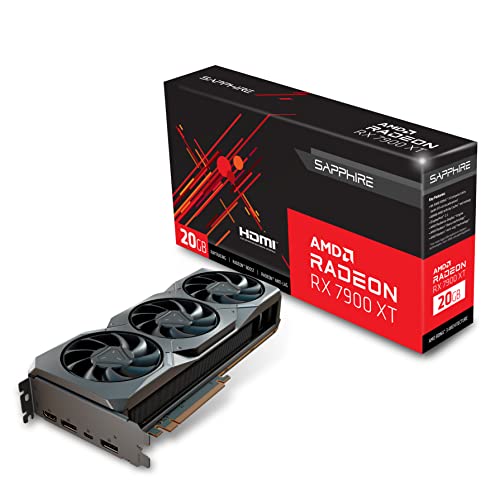
CPU power draw varies with the processor, motherboard settings, and workload. Gaming consumption is not the same as the advertised thermal design power, so treat the figures below as planning estimates rather than guaranteed measurements. The RX 7900 XT itself can draw roughly 300–320 W under demanding gaming loads. Add the CPU, the rest of the PC, and some headroom when sizing the power supply.
| CPU tier | Approx. CPU package power in heavy gaming | Example system power budget | Practical PSU target for the build |
|---|---|---|---|
| Ryzen 5 9600X | About 50–100 W | 320 W GPU + 80 W CPU + 70 W other parts = 470 W | Quality 750 W unit |
| Ryzen 7 7800X3D or 9800X3D | About 60–140 W | 320 W GPU + 120 W CPU + 70 W other parts = 510 W | Quality 750–850 W unit |
The example adds a 30% margin to the estimated 510 W peak: 510 × 1.3 = 663 W, making a good 750 W PSU a reasonable baseline. Choose 850 W if you want extra upgrade room, have a heavily overclocked system, or prefer more margin for transient spikes. Follow the graphics card manufacturer’s PSU guidance and use separate PCIe power cables where the card’s instructions recommend them.
Choose based on your actual build
- 1440p at 200–240 Hz: start with the 9800X3D; choose the 7800X3D if the savings are substantial.
- 1440p at 144 Hz: compare the 7800X3D and 9600X by total platform price and the games you play. Favor the X3D option for CPU-heavy titles and stronger lows.
- 4K at 60–120 Hz: the 9600X is usually the more balanced new-build choice. Put the savings toward the display or storage unless your games are especially CPU-intensive.
- Already own AM4 and DDR4: check motherboard support and the total cost of a 5700X3D upgrade before replacing the platform.
- Gaming plus frequent production work: weigh core count and workload performance alongside gaming results; the best gaming-focused CPU is not automatically the best rendering or encoding CPU.
Frequently asked questions
Will the Ryzen 5 9600X handle streaming while gaming?
It may, but the article recommends considering a higher-core-count processor for heavy streaming, rendering, or frequent content creation. The 9600X is described as a six-core option suited to gaming-focused builds, particularly when 4K puts most of the load on the GPU.
Can I install a Ryzen 7 5700X3D in my current AM4 motherboard?
Possibly, but first confirm that your motherboard supports the 5700X3D. The article also advises updating the BIOS before installation if required. Keeping your existing compatible motherboard and DDR4 memory can make this upgrade less costly than replacing the platform.
How can I tell whether my RX 7900 XT is being held back by the CPU?
Check GPU utilization and frame-time behavior in the games you play. If lowering graphics settings substantially raises the frame rate, the GPU was likely the main limit; if the frame rate barely changes while CPU threads are heavily loaded, a faster CPU may help. A single utilization reading is not conclusive.
Do I need a new motherboard and memory for a Ryzen 7 7800X3D build?
A new AM5 build needs an AM5 motherboard and DDR5 memory. The article gives a 2 × 16 GB DDR5-6000 kit as a common starting point for Ryzen gaming builds, while noting that the final stable memory speed depends on the CPU and motherboard.
Is a 750 W power supply enough for an RX 7900 XT system?
A quality 750 W unit is described as a reasonable baseline for the example system, which estimates a 510 W peak and adds a 30% margin. Consider 850 W for extra upgrade room, a heavily overclocked system, or more margin for transient spikes, and follow the graphics card manufacturer’s guidance.
Bottom line
For a 1440p high-refresh RX 7900 XT system, the Ryzen 7 9800X3D is the top choice, with the 7800X3D often the smarter buy when discounted. For 4K gaming, the Ryzen 5 9600X typically offers better balance because the GPU is more often the limiting component. If you already have an AM4 system, consider the Ryzen 7 5700X3D as an upgrade rather than paying for a full platform change.