
The best jigsaws for curved cuts in 2026 are the Festool Carvex PS 420, the Bosch JS470E, and the Milwaukee M18 Fuel 2737-20 — but which one suits you depends less on raw power and more on orbital control, blade guidance, and how tight a radius you actually need to cut. Below is a decision-driven breakdown of what matters for scroll work, followed by a comparison table and a matrix matching common use cases to the right tool.
As an Amazon Associate we earn from qualifying purchases at no extra cost to you.

Our Top Picks
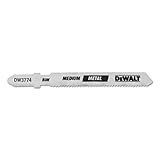
 DEWALT DW3774-5 3-Inch 18TPI Medium Metal Cut CobaltOne Size6.75 x 2.88 x 0.13 inches0.04 PoundsCheck on Amazon

What Actually Determines Curve-Cutting Ability
Spec sheets emphasize stroke rate and motor watts, but five features matter more when you’re steering through a curve:
- Orbital action settings. Aggressive orbit (setting 3–4) speeds straight cuts but widens the kerf and causes tear-out on tight arcs. A jigsaw that lets you dial back to orbit 0–1 — or a pendulum system with truly independent settings — gives cleaner, tighter curves.
- Blade guidance. Blade deflection is the enemy of accurate curves. Tools with blade guide rollers or parallel guide systems (Festool’s stroboscopic light + triple guide, Bosch’s Precision Control) hold the blade vertical through the turn, preventing the beveled “leaning” cut that ruins stacked workpieces.
- Vibration damping. Low vibration isn’t just comfort — it’s what lets you see and correct your line mid-cut. Barrel-grip designs sit closer to the work and typically track steadier on arcs than D-handle models.
- Shoe visibility and size. A compact shoe with a cut-out front section lets you watch the blade tip. Large oversize shoes are stable for straight rips but block sightlines on interior scrollwork.
- Blade compatibility. Tight curves need narrow blades (5–6 TPI scroll blades or dedicated curve blades ~4 mm wide). A tool is only as capable as the narrowest quality blade it accepts without wobble — T-shank is standard now, and essentially universal.
Minimum Turning Radius: The Math Nobody Publishes
Your minimum achievable radius is set by blade width, not the tool. The geometry is simple: a blade of width w can only turn inside a kerf it has already cleared. As a working rule:
Minimum radius ≈ blade width × 5–8, depending on material thickness and tooth set.
Worked example: a standard 7.5 mm wide wood blade in 18 mm plywood gives a practical minimum radius of roughly 40–60 mm. Switch to a 4 mm scroll blade (e.g., a Bosch T119BO or Makita B-13 class blade) and you can pull a 20–30 mm radius in the same stock. In 40 mm hardwood, that floor roughly doubles — the extra depth means more blade surface resisting the turn, so budget a 50 mm radius minimum even with a narrow blade. If your project requires a sub-20 mm radius, no jigsaw is the right tool; that’s coping saw or scroll saw territory.
Head-to-Head Comparison
| Model | Type | Orbital Settings | Blade Guidance | Vibration Control | Best For |
|---|---|---|---|---|---|
| Festool Carvex PS 420 | Corded, barrel grip | 4 + auto mode | Triple blade guide, strobe light | Excellent | Fine furniture, tightest radius work |
| Bosch JS470E | Corded, top handle | 4 | Precision Control guide system | Very good | All-round curved work, value pick |
| Milwaukee M18 Fuel 2737-20 | Cordless, D-handle | 4 + variable trigger | Blade guide roller | Very good | Site work, mixed materials |
| DeWalt DCS334B | Cordless, barrel grip | 4 | Standard guide | Good | Contractors already on 20V MAX |
| Festool Trion PS 300 | Corded, D-handle | 3 | Carbide guide jaws | Excellent | Precision cuts where barrel grip isn’t preferred |
| Makita XVJ03Z / DJV182 | Cordless, barrel or top grip | 3 | Standard guide | Good | Budget-conscious cordless users |
Price positioning broadly tracks capability: the Festool Carvex sits in premium territory (roughly $350–$500 depending on kit), the Bosch JS470E and cordless flagships land in the $130–$220 body-only or corded range, and solid mid-tier options start around $80–$120.
Performance by Material
Plywood
The forgiving material — but tear-out on the face veneer is the real problem. Run orbit 0 or 1 with a fine down-cut or reverse-tooth blade, and tape the cut line on the show face. Every jigsaw in the table handles plywood curves well; the differentiator is chip clearance on tight radii, where the Carvex’s blower and strobe light genuinely help you stay on line.
Hardwood (oak, maple 25 mm+)
Blade deflection becomes the limiting factor. The Bosch Precision Control and Festool guide systems earn their keep here — standard guide jigsaws will produce visibly beveled edges on curves over 30 mm deep. Drop your feed rate by roughly half versus plywood of the same thickness, keep orbit at 0, and let the stroke rate (2,500+ SPM) do the work. Pushing harder doesn’t speed the cut; it bends the blade.
Laminate and melamine
Use a down-cut blade, orbit 0, and cut from the back where possible. The main risk is chipping at entry and exit points — start the blade at full speed before touching the material, and support the offcut so it doesn’t peel the laminate as it drops. Cordless barrel grips excel here because you’re often cutting installed panels where cord management is awkward.
Decision Matrix
| Your Situation | Recommended Choice | Why |
|---|---|---|
| Fine furniture, fretwork, radii under 30 mm | Festool Carvex PS 420 | Best blade guidance + strobe light for line visibility |
| General DIY, occasional curves, corded power | Bosch JS470E | Precision Control at roughly a third of Festool’s price |
| Jobsite cuts, already own Milwaukee batteries | Milwaukee M18 Fuel 2737 | Brushless power comparable to corded, no platform swap |
| Laminate flooring and countertop cutouts | DeWalt DCS334B (barrel grip) | Low sightline, compact shoe, easy plunge starts |
| Tight budget, thin stock only | Any 3-orbit corded jigsaw + quality narrow blades | Blade choice matters more than the tool under 18 mm |
Settings That Improve Any Jigsaw’s Curves
- Orbit 0 or 1 for any radius under ~150 mm; reserve orbit 3+ for straight rough cuts.
- Full stroke rate, slow feed. Under-speeding the blade while pushing hard is the most common cause of blade wander.
- Narrowest blade that fits the depth. Move from a 7.5 mm to a 4 mm blade whenever the radius drops below ~50 mm.
- Relief cuts. For radii tighter than your blade’s floor, cut perpendicular relief kerfs into the waste side every 10–15 mm — the waste falls away and frees the blade to turn.
- Fresh blades. A dull blade needs more feed pressure, and pressure is what deflects it on curves. Swap blades more often than feels necessary.
FAQ
Barrel grip or D-handle for curves?
Barrel grip generally tracks better on curves because your hand sits lower and closer to the blade’s pivot point, giving finer steering control. D-handle users get better visibility over the shoe for long gentle arcs. Both work — barrel grip is the safer default for scroll-heavy work.
Is a cordless jigsaw as good as corded for curved cuts?
In 2026, brushless cordless flagships match corded stroke rates and cutting speed. The remaining gap is sustained heavy cutting in thick hardwood, where corded tools don’t thermal-throttle. For most curved work in stock under 40 mm, cordless is fully equivalent.
Why does my cut edge come out beveled instead of square?
Blade deflection — usually from feeding too fast, a blade too narrow for the material thickness, or a dull blade. Slow down, move up one blade width, and check that your tool’s guide roller is touching the blade back.


