
The best Prime Day Sony camera deal for creators is the Sony ZV-E10 with its 16–50mm lens: it gives vloggers, streamers, and hybrid creators a large APS-C sensor, interchangeable lenses, a side-opening screen, and a practical path to better audio and low-light quality without the cost of a full-frame kit. Choose the Sony ZV-1 instead if you want the smallest all-in-one setup, the Sony Alpha a7 IV if still photography and full-frame image quality matter most, or the Alpha a6400 if you want a compact interchangeable-lens camera with a viewfinder and strong autofocus. The Ploomen 4K compact camera is the low-cost option for casual travel clips, but it belongs in a different category from Sony’s established creator and interchangeable-lens systems.
Prime Day pricing changes quickly, so the useful question is not simply which camera has the largest discount. The better question is which camera leaves you with the right sensor size, lens flexibility, microphone options, stabilization expectations, and upgrade path after the sale. This guide compares all five listed models by creator type and budget, then works through the practical trade-offs that specifications alone do not show.
Our Top Picks
 Sony ZV-E10 APS-C Mirrorless Camera with 16-50mm LensBase1.8 x 4.5 x 2.5 inches1 poundsCheck on Amazon
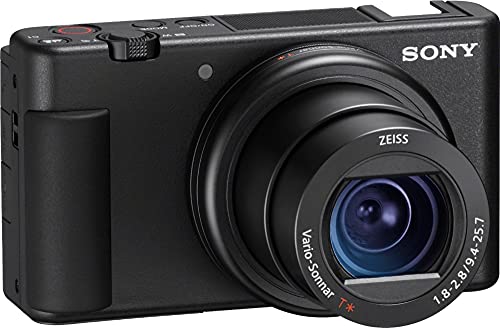 Sony ZV-1 Digital Camera for Content CreatorsCompact4.15 x 2.36 x 1.7 Inches0.6 PoundsCheck on Amazon
 Sony Alpha a7 IV Mirrorless Camera with 28-70mmCompact6.4 x 9.1 x 9.1 inches3.3 poundsCheck on Amazon
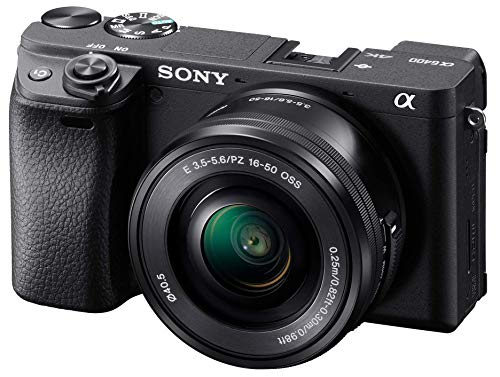 Sony Alpha a6400 Mirrorless Camera: Compact APS-C Interchangeable6.2 x 9.2 x 4.55 inches6.2 x 9.2 x 4.55 inches0.6 PoundsCheck on Amazon
Top 3 picks at a glance


Quick Comparison
| Product | Best for | Key specs and characteristics | Price tier |
|---|---|---|---|
| Sony ZV-E10 with 16–50mm Lens | Most creators, vlogging, streaming, and lens-based upgrades | APS-C mirrorless body, interchangeable lens mount, 16–50mm kit zoom, creator-focused controls, flip screen, built-in microphone, external microphone support | Mid-range |
| Sony ZV-1 | Portable vlogging and ready-to-use travel content | Compact digital camera, built-in zoom lens, flip screen, built-in microphone, 4K recording, creator-oriented operation | Budget |
| Sony Alpha a7 IV with 28–70mm Lens | Full-frame hybrid creators, professional stills, and long-term system investment | Full-frame interchangeable-lens mirrorless camera, 28–70mm kit lens, high-resolution sensor class, advanced autofocus, 4K video, extensive lens ecosystem | Premium |
| Sony Alpha a6400 | Compact photography, travel, and creators who want a viewfinder | APS-C interchangeable-lens camera, real-time Eye autofocus, flip-up screen, electronic viewfinder, compact body, 4K video | Mid-range |
| Ploomen 4K Digital Camera | Casual beginners seeking a low-cost compact camera | Listed 4K digital camera, 56MP listing claim, autofocus point-and-shoot design, 3-inch 180-degree flip screen, built-in compact-camera lens | Budget |
How We Chose
The best Prime Day Sony camera deals for creators should be judged by more than a headline resolution number. The comparison weighs sensor class, lens flexibility, autofocus suitability, screen design, microphone options, portability, and how easily each camera can grow with a creator’s skills. A camera that is inexpensive but forces an immediate replacement after a few months may be a weaker value than a slightly more expensive body with a usable upgrade path.
Category fit also matters. A compact camera should be compared with other compact cameras for convenience, while an interchangeable-lens camera should be judged on the quality and availability of future lenses. The listed Sony models benefit from established camera-system support and recognizable creator features; the Ploomen is considered as a simple budget point-and-shoot rather than as a direct substitute for a Sony lens system. Because sale prices and bundles change, the price labels below use budget, mid-range, and premium tiers instead of fixed product prices.
1. Sony ZV-E10 – Best for most creators
As an Amazon Associate we earn from qualifying purchases at no extra cost to you.
The Sony ZV-E10 is the strongest all-round choice in this group for a creator who wants to start with a simple kit and retain room to improve. Its APS-C sensor is larger than the sensor class normally used in small compact cameras, and its interchangeable lens mount means the camera does not have to be replaced when your subject or shooting style changes. The included 16–50mm lens covers a useful everyday range, from moderately wide framing for a talking-head video to a short telephoto perspective for portraits and detail shots.
It is especially well suited to YouTube presenters, home-studio creators, product demonstrators, travel vloggers, and livestreamers who want a camera that can eventually accept a faster prime lens, a wider lens, or a more specialized zoom. The side-opening screen is useful when the camera is mounted in front of you because it remains visible even when a microphone or accessory occupies the top of the camera. Creator-oriented controls also make it less intimidating than a traditional camera designed primarily around still photography.
- Sensor class: APS-C mirrorless sensor.
- Lens: Included 16–50mm kit zoom with an interchangeable-lens mount.
- Video: 4K recording capability for creator and general video work.
- Framing: Flip-out screen designed for self-recording.
- Audio: Built-in microphone plus support for a more capable external microphone setup.
- System: Compatible with a broad range of lenses and accessories made for its mount.
The main advantage over a fixed-lens compact camera is not just image quality. It is control over the look of the image. A wider lens can make a small room feel less cramped, a brighter lens can help separate a face from the background, and a longer lens can produce a tighter product or interview composition. The 16–50mm kit zoom is also compact enough that the camera remains practical for everyday carry.
There are limits. This camera is not the obvious choice for someone who needs full-frame low-light performance, a professional stills body, or the shortest possible setup. The kit zoom is convenient rather than specialized, and an APS-C body generally provides less extreme background separation than a comparable full-frame camera using a similar field of view. As with many small mirrorless bodies, serious creators should also plan their handling and audio accessories rather than expecting the camera alone to solve every production problem.
Pros
- Excellent balance of price, image potential, portability, and upgradeability.
- APS-C sensor provides a stronger starting point than typical small point-and-shoot cameras.
- Interchangeable lenses support wide, bright, portrait, and specialty shooting styles.
- Flip-out screen and creator-focused operation suit self-recording.
- External microphone support makes it easier to improve sound quality later.
Cons
- The kit lens is versatile but not especially bright for dark interiors.
- It lacks the full-frame look and larger low-light margin of the Alpha a7 IV.
- A complete creator rig may still need a microphone, tripod, light, and spare battery.
- It is less pocketable than the fixed-lens Sony ZV-1.
How it compares
Against the Sony ZV-1, the ZV-E10 is larger and less self-contained, but it offers a much clearer upgrade path. Against the Alpha a6400, it is more directly tailored to video creators because of its creator-oriented design and self-recording emphasis, while the a6400 appeals more strongly to photographers who want an electronic viewfinder. Against the Alpha a7 IV, it gives up full-frame performance and some advanced capability in exchange for a substantially more approachable system cost. For most people buying one camera to learn on and keep using, the ZV-E10 is the safest recommendation.
2. Sony ZV-1 – Best for compact vlogging
The Sony ZV-1 is the most convenient Sony choice for a creator who values a small, ready-to-use camera above lens flexibility. It is a compact digital camera with a built-in zoom lens, flip screen, built-in microphone, and 4K recording, so there is no separate lens to select, carry, or protect. That simplicity makes it appealing for travel videos, family content, casual YouTube work, behind-the-scenes clips, and creators who want a camera that can be packed alongside a phone without building a larger kit.
A fixed-lens camera can be easier to use consistently than an interchangeable-lens body. The lens is always attached, the framing range is available immediately, and there is no risk of buying a body and then discovering that the preferred lens costs more than expected. For a creator who records in good light and mostly wants a noticeable step up from a phone’s ergonomics and handling, this can be a more sensible purchase than a larger system.
- Design: Compact digital camera with a built-in zoom lens.
- Video: 4K recording capability.
- Screen: Flip screen for monitoring self-recorded footage.
- Audio: Built-in microphone designed for creator use.
- Use case: Vlogging, YouTube, travel, and everyday portable content.
The ZV-1’s greatest strength is friction reduction. If the camera is small enough to carry, it is more likely to be available when an idea appears. A flip screen makes solo framing easier, while a built-in lens avoids the dust, bulk, and decision-making associated with an interchangeable-lens system. It can also be less conspicuous in public spaces than a larger body with a long lens.
The compromise is flexibility. You cannot replace the lens with a wider option for a very small room or a brighter option for a dark interior. The compact body also gives you less physical room for controls and accessories than the ZV-E10 or a6400. Its sensor is in a smaller compact-camera class than the APS-C models, so the larger cameras have more latitude for subject separation and difficult light. Creators who expect to buy several lenses should start with the ZV-E10 instead.
Pros
- Small and easy to carry for spontaneous content.
- Built-in zoom lens means no extra lens purchase is required.
- Flip screen supports solo vlogging and self-framing.
- 4K recording and creator-oriented controls cover common online-video needs.
- Usually easier for beginners to operate than a full interchangeable-lens kit.
Cons
- Fixed lens prevents future lens upgrades.
- Smaller sensor class offers less flexibility than the APS-C Sony bodies.
- Compact cameras have less room for accessories and physical controls.
- Less suitable for creators who want to build a long-term lens collection.
How it compares
The ZV-1 is the direct convenience alternative to the ZV-E10. Choose it when “small enough to carry every day” is more important than interchangeable lenses. The Ploomen is another compact option, but the Sony has a clearer creator-oriented identity and a more established camera platform. The a6400 is more capable as a photography system but requires a separate lens and is not as immediately optimized for a simple vlogging workflow. The ZV-1 is therefore the best low-complexity Sony pick, not the best long-term system pick.
3. Sony Alpha a7 IV – Best for full-frame hybrid creators
The Sony Alpha a7 IV with its 28–70mm lens is the premium option for creators who want one camera to cover serious photography, video production, portraits, events, and long-term system growth. Its full-frame mirrorless design places it above the APS-C models in sensor class, while the included standard zoom gives a useful starting range for portraits, travel, documentary work, and general-purpose shooting.
This is the camera to consider when still images are as important as video. A full-frame sensor can provide a broader low-light margin and more control over depth of field when paired with suitable lenses. That does not automatically make every image better, and lighting, lens choice, focus, and composition still matter, but the larger format gives experienced users more room to shape the result.
- Sensor class: Full-frame mirrorless sensor.
- Lens: Included 28–70mm standard zoom.
- Video: 4K recording for high-quality creator production.
- Autofocus: Advanced subject-detection autofocus suitable for hybrid work.
- System: Broad full-frame interchangeable-lens ecosystem.
- Positioning: Premium hybrid body for creators who have outgrown entry-level equipment.
The included 28–70mm lens is a sensible first lens because it covers a normal perspective for interviews and everyday scenes, a moderately wide setting for environmental framing, and a short telephoto setting for portraits. It is not the ideal specialist lens for every job. A creator filming in a narrow room may eventually want a wider lens, while a portrait photographer may prefer a brighter prime. The value of this kit is that it provides a credible starting point rather than ending the upgrade path.
The main drawback is cost and complexity. The body and full-frame lenses can make the total system substantially more expensive than an APS-C kit. A larger sensor does not eliminate the need for lights, clean audio, stable support, and thoughtful exposure. Full-frame lenses can also be heavier, which matters for handheld vlogging and travel. If your output is primarily casual social clips, the a7 IV may spend much of its capability unused.
Pros
- Full-frame sensor class suits demanding stills and hybrid production.
- 28–70mm lens is a practical general-purpose starting point.
- Strong autofocus and 4K capability support professional-looking work.
- Large ecosystem offers a clear route to specialized lenses and accessories.
- More room for creative control over depth of field and difficult light.
Cons
- Premium purchase and ownership cost.
- Full-frame lenses and accessories can be heavier and more expensive.
- More camera than many casual vloggers need.
- The kit zoom is useful but not a replacement for a bright specialist lens.
How it compares
The a7 IV is the clear step up from the ZV-E10 when full-frame performance and advanced hybrid work justify the budget. It is less convenient for a beginner and less portable than the ZV-1. Compared with the a6400, it offers a larger sensor class and a more premium platform, while the a6400 remains attractive for travel photographers who want a smaller body and lower system cost. Choose the a7 IV because you need its headroom, not simply because its specifications are higher.
4. Sony Alpha a6400 – Best for compact photography and travel

The Sony Alpha a6400 is a compact APS-C interchangeable-lens camera that suits photographers and creators who want a small body without giving up a viewfinder or access to a broader lens system. Its real-time Eye autofocus is a particularly useful feature for portraits, people, and moving subjects, while the flip-up screen can help with self-recording and low-angle compositions.
It occupies an interesting middle ground. The ZV-E10 is more obviously designed around creator operation, but the a6400 feels more like a conventional camera for someone who alternates between photography and video. The electronic viewfinder is valuable outdoors, where a rear screen can become difficult to see, and it encourages a more stable, deliberate shooting position for still images.
- Sensor class: APS-C interchangeable-lens mirrorless camera.
- Autofocus: Real-time Eye autofocus for compatible people and subject-focusing situations.
- Screen: Flip-up screen for self-recording and flexible composition.
- Viewfinder: Electronic viewfinder for bright conditions and eye-level shooting.
- Video: 4K recording capability.
- System: Interchangeable lenses and accessories for future expansion.
The a6400 makes sense for a travel photographer who wants one compact body, a small zoom, and the option to add a portrait prime later. It is also a strong choice for a creator who takes stills seriously and does not want a camera designed only around front-facing video. The APS-C format balances image quality, body size, and lens cost more effectively than a full-frame kit for many travelers.
Its flip-up screen is useful, but creators should check how a top-mounted accessory affects visibility. Depending on the microphone or support arrangement, a screen that flips upward may be less convenient than a side-opening screen. That is one reason the ZV-E10 is often the better dedicated-vlogging choice. The a6400 is also more dependent on the user understanding photographic controls, although automatic modes make it approachable.
Pros
- Compact body with an electronic viewfinder.
- APS-C sensor provides a strong balance of quality and portability.
- Real-time Eye autofocus is useful for portraits and people.
- Interchangeable lenses support both photography and video growth.
- 4K recording adds useful video capability to a photography-focused body.
Cons
- Less specifically creator-focused than the ZV-E10.
- Flip-up screen can be less flexible with top-mounted accessories.
- Requires a lens purchase or kit lens to be useful.
- Full-frame users will have more low-light and depth-of-field flexibility.
How it compares
The a6400 and ZV-E10 share the appeal of a compact APS-C lens system. Pick the a6400 if the viewfinder, photography controls, and Eye autofocus are central to your use. Pick the ZV-E10 if your priority is front-facing video, simple creator controls, and a side-opening screen. It is more capable and expandable than the ZV-1, but not as pocketable. It is also more affordable and compact than the Alpha a7 IV, with an APS-C rather than full-frame sensor.
5. Ploomen 4K Digital Camera – Best for a low-cost casual starter

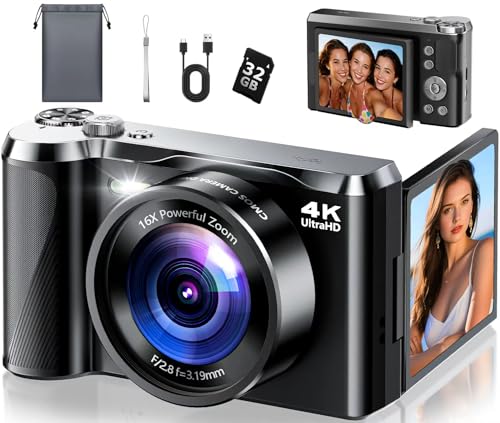
The Ploomen 4K Digital Camera is the budget outlier in this comparison. Its listing describes a 4K digital camera for photography and travel with a 56MP claim, autofocus, a 3-inch 180-degree flip screen, and a point-and-shoot design. Those features position it as an inexpensive compact camera for casual users who want a dedicated device with a forward-facing screen rather than a lens-based system intended for long-term expansion.
It may suit a child, a first-time camera owner, a travel user who wants a simple backup device, or someone making informal clips where convenience matters more than maximum image consistency. The flip screen is useful for self-framing, and the point-and-shoot format reduces the number of decisions between turning the camera on and recording.
- Format: Compact digital point-and-shoot camera.
- Video: Listed 4K recording capability.
- Still-image claim: Listing states 56MP; treat headline resolution separately from sensor quality.
- Autofocus: Listed autofocus functionality.
- Screen: 3-inch 180-degree flip screen.
- Use case: Budget travel, casual photography, and simple self-recorded video.
The important buying distinction is that a high megapixel claim does not, by itself, establish better detail, dynamic range, low-light performance, or autofocus reliability. A camera’s real results depend on sensor size, lens quality, image processing, stabilization, exposure behavior, and the lighting in which it is used. For daylight snapshots and straightforward clips, a compact camera may be sufficient. For work where skin tones, audio, focus transitions, and image consistency matter, the Sony options are safer choices.
The Ploomen also has the least obvious upgrade path. Its appeal is that the initial setup can be inexpensive and simple, but you should not expect to change lenses or build a mature camera system around it. Consider the cost of a memory card, spare battery, charging equipment, and a small tripod when comparing the total purchase. If the price difference to the ZV-1 is small during a sale, the Sony compact may offer the stronger creator-oriented choice.
Pros
- Budget-friendly entry point for casual camera use.
- Point-and-shoot design is simple for beginners.
- 180-degree flip screen helps with self-framing.
- Listed 4K video and autofocus cover basic creator requirements.
- Compact travel format is less intimidating than a larger system camera.
Cons
- Headline megapixel count does not guarantee image quality.
- Limited information about sensor class and long-term system support.
- No interchangeable-lens upgrade path.
- Less suitable for demanding low-light, audio, or professional work.
How it compares
The Ploomen competes most directly with the Sony ZV-1 on simplicity and portability, not with the Sony APS-C and full-frame models on system capability. Choose it when the lowest initial cost and basic operation are the main goals. Choose the ZV-1 when creator-focused operation and a more established compact-camera platform justify spending more. Choose the ZV-E10 if you already know that you will want different lenses or better control over your visual style.
How to Choose
The best Prime Day Sony camera deals for creators depend on what you record, where you record it, and how likely you are to expand your kit. Start with the workflow rather than the camera label. A person filming occasional travel clips has a different definition of value from a person producing weekly studio videos, photographing clients, or building a channel around product demonstrations.
1. Decide whether you need a system camera
A fixed-lens compact camera is the simplest route. The Sony ZV-1 and Ploomen are ready to use without choosing a lens, which reduces cost and weight. This is useful if you want to place the camera in a small bag, record quickly, or avoid learning the differences between wide, normal, and telephoto lenses.
An interchangeable-lens camera is the better choice when your shooting environments will change. The ZV-E10 and a6400 use an APS-C system, while the a7 IV uses a full-frame system. With a system camera, you can replace a general-purpose kit zoom with a wider lens for a cramped room, a brighter lens for indoor work, or a longer lens for distant subjects. That flexibility is the main reason to buy beyond a compact camera.
2. Match sensor class to lighting and background separation
Sensor size affects more than marketing image quality. Larger sensors can provide more flexibility in dim conditions and make it easier to obtain shallow depth of field with an appropriate lens. APS-C models such as the ZV-E10 and a6400 offer a useful balance for most creators. They are generally smaller and less expensive to build around than full-frame systems.
The a7 IV’s full-frame sensor is most valuable when you regularly shoot portraits, events, interviews, or still images in challenging light and want greater control over the final look. It is not automatically the right choice for a creator who records in a brightly lit room with a fixed camera position. A good light placed close to the subject can improve footage more visibly than moving from an APS-C body to a premium full-frame body.
3. Choose the right field of view for your room
Self-recording usually needs a wider view than ordinary portrait photography. A camera placed roughly an arm’s length away must show your face, upper body, and some surrounding context without forcing you against the wall. The ZV-E10’s 16–50mm kit zoom gives you room to experiment, while the a7 IV’s 28–70mm kit lens begins at a less expansive perspective on a full-frame body.
As a practical setup, place the camera far enough away that your elbows or upper torso fit comfortably in the frame, then leave a little space above your head. If the widest setting still feels tight, move the camera farther back before assuming you need a different body. In a small room, a wider lens can be more useful than a higher-resolution sensor. In a larger room, a normal or short-telephoto setting can create a cleaner portrait composition.
4. Treat audio as part of the camera budget
Viewers often tolerate a slightly soft image more readily than distracting echo, clipping, fan noise, or inconsistent speech volume. Set aside part of the camera budget for audio and room treatment. Start with the camera’s built-in microphone for casual clips, then add an external microphone when the camera supports the connection and your production depends on clear speech.
Distance is the key calculation. If a microphone is twice as far from the speaker, the direct sound loses substantially relative to nearby room reflections and noise. That is why moving a microphone closer can improve speech more than buying a more expensive camera. For a desk setup, position the microphone just outside the frame or use a small directional option; for walking videos, consider a compact wireless or camera-mounted solution compatible with the chosen body.
5. Pick the right screen design
A side-opening screen is particularly convenient for vlogging because it can remain visible while the camera has a microphone or small accessory mounted on top. The ZV-E10 is the strongest fit here. The ZV-1 also provides a creator-friendly flip screen in a smaller body.
The a6400’s flip-up screen is useful for self-recording and low-angle photography, but check whether your planned accessory blocks the display. A viewfinder is valuable when shooting outdoors in strong light, which is one of the a6400’s advantages over a simple creator compact. The a7 IV provides a more advanced hybrid shooting experience for users who regularly alternate between video and stills.
6. Understand resolution, frame rate, and storage
4K describes image resolution, not overall video quality. A 4K frame contains about four times as many pixels as a 1080p frame, but storage requirements depend on the camera’s bitrate, frame rate, codec, and recording mode. A useful planning calculation is:
Storage required in gigabytes ≈ bitrate in megabits per second × recording minutes × 60 ÷ 8 ÷ 1,000.
For example, a hypothetical 100 Mb/s recording mode used for 30 minutes needs approximately 22.5GB before allowing for file-system overhead: 100 × 30 × 60 ÷ 8 ÷ 1,000 = 22.5. A 64GB card would therefore be much less spacious than its label suggests once the card’s formatted capacity and other files are considered. Always confirm the camera’s supported card type and recording modes before buying storage.
Resolution also affects editing. A 4K timeline can require more processor, graphics memory, and storage speed than a 1080p project, especially with multiple camera angles, noise reduction, or color effects. If your computer struggles with 4K footage, record 4K for cropping flexibility and create proxy files for editing, or record 1080p when delivery requirements do not need a larger frame.
7. Plan for power and heat
Battery runtime varies with screen brightness, autofocus activity, wireless functions, temperature, recording mode, and battery age. Do not treat a manufacturer’s maximum figure as a guaranteed filming time. For a two-hour recording session, bring at least one spare battery or arrange continuous power if the model and setup support it.
A simple planning example illustrates the margin: if your real-world working estimate is 45 minutes per battery, two hours of filming needs 120 ÷ 45 = 2.67, so three batteries are the mathematical minimum. In practice, four batteries or a continuous-power arrangement gives more margin for setup, retakes, and cold conditions. The camera’s screen and autofocus can consume power even when you are not actively recording.
8. Consider stabilization before buying
A camera can record excellent 4K footage and still produce unpleasant handheld video if movement is uncontrolled. For desk videos, use a stable tripod. For walking content, hold the camera close to your body, use a small grip, and keep steps smooth. Optical or electronic stabilization behavior depends on the camera, lens, mode, and crop, so do not assume that 4K resolution means the footage will be steady.
The ZV-1’s compact form is easier to carry, while the ZV-E10 gives you the option of selecting a lens with characteristics better suited to your movement and framing. The a7 IV can support demanding production, but its larger system can become tiring during long handheld sessions. A lighter setup that you can hold steadily may produce better footage than a heavier camera used carelessly.
9. Choose by budget and upgrade path
| Creator situation | Recommended choice | Why | What to budget for next |
|---|---|---|---|
| Lowest-cost casual snapshots and simple clips | Ploomen 4K Digital Camera | Simple point-and-shoot format and flip screen | Memory card, spare battery, small tripod |
| Smallest Sony setup for travel vlogging | Sony ZV-1 | Built-in lens, 4K, flip screen, creator-focused operation | Compact grip, wind protection, spare battery |
| First serious creator system | Sony ZV-E10 | APS-C sensor and interchangeable lenses with video-friendly design | External microphone, light, wider or brighter lens |
| Travel photography and viewfinder use | Sony Alpha a6400 | Compact APS-C body, Eye autofocus, electronic viewfinder | Compact zoom or portrait prime, spare battery |
| Professional hybrid work and full-frame growth | Sony Alpha a7 IV | Full-frame platform, 28–70mm starting lens, advanced hybrid capability | Bright prime, wider lens, audio, lighting, fast storage |
10. Think about the computer and delivery platform
Before selecting 4K as your default, check your computer’s storage and editing performance. A typical long-form creator workflow may include camera originals, backups, proxy files, project files, exported versions, and audio assets. If one hour of footage occupies 45GB in a selected recording mode, keeping two backups already requires about 135GB before exports and working files.
For a simple social workflow, the ZV-1 or ZV-E10 is usually easier to manage. For a professional workflow where still photographs, 4K projects, and color adjustments all matter, the a7 IV provides more headroom but also creates larger and more demanding files. The camera should fit your entire production chain, not only the moment of capture.
Frequently Asked Questions
Which is the best Prime Day Sony camera deal for most creators?
The Sony ZV-E10 is the best overall choice because it combines an APS-C sensor, a practical 16–50mm lens, a creator-friendly screen, and an interchangeable-lens upgrade path. It is more flexible than the ZV-1 without reaching the cost and complexity of the Alpha a7 IV.
Is the Sony ZV-1 better than the ZV-E10 for beginners?
It can be, if simplicity and portability matter most. The ZV-1 has a built-in lens and requires fewer purchasing decisions, while the ZV-E10 is the better beginner camera for someone who expects to learn lenses and improve the system over time.
Should a vlogger buy the Alpha a7 IV?
Only if the creator also needs its full-frame stills and hybrid-production advantages. For casual front-facing video, the a7 IV is often more expensive and heavier than necessary; the ZV-E10 is a more proportionate choice.
Is the Alpha a6400 good for YouTube?
Yes. Its APS-C sensor, 4K recording, flip-up screen, interchangeable lenses, and Eye autofocus can support strong YouTube production. The ZV-E10 is usually more convenient for dedicated self-recording, especially when using top-mounted accessories.
Does the Ploomen’s 56MP claim mean it takes better photos?
No. Megapixel count alone does not establish sensor quality, dynamic range, autofocus performance, or low-light results. Treat the Ploomen as a budget point-and-shoot and compare the complete workflow rather than relying on the headline number.
Do I need an external microphone immediately?
Not for every casual clip, but it is one of the most useful upgrades for spoken content. Start with the built-in microphone in quiet conditions, then add a compatible external microphone when room echo, wind, distance, or background noise begins to affect speech.
Is 4K necessary for a creator?
It is useful when you want to crop, reframe, stabilize, or deliver a sharper final image, but it also consumes more storage and editing resources. If your computer or delivery platform is limited, well-lit 1080p footage can still be entirely suitable.
What should I buy with the camera?
At minimum, plan for a compatible memory card, a spare battery or continuous-power solution, and stable support. Video creators should then prioritize audio and lighting before buying a collection of cosmetic accessories or unnecessary lenses.
For most new creators, choose the Sony ZV-E10 with the 16–50mm lens. Choose the Sony ZV-1 when compact travel convenience is the deciding factor, the Alpha a6400 when photography and an electronic viewfinder matter most, and the Alpha a7 IV when full-frame hybrid work justifies the premium. Choose the Ploomen only when a low-cost, simple point-and-shoot camera is the priority and you do not need a Sony lens-system upgrade path.


