
The best Sony E-mount lens for most people is the Tamron 28-200mm F/2.8-5.6 Di III RXD. It covers 28mm to 200mm on full frame in a body that weighs roughly 575 g, opens to f/2.8 at the wide end, focuses down to 0.19 m at 28mm, and slides onto an APS-C body as a 42-300mm equivalent — which is enough range for travel, landscapes, environmental portraits and most video work without changing lenses. If your priority is people rather than reach, the Tamron 70-180mm F/2.8 Di III VC VXD G2 is the stronger tool: constant f/2.8 plus optical stabilization buys shutter speed in dim rooms. APS-C shooters who want inexpensive reach should look at the Sony E 55-210mm F4.5-6.3 OSS or the Tamron 70-300mm F/4.5-6.3 Di III RXD, while the VILTROX 9mm F2.8 and VILTROX 15mm F1.7 cover the ultra-wide end for vlogging and low light. For deliberate film-look lo-fi images, the Retropia Repurposed Disposable Camera Lens is a one-trick specialist that does its trick very well.
Our Top Picks
 Tamron 70-300mm F/4.5-6.3 Di III RXD for SonySony FE Mount5.8 x 3 x 3 Inches1.2 poundsCheck on Amazon
 Sony E 55-210mm F4.5-6.3 Telephoto Lens for E-Mount1004.49 x 4.33 x 7.87 inches0.8 PoundsCheck on Amazon
 Tamron 28-200 F/2.8-5.6 Di III RXD All-in-One LensSony FE Mount4.6 x 2.91 x 2.91 Inches1.3 PoundsCheck on Amazon
 VILTROX 9mm F2.8 E-Mount APS-C Lens for Sonyfor Sony E-Mount2.22 x 2.56 x 2.56 inches0.4 PoundsCheck on Amazon

Top 3 picks at a glance

Quick Comparison
| Product | Best for | Key specs | Price tier |
|---|---|---|---|
| Tamron 70-300mm F/4.5-6.3 Di III RXD | Long reach on a light budget, full frame and APS-C | 70-300mm; f/4.5-6.3; 67mm filter thread; approx. 545 g; approx. 148 mm long; RXD stepping motor; no optical stabilization; minimum focus 0.8 m wide / 1.5 m tele; moisture-resistant build; 105-450mm equivalent on APS-C; 6-year limited USA warranty | Mid-range |
| Sony E 55-210mm F4.5-6.3 OSS | Compact APS-C telephoto for travel and family events | 55-210mm; f/4.5-6.3; 49mm filter thread; approx. 345 g; 9 elements in 8 groups; OSS optical stabilization; minimum focus 1.0 m; approx. 0.225x max magnification; APS-C coverage only (82.5-315mm equivalent) | Mid-range |
| Tamron 70-180mm F/2.8 Di III VC VXD G2 | Fast telephoto portraits, weddings, indoor events | 70-180mm; constant f/2.8; 67mm filter thread; approx. 855 g; VXD linear focus motor; VC optical stabilization; minimum focus approx. 0.3 m at 70mm with high magnification; full-frame coverage; 105-270mm equivalent on APS-C | Premium |
| Tamron 28-200mm F/2.8-5.6 Di III RXD | One-lens travel, landscapes, everyday video | 28-200mm; f/2.8-5.6; 67mm filter thread; approx. 575 g; approx. 117 mm long; minimum focus 0.19 m at 28mm (approx. 1:3.1); RXD stepping motor; no optical stabilization; full-frame coverage; 42-300mm equivalent on APS-C | Premium |
| VILTROX 9mm F2.8 APS-C | Ultra-wide vlogging, interiors, action on APS-C | 9mm f/2.8; autofocus; APS-C coverage only (13.5mm equivalent); compact prime; wide-angle perspective ideal for gimbal and handheld walking shots | Budget |
| VILTROX 15mm F1.7 APS-C | Low-light wide-angle on APS-C: interiors, night streets | 15mm f/1.7; autofocus; APS-C coverage only (22.5mm equivalent); fast aperture for dim conditions; compact prime | Budget |
| Retropia Repurposed Disposable Camera Lens | Film-look lo-fi stills and video, unlimited frames | Repurposed disposable-camera optics; fixed focus; fixed aperture (no iris to change); manual operation, no electronics, no autofocus, no stabilization; compact barrel; film-look rendering | Budget |
How We Chose
This roundup is built from published specifications, manufacturer documentation and the practical math of focal length, aperture and coverage — not from any claim of laboratory measurement. Four criteria decided the shortlist. First, specification honesty: a lens earns a place only if its stated focal range, aperture range, filter thread, weight and format coverage are consistent with how it is actually marketed, and if those numbers mean something specific for a real type of shooting. Second, category fit: the list is deliberately spread across the four jobs readers most often search for — portraits, travel, landscapes and video — so that no two entries compete for exactly the same buyer.
Third, use case over paper specs. A constant f/2.8 zoom and an f/4.5-6.3 zoom can share a focal range and be completely different tools, because two stops of light is a 4x difference in exposure. We weighed how each lens behaves at its weakest point — the long end of a variable-aperture zoom, the corners of an ultra-wide prime, the fixed focus of a lo-fi optic — rather than only at its best. Fourth, upgrade path. A sensible E-mount kit is built in layers: one general zoom, one fast prime or fast telephoto, one specialist. Every product below is assessed for where it sits in that progression, what it lets you add later, and whether it forces a mount or format compromise you cannot undo.
1. Tamron 70-300mm F/4.5-6.3 Di III RXD – Best for Affordable Telephoto Reach
As an Amazon Associate we earn from qualifying purchases at no extra cost to you.

This is the lens for the photographer who wants genuine reach without carrying a bag that weighs more than the camera. At roughly 545 g and about 148 mm long, the Tamron 70-300mm F/4.5-6.3 Di III RXD is a full-frame telephoto zoom that also mounts on APS-C bodies, where it behaves like a 105-450mm equivalent. That makes it the natural second lens for someone who bought a kit zoom, discovered that 70mm is not nearly enough for birds, field sports or compressed landscape layers, and does not want to spend premium money to find out whether they enjoy telephoto work at all.
The range is the point. Seventy millimetres is a usable short portrait length with mild compression; 300mm is long enough to isolate a single tree on a ridgeline or fill the frame with a small bird at a feeder. The RXD stepping motor is quiet and smooth enough for autofocus during video, which is unusual at this price and weight, and the moisture-resistant construction means a light drizzle is not an emergency. Tamron also backs this model with a 6-year limited USA warranty, which is a meaningful longevity signal for a lens you will probably keep for years.
- Focal length: 70-300mm (105-450mm equivalent on APS-C)
- Maximum aperture: f/4.5 at 70mm, f/6.3 at 300mm
- Filter thread: 67mm
- Weight and length: approx. 545 g, approx. 148 mm
- Focus motor: RXD stepping motor, quiet enough for video
- Stabilization: none in the lens — relies on in-body stabilization
- Minimum focus: 0.8 m at 70mm, 1.5 m at 300mm
- Coverage: full frame, with APS-C bodies supported
The absence of optical stabilization is the single most important thing to understand about this lens, and it is where the math matters. The classic handheld rule is that your shutter speed should be at least 1 over the focal length, so at 300mm you want roughly 1/300 s to keep things sharp. A body with five stops of in-body stabilization buys you a factor of 2^5, or 32x, which takes that requirement down to about 1/10 s — but only for a stationary subject and only with good technique. On a body without IBIS, this lens demands bright light or a monopod at the long end. That is not a flaw so much as a trade: dropping the stabilization motors is how the weight and price stay low.
The second calculation worth doing is framing. A 300mm lens on full frame sees a horizontal angle of view of roughly 6.9 degrees, which means at 10 m the frame is about 1.2 m wide. On APS-C, where the same lens acts like 450mm, that frame narrows to roughly 0.8 m at the same distance. In practice: on full frame you can photograph a whole person at 10 m; on APS-C you get a head-and-shoulders crop. Knowing this tells you whether you need the extra reach of APS-C mode or whether 300mm on full frame is already too tight for the venue you shoot in.
Where it struggles is dusk. At f/6.3 on the long end, a 1/500 s shutter speed in evening light will push ISO high, and the image gets noisy before the lens gets fast. Plan around it: shoot telephoto in daylight, use the 70mm end indoors, and accept that this is a fair-weather long lens.
Pros
- Reach-to-weight ratio that is hard to match at this price tier
- Works on both full-frame and APS-C bodies, so it survives a body upgrade
- Quiet RXD autofocus suitable for video
- Close 0.8 m minimum focus at the wide end for near-macro detail shots
- Moisture-resistant construction and a 6-year limited USA warranty
- 67mm filter thread shared with several other Tamron E-mount zooms
Cons
- No optical stabilization, so a non-IBIS body makes it a daylight-only lens
- f/6.3 at 300mm limits low-light and fast-action use
- Not as sharp at 300mm wide open as premium telephotos
- No tripod collar, so balance on a tripod head is front-heavy
Nearest alternative in this list: the Sony E 55-210mm F4.5-6.3 OSS. The Sony is lighter, cheaper, and has optical stabilization built in — a real advantage on an APS-C body without IBIS. But it stops at 210mm, covers APS-C only, and cannot follow you to a full-frame body. If you shoot APS-C exclusively and want a light stabilized telephoto, choose the Sony. If you might move to full frame, or you need 450mm-equivalent reach, the Tamron is the more future-proof buy.
2. Sony E 55-210mm F4.5-6.3 OSS – Best for Compact APS-C Telephoto Travel
The Sony E 55-210mm F4.5-6.3 OSS is the telephoto zoom that a huge number of APS-C owners end up with, and for good reason: it is small, light, stabilized, and it makes a two-lens travel kit that fits in a small shoulder bag. It is designed for APS-C sensors, so on a full-frame body it only works in crop mode — a limitation to understand before you buy, not after.
At approximately 345 g with a 49mm filter thread, this is a lens you can leave attached all day without noticing it. The 55-210mm range translates to roughly 82.5-315mm on APS-C, which covers the classic travel telephoto jobs: compressing a harbour into a stack of boats, pulling a distant temple out of a crowd, and getting a usable portrait at the long end. Optical stabilization (OSS) is the headline feature here, and it matters more than it might seem. Several popular APS-C bodies in Sony’s lineup lack in-body stabilization, and on those cameras OSS is the difference between hand-holding 210mm at 1/60 s and needing 1/250 s. That is roughly two stops of usable light, or the difference between ISO 1600 and ISO 6400 in a dim church interior.
- Focal length: 55-210mm (approx. 82.5-315mm equivalent on APS-C)
- Maximum aperture: f/4.5 at 55mm, f/6.3 at 210mm
- Filter thread: 49mm
- Weight: approx. 345 g
- Optical design: 9 elements in 8 groups
- Stabilization: OSS optical stabilization built in
- Minimum focus: 1.0 m, approx. 0.225x maximum magnification
- Coverage: APS-C only — full-frame bodies must use crop mode
The crop-mode math is worth spelling out because it catches people out. A full-frame sensor in APS-C crop mode uses about 1/2.25 of the sensor area, since the crop factor is 1.5 and 1.5 squared is 2.25. So a 24MP full-frame body drops to roughly 10.7MP in crop mode, a 33MP body to about 14.7MP, and a 61MP body to around 27MP. If you own a high-resolution full-frame camera, mounting this APS-C lens costs you less resolution than you would expect. If you own a 24MP full-frame body, you are effectively shooting a 10.7MP camera, and that changes how much you can crop or print.
The magnification figure of roughly 0.225x also deserves a mention: it is not macro, but it is enough to photograph a flower head or a detail on a market stall at 210mm without switching lenses. Combined with the long focal length, that gives you a reasonably versatile close-up option for travel.
Where it gives ground is aperture. f/6.3 at 210mm is slow, and it arrives quickly as you zoom. For outdoor travel in good light this is irrelevant. For indoor events, evening street photography, or anything that moves fast in poor light, it is the limiting factor. There is also no weather sealing, so treat it as a fair-weather companion despite the metal mount and solid feel.
Pros
- Very light at approx. 345 g, ideal for a two-lens travel kit
- OSS stabilization is genuinely useful on bodies without IBIS
- 49mm filter thread keeps filter costs low
- Compact enough to stay mounted on the camera in a small bag
- Approx. 0.225x magnification adds casual close-up capability
- Inexpensive entry into telephoto shooting for APS-C owners
Cons
- APS-C coverage only — no full-frame use outside crop mode
- f/6.3 at 210mm restricts low-light and action photography
- Stops at 315mm equivalent, well short of the Tamron 70-300mm’s reach
- No weather sealing
Nearest alternative in this list: the Tamron 70-300mm F/4.5-6.3 Di III RXD. The Tamron gives you 450mm equivalent on APS-C, full-frame coverage for a future body upgrade, and a 67mm filter thread — but it has no optical stabilization and weighs about 200 g more. If your APS-C body lacks IBIS and you shoot handheld in shade, the Sony’s OSS is worth more than the Tamron’s extra reach. If your body has IBIS and you want maximum focal length per dollar, the Tamron wins.
3. Tamron 70-180mm F/2.8 Di III VC VXD G2 – Best for Fast Telephoto Portraits and Events

The Tamron 70-180mm F/2.8 Di III VC VXD G2 is the lens you buy when light is the problem. A constant f/2.8 aperture across the whole zoom range, a VXD linear focus motor, and — new in this second generation — VC optical stabilization make it the most capable people-and-events lens in this roundup. It is aimed at portrait photographers, wedding and event shooters, indoor sports parents, and anyone who regularly works in rooms where the available light is whatever the venue decided to install.
The aperture math is what sells it. Going from f/5.6 to f/2.8 is two full stops, which is a 4x increase in light reaching the sensor. Concretely: if a slow telephoto zoom needs ISO 6400 to hold 1/500 s in a school gym, this lens holds the same shutter speed at ISO 1600, which is the difference between a usable file and a noisy one. Alternatively, you can keep ISO at 1600 and push the shutter to 1/2000 s for indoor sports, or trade the light for depth-of-field control and shoot a head-and-shoulders portrait at 180mm f/2.8 with the background dissolved.
- Focal length: 70-180mm (105-270mm equivalent on APS-C)
- Maximum aperture: constant f/2.8 across the range
- Filter thread: 67mm
- Weight: approx. 855 g
- Focus motor: VXD linear motor for fast, quiet autofocus
- Stabilization: VC optical stabilization (added in the G2 generation)
- Minimum focus: approx. 0.3 m at 70mm with high maximum magnification
- Coverage: full frame, with APS-C support
Two design choices are worth understanding. First, the range stops at 180mm rather than 200mm. That is deliberate: keeping the front element and barrel smaller is how a constant f/2.8 zoom stays at roughly 855 g instead of over a kilogram. In practice, the difference between 180mm and 200mm is about 11 percent of reach, which almost nobody notices when framing a person. Second, the close minimum focus distance at 70mm combined with high magnification turns the lens into a semi-macro tool for detail work — rings, hands, table settings, food — at the wide end of its range. That is a genuinely useful second job for a lens that would otherwise only come out for people.
VC stabilization changes the handheld math at the long end. At 180mm, the 1-over-focal-length rule asks for about 1/200 s. With VC contributing several stops of correction, and IBIS adding more on a stabilized body, you can realistically work at 1/60 s or slower on a static subject. That is roughly a two-stop gain in usable light — which stacks with the two-stop gain from the f/2.8 aperture. Together they are the reason this lens works at indoor events where a variable-aperture telephoto simply cannot.
The trade-offs are honest ones. It is the heaviest lens here at roughly 855 g, so it is a committed choice rather than a casual carry. The zoom range is shorter than the 70-300mm’s, so it is not a wildlife lens. And it costs premium money, which is the price of constant f/2.8 plus stabilization plus a linear motor.
Pros
- Constant f/2.8 — two stops more light than f/5.6, a 4x advantage
- VC optical stabilization plus VXD linear autofocus in one lens
- Fast, quiet focusing suits both stills and video autofocus
- Very close minimum focus at 70mm with high magnification
- Lighter than most first-party constant f/2.8 telephoto zooms
- Full-frame coverage with APS-C compatibility
Cons
- Premium price tier
- Approx. 855 g makes it the heaviest option in this roundup
- Stops at 180mm — noticeably less reach than the 70-300mm
- Overkill if you mostly shoot in daylight at f/8
Nearest alternative in this list: the Tamron 28-200mm F/2.8-5.6 Di III RXD. The 28-200 covers far more range in a body about 280 g lighter, which makes it the better travel and landscape choice. But its aperture narrows to f/5.6 by 200mm, so in dim indoor light it needs roughly four times the ISO to hold the same shutter speed. If your photography happens after sunset or indoors, the 70-180mm G2 is worth the weight and the money. If it happens outdoors in daylight, the 28-200mm will serve you better.
4. Tamron 28-200mm F/2.8-5.6 Di III RXD – Best for One-Lens Travel and Everyday Versatility

If you only want to own one lens, this is the one. The Tamron 28-200mm F/2.8-5.6 Di III RXD spans wide angle to long telephoto in a barrel roughly 117 mm long and about 575 g, with an f/2.8 maximum aperture at 28mm and a minimum focus distance of 0.19 m. It is the most versatile lens in this roundup by a wide margin, and it is the reason a single-lens travel kit no longer means settling for a slow 28-70mm.
Think about what 28-200mm actually covers on a full-frame body. At 28mm you have a wide angle suitable for cityscapes, interiors and group shots. At 35-50mm you have the documentary and street range. At 85-135mm you have classic portrait compression. At 200mm you have enough reach to isolate architectural details, distant wildlife in good light, and compressed landscape layers. That is four lenses’ worth of framing in one barrel, and because there is no lens change, you never miss a shot while swapping glass — which is the real reason all-in-one zooms exist.
- Focal length: 28-200mm (42-300mm equivalent on APS-C)
- Maximum aperture: f/2.8 at 28mm, narrowing to f/5.6 at 200mm
- Filter thread: 67mm
- Weight and length: approx. 575 g, approx. 117 mm
- Minimum focus: 0.19 m at 28mm with approx. 1:3.1 magnification
- Focus motor: RXD stepping motor
- Stabilization: none in the lens — relies on in-body stabilization
- Coverage: full frame, with APS-C support
The f/2.8 wide end is the specification that separates this from ordinary superzooms. Most all-in-one zooms start at f/3.5 or f/4. Starting at f/2.8 gives you a full stop over f/4 at the focal length where you will most often shoot indoors, at night, or in a restaurant. A full stop is 2x the light: if an f/4 zoom needs ISO 3200 for a dim interior at 28mm, this lens does the same shot at ISO 1600. It is not a fast prime, but it is meaningfully better than the class norm.
The 0.19 m minimum focus distance at 28mm, with roughly 1:3.1 magnification, is the other quietly excellent feature. It means you can get close to a plate of food, a wildflower, or a detail on a market stall and fill the frame without switching to a macro lens. Combined with the wide end, this makes the lens unusually good for travel photography, where the interesting subject is often a small thing close to you rather than a landmark far away.
The compromise is aperture at the long end. By 200mm you are at f/5.6, which is two stops slower than the 70-180mm G2. In daylight that is irrelevant. In a dim concert hall or an evening street scene, it means ISO climbs. There is also no optical stabilization, so on a body without IBIS the 200mm end needs a shutter speed of roughly 1/200 s or faster, or a steady hand and a stable stance.
Pros
- 28-200mm in a single lightweight barrel — no lens changes
- f/2.8 at the wide end, a full stop faster than typical all-in-one zooms
- 0.19 m minimum focus at 28mm with approx. 1:3.1 magnification
- Approx. 575 g and 117 mm long — genuinely travel-sized
- 67mm filter thread matches the other Tamron zooms here
- RXD motor is quiet enough for video autofocus
Cons
- f/5.6 at 200mm limits indoor and low-light telephoto work
- No optical stabilization — IBIS-dependent at the long end
- Variable aperture means exposure shifts as you zoom
- Wide-open sharpness at 200mm trails a dedicated telephoto
Nearest alternative in this list: the Tamron 70-180mm F/2.8 Di III VC VXD G2. The two are complements rather than rivals, and the choice is straightforward. If you want one lens that does everything acceptably, take the 28-200mm. If you want one lens that does people and low light exceptionally, take the 70-180mm G2 and accept that you have no wide angle. Many owners eventually carry both, using the 28-200mm for daylight travel and the 70-180mm G2 for paid indoor work.
5. VILTROX 9mm F2.8 APS-C – Best for Ultra-Wide APS-C Vlogging and Action

The VILTROX 9mm F2.8 is the widest lens in this roundup, and on an APS-C body it behaves like a 13.5mm full-frame equivalent — a field of view that swallows a whole room, a whole street, or your entire outstretched arm plus the scenery behind you. It is an autofocus prime built for APS-C E-mount bodies, and it exists to solve a specific problem: getting everything in the frame when you cannot back up any further.
That problem shows up in three places. Vlogging and talking-head video, where you want the camera at arm’s length and still want context behind you. Real estate and interior photography, where the room is small and the client wants to see all of it. And action or POV shooting, where the ultra-wide perspective exaggerates motion and makes even a slow walk look dynamic. The 13.5mm equivalent field of view is wide enough to include your own hands and the environment around them, which is exactly what handheld creators need.
- Focal length: 9mm (approx. 13.5mm equivalent on APS-C)
- Maximum aperture: f/2.8 constant
- Focus: autofocus prime, designed for APS-C E-mount bodies
- Coverage: APS-C only
- Stabilization: none in the lens — relies on in-body stabilization or a gimbal
- Form factor: compact, lightweight prime barrel
Depth of field is where ultra-wide lenses surprise people, and it is worth running the numbers conceptually. Depth of field depends on focal length, aperture, subject distance and the acceptable circle of confusion. At 9mm on APS-C, even at f/2.8, the depth of field at a normal subject distance is enormous — which means the background will not melt away the way it does with a 50mm f/1.8. What you get instead is context: the whole scene is legible, from the foreground object to the far wall. That is a compositional tool, not a limitation, but you have to want it.
The f/2.8 aperture is useful for a different reason: it lets you keep ISO low indoors. A 13.5mm equivalent lens at f/2.8 and 1/50 s will expose a normally lit interior at a low ISO, which matters because video has less tolerance for noise than stills do once you start moving and compressing. Combined with IBIS on a stabilized APS-C body, the combination of wide angle and fast aperture makes handheld interior video genuinely practical.
What you give up is obvious. It is APS-C only, so it cannot follow you to a full-frame body outside crop mode. There is no optical stabilization, so on a non-IBIS body you are relying on the wide angle’s natural forgiveness rather than any mechanical help. Ultra-wide primes at this price tier typically show softer corners and more vignetting wide open than premium wide angles, and the extreme perspective means anything near the frame edges gets stretched. If you are not sure you need 13.5mm, you probably do not — this is a specialist tool.
Pros
- 13.5mm equivalent field of view is the widest option here
- Autofocus makes it easy for solo creators to shoot themselves
- f/2.8 helps keep ISO low in interiors and at night
- Compact and light — ideal on a gimbal or a small rig
- Budget price tier for a specialist wide-angle prime
- Ultra-wide perspective adds drama to movement in video
Cons
- APS-C coverage only
- No optical stabilization
- Extreme perspective distortion at the frame edges
- Too wide for portraits or general walkaround use
- Corners and vignetting at this price tier are not premium-grade
Nearest alternative in this list: the VILTROX 15mm F1.7. The 15mm is a 22.5mm equivalent — still wide, but a much more normal-looking field of view, and its f/1.7 aperture is more than a stop faster than f/2.8. If you want one wide lens that can also do street, environmental portraits and dim interiors without looking distorted, the 15mm is the better all-rounder. If you specifically need to fit a whole room or your whole arm’s-length self into frame, only the 9mm will do it.
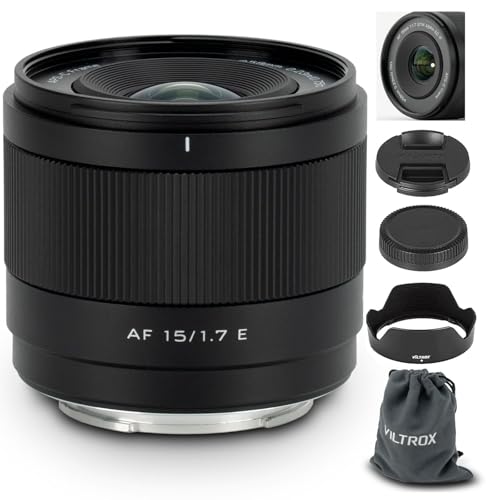
6. VILTROX 15mm F1.7 APS-C – Best for Wide-Angle Low-Light APS-C Shooting

The VILTROX 15mm F1.7 is the lens for APS-C shooters who keep hitting the same wall: the scene is wide, the light is poor, and the kit zoom at f/3.5 is not cutting it. At 15mm on APS-C it behaves like a 22.5mm full-frame equivalent — a classic documentary wide angle — and its f/1.7 maximum aperture is more than two stops faster than a typical kit zoom at its wide end.
Run the light math and the appeal becomes obvious. f/1.7 versus f/3.5 is roughly two stops, which is a 4x difference in light. If your kit lens forces ISO 6400 for a 1/30 s handheld shot in a dim street, this lens does the same shot at ISO 1600. Alternatively you keep ISO 1600 and shoot at 1/125 s, which is fast enough to freeze people walking. That single change is what turns a camera you only use outdoors into a camera you can carry at night.
- Focal length: 15mm (approx. 22.5mm equivalent on APS-C)
- Maximum aperture: f/1.7
- Focus: autofocus prime for APS-C E-mount bodies
- Coverage: APS-C only
- Stabilization: none in the lens — relies on in-body stabilization
- Form factor: compact, lightweight prime
The 22.5mm equivalent focal length is the sweet spot that the 9mm cannot reach. It is wide enough to photograph a small room, a narrow street, or a group of people at close range, but not so wide that faces at the edges of the frame look stretched. That makes it usable for environmental portraits — the kind where the person matters and the place they are standing matters just as much — which is exactly where a 13.5mm equivalent starts to fight you.
Handheld technique is worth a moment here. The traditional rule of 1 over focal length applied to a 22.5mm equivalent suggests a minimum shutter speed around 1/25 s. But that rule was written for film-era expectations and does not account for the fact that you are also trying to freeze subject motion. For people walking, 1/60 s is a safer floor; for anyone moving quickly, 1/125 s. The good news is that f/1.7 makes those shutter speeds easy to reach at moderate ISO, which is precisely the point of buying a fast wide prime instead of a fast 50mm.
The compromises are the same as its sibling’s. APS-C coverage only, no optical stabilization, and no weather sealing — this is a light, inexpensive specialist, not a rugged professional wide angle. Fast primes at the budget tier also tend to show vignetting and softer corners at maximum aperture, cleaning up as you stop down to f/2.8 or f/4. For video shooters there is one more consideration: focus breathing and autofocus transitions are usually less refined at this price than on premium glass, so if you rely heavily on autofocus pulls between near and far subjects, expect to practise with it.
Pros
- f/1.7 aperture is roughly two stops faster than a typical kit zoom
- 22.5mm equivalent is a versatile documentary and interior focal length
- Autofocus, unlike many budget wide primes
- Compact and light enough to live on the camera
- Budget price tier for a fast wide prime
- Good for night street, interiors and environmental portraits
Cons
- APS-C coverage only
- No optical stabilization
- No weather sealing
- Vignetting and corner softness wide open
- Not wide enough for the tightest interiors or arm’s-length vlogging
Nearest alternative in this list: the VILTROX 9


