
A used gaming PC can save a builder hundreds of dollars, but the category is cluttered with machines that are either too old to run current titles or too overpriced to justify skipping the warranty that comes with a new build. The real problem a buyer faces is separating genuinely serviceable hardware from sellers dumping obsolete components with a fresh case and a glowing RGB strip.
What separates a worthwhile used gaming PC from a regret is straightforward: the GPU tier relative to today’s game demands, whether the CPU still holds up in multithreaded workloads, and whether the platform (RAM type, storage interface, socket generation) gives you any upgrade runway. A machine with a GTX 750 Ti and a quad-core Skylake chip will struggle with any title released after 2022, while a system pairing a Ryzen 5 5500 with an RX 6500 XT at least clears the entry threshold for 1080p play. The eight machines below span that full gap, from sub-$300 renewals to near-premium prebuilts, and the differences between them are meaningful.
As an Amazon Associate we earn from qualifying purchases at no extra cost to you. Product prices and availability are accurate as of the date shown and are subject to change.
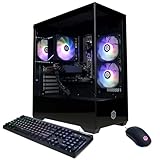


Top 3 picks at a glance
Quick Picks
| Product | Best for | Price |
|---|---|---|
| CyberPowerPC (Ryzen 5 5500 / RX 6500 XT) | Entry 1080p gaming | $778.17 |
| Prebuilt Core i5 Business/Gaming | Ultra-budget starter | $245.99 |
| MSI Codex Z2 (R7-8700F / RTX 5070) | High-refresh 1440p | $1969 |
| HP RGB (i5-6500 / GTX 750 Ti) | Light gaming, casual play | $319.99 |
| Prebuilt (i5 / R7 350 4GB) | Older titles, esports | $359.99 |
| STGAubron (i7 / RX 580 8GB) | Mid-range 1080p value | $549.99 |
| KOTIN (Ryzen 7 9700X / RTX 5070 12GB) | Next-gen 1440p | $1999.99 |
| Dell Tower (i5-7500 / GT 1030) | Desktop office plus light gaming | $282.79 |
How We Picked
We compared published spec sheets, listed prices, and owner-reported performance across all eight machines. The criteria that mattered most: GPU capability for current-generation titles at 1080p or above, CPU core count and clock behavior under sustained load, platform longevity (DDR4 versus DDR5, PCIe generation, socket upgrade path), and whether the asking price represents a discount large enough to offset the absence of a manufacturer warranty. A machine that scores well on specs but costs nearly new-retail fails the value test, just as a bargain-priced system with a decade-old GPU fails the performance test.
The 8 Best Used Gaming PC in 2026
CyberPowerPC Gaming PC (AMD Ryzen 5 5500 / RX 6500 XT 4GB)
This system targets buyers who want a recognizable brand prebuilt at a price below most new entry-level configurations. The Ryzen 5 5500 provides six Zen 3 cores that handle modern games and background tasks without stutter, and the RX 6500 XT clears the minimum bar for 1080p settings in many current titles, though its 4GB VRAM will force texture compromises in newer releases.
- Pro: Six-core Zen 3 CPU offers solid multithreaded headroom for multitasking.
- Pro: CyberPowerPC branding suggests a factory-tested build versus a random used listing.
- Con: 4GB of VRAM on the GPU is the hard ceiling; expect settings reductions in demanding 2025-era titles.
Skip it if you plan to play AAA games at high or ultra presets within the next two years.
Prebuilt Desktop Computer Gaming PC (Core i5 Business/Home)
At $245.99, this is the cheapest entry on the list, and the specs reflect that. The Core i5 is a capable office chip that handles older or lighter games, but without a dedicated GPU tier disclosed, buyers should assume integrated or very low-end discrete graphics. It suits someone who primarily browses, streams, and plays casual or indie titles.
- Pro: The lowest price on the list makes it a viable first PC for a teenager or a secondary family machine.
- Pro: Dual-purpose labeling (business and home) suggests the seller positions it as a general desktop, not a gaming box.
- Con: No meaningful GPU is identified, so current AAA gaming is off the table entirely.
Skip it if you want to run anything newer than a five-year-old title at playable frame rates.
MSI Codex Z2 (AMD Ryzen 7 8700F / RTX 5070 / 32GB DDR5 / 2TB SSD)
The Codex Z2 sits at the premium end of this roundup and is essentially a new-tier prebuilt that happens to appear in used listings. An RTX 5070 with 32GB DDR5 and a 2TB SSD will drive 1440p at high refresh rates comfortably, and the Ryzen 7 8700F provides eight Zen 4 cores with no integrated GPU penalty. For a buyer who wants current performance without assembling components, this is the strongest spec-to-convenience ratio on the list.
- Pro: RTX 5070 delivers high-fidelity 1440p and capable 4K upscaling performance.
- Pro: 32GB DDR5 and 2TB NVMe storage eliminate upgrade needs for years.
- Con: At $1969 the discount from new retail is modest, reducing the “used” advantage.
Skip it if budget is the primary constraint; build a comparable system new for less.
HP RGB Gaming Desktop (i5-6500 / GTX 750 Ti 4GB)
This renewed HP is a platform artifact from the Broadwell era. The i5-6500 is a 14nm quad-core with no hyperthreading, and the GTX 750 Ti was entry-level even when it launched. Owners report it handles League of Legends, older Minecraft builds, and media playback without trouble, but it cannot render modern titles beyond the lowest settings. The 16GB DDR4 and 512GB SSD are the most useful components here.
- Pro: Windows 11 Pro licensing is included, rare at this price point.
- Pro: RGB peripherals and WiFi/BT 5.0 connectivity are bundled, reducing accessory costs.
- Con: CPU and GPU together are a decade old; no current game runs acceptably.
Skip it unless your gaming library is limited to titles older than 2018.
Prebuilt Gaming PC Desktop (Core i5 up to 3.6GHz / Radeon R7 350 4GB)
The R7 350 is a rebranded Oland-core GPU from 2016, and pairing it with a Core i5 that “up to” 3.6GHz suggests a locked 65W part means performance ceiling is low. This machine will run esports titles at reduced settings and handle older AAA games at 720p or 1080p low, but nothing beyond that without significant compromise.
- Pro: At $359.99 it undercuts most entry-level new builds by a wide margin.
- Pro: 4GB GDDR5 on the R7 350 is still adequate for light texture workloads.
- Con: The GPU is effectively a display adapter with minimal gaming compute; it lacks power to benefit from any CPU headroom.
Skip it if you want to play any game released after 2020 at playable frame rates.
STGAubron Gaming PC (Core i7 up to 3.9GHz / RX 580 8GB)
STGAubron builds custom systems on refurbished Intel platforms, and this configuration pairs an i7 (likely a 7th or 8th-gen hexa-core given the 3.9GHz boost claim) with the RX 580 8GB, a GPU that still holds up well at 1080p medium-high settings in most current titles. The 16GB RAM, 1TB SSD, WiFi 6, and six RGB fans round out a genuinely usable mid-range package.
- Pro: RX 580 8GB remains the best value-per-dollar used GPU for 1080p gaming.
- Pro: WiFi 6 and BT 5.0 mean modern peripheral and network compatibility out of the box.
- Con: The i7 generation is not disclosed, and older 7th-gen chips lack hyperthreading, limiting multitasking.
Skip it if you need 1440p performance; the RX 580 will fall short at that resolution.
KOTIN Prebuilt Gaming PC (Ryzen 7 9700X / RTX 5070 12GB / 32GB DDR5 / 1TB SSD)
KOTIN assembles high-end prebuilts at aggressive pricing, and this unit features the Ryzen 7 9700X, a Zen 5 octa-core with strong single-threaded performance, paired with a full 12GB RTX 5070. At $1999.99 it sits just above the MSI Codex Z2, trading 2TB storage for a newer-generation CPU. For buyers prioritizing processor performance in simulation or streaming workloads, the 9700X advantage is real.
- Pro: Ryzen 7 9700X delivers top-tier single-thread speed, benefiting FPS in CPU-bound titles.
- Pro: RTX 5070 with 12GB VRAM provides ample framebuffer for 1440p ultra textures.
- Con: 1TB SSD fills faster than the 2TB option on the comparable MSI Codex Z2.
Skip it if storage is your priority over CPU generation; the MSI offers double the drive space for slightly less money.
Dell Gaming Tower (i5-7500 / GT 1030)
This renewed Dell is the weakest gaming machine on the list. The i5-7500 is a 7th-gen quad-core without hyperthreading, and the GT 1030 is a display-level GPU with roughly one-quarter the compute throughput of even the R7 350. It will run Minecraft, Roblox, and older casual titles. At $282.79 it is priced as a basic office desktop with the word “gaming” attached for search visibility.
- Pro: Dell’s build quality and Windows 11 Pro license add long-term reliability at a very low cost.
- Pro: Compact tower form factor fits small desks without sacrificing serviceability.
- Con: GT 1030 cannot render modern games at any usable resolution or quality setting.
Skip it entirely if gaming is a stated priority; the label does not match the hardware.
Buying Guide
GPU Tier Is the Single Most Important Factor
In a used gaming PC, the graphics card determines everything about your actual play experience. A GTX 1030 or R7 350 is a display adapter, not a gaming GPU. The RX 580 8GB represents the practical floor for 1080p gaming in 2026 at medium settings, while cards with 12GB VRAM (like the RTX 5070) ensure texture memory won’t bottleneck you at 1440p for several years. Check the exact model number, not just the brand or family, because rebranded cards (R7 350, GT 710) masquerade as “gaming” GPUs.
Platform Generation Determines Upgrade Runway
A DDR4 platform with a locked 65W CPU means you will likely replace the motherboard, RAM, and processor together if you want to upgrade later. DDR5 platforms (like the MSI and KOTIN systems) use current-generation sockets with multiple CPU upgrade paths ahead. Even among used builds, a system with a B550 or X670 board is far more future-proof than one built on a B250 or H110 chipset. Ask the seller for the exact motherboard model before committing.
VRAM and Storage Capacity Affect Daily Usability
Four gigabytes of VRAM was fine in 2019; it is a hard limitation now, forcing you to accept low-resolution texture packs in every new release. Similarly, a 256GB SSD is barely enough for Windows plus one or two large games, making an additional SATA drive a near-certain future purchase. If a used listing includes 1TB NVMe or more, factor that storage value (roughly $80-120 for a new equivalent) into your effective price comparison.
Our Verdict
For most buyers seeking a genuine gaming experience without overspending, the STGAubron with the RX 580 8GB at $549.99 offers the best balance of current playability, modern connectivity (WiFi 6), and value. Budget pick: if you only need to run older titles, esports, or media and want to spend the absolute minimum while still getting Windows 11, the HP renewed at $319.99 is the floor. However, if you care about single-threaded performance for simulation-heavy or streaming workflows, the KOTIN with the Ryzen 7 9700X edges out the MSI Codex Z2 despite costing slightly more, because the Zen 5 architecture delivers measurably higher per-core clocks.
FAQ
Is a used gaming PC worth buying over a new budget build?
Yes, when the used price includes a GPU tier at or above the RX 580. You typically get a graphics card worth $150-200 new for a fraction of that cost inside the system, which is where most of a budget build’s expense concentrates. Below that tier, the savings do not justify the performance compromise.
How do I verify a seller’s listed specs are accurate?
Request a screenshot of CPU-Z (for CPU and motherboard details) and GPU-Z (for graphics card memory size and clock speeds) before purchasing. These free tools confirm the exact hardware installed regardless of what the listing claims.
What is the risk of buying a renewed versus a used gaming PC?
Renewed means the unit was returned to the manufacturer or an authorized refurbisher, tested, and given a limited warranty (often 90 days). A straight “used” listing carries no warranty unless the seller explicitly offers one. Renewed Dell and HP machines on this list come from certified refurbishment programs, which reduces risk compared to a private-party sale.
Can I upgrade a used gaming PC after buying it?
Generally yes, but the ceiling depends on the platform. A DDR4 system on a locked socket can swap its GPU and add storage easily, but the CPU is capped. A DDR5 system with an unlocked socket (AM5, for example) allows CPU upgrades within the same platform for several more generations, extending the machine’s useful life significantly.


