
Choosing a Lenovo gaming PC is harder than it looks on paper. The Legion Tower line spans a wide range of configurations, and the differences between adjacent price tiers — often just a few hundred dollars — can shift your experience from smooth 1440p play to frame-rate dips in demanding titles. Owners consistently flag two pain points: thermals on air-cooled builds that push high-TDP components in cramped chassis, and the gap between benchmark numbers and real sustained performance after extended sessions.
What separates a worthwhile Lenovo gaming PC from a disappointing one comes down to matching GPU class to your monitor, giving the CPU enough headroom so it does not throttle the graphics card, and selecting a cooling solution that holds clocks steady over hours of play. Below, we compared the published specs, street prices, and recurring owner feedback across eight configurations to find where Lenovo’s lineup delivers and where it leaves money on the table. This roundup reflects the 2026 hardware landscape, where RTX 50-series cards and X3D-enabled Ryzen chips have reset expectations for price-to-performance.
As an Amazon Associate we earn from qualifying purchases at no extra cost to you. Product prices and availability are accurate as of the date shown and are subject to change.

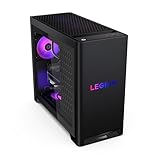
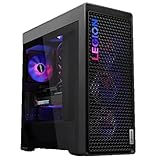
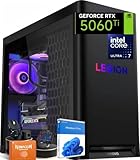


Top 3 picks at a glance
Quick Picks
| Product | Best for | Price |
|---|---|---|
| Legion Tower 5i – RTX 5070 Ti / 32 GB | Best overall Intel value | $2,554.45 |
| Legion Tower 5i – RTX 5060 Ti / 16 GB | Best budget Intel config | $1,799.99 |
| Legion Tower 5 – RTX 5070 Ti / 9800X3D | Best AMD gaming performance | $2,785.78 |
| Legion Tower 5 – RTX 5070 / 7800X3D | Best AMD mid-range balance | $2,378.37 |
| Legion Tower 7i Gen 10 – RTX 5090 | Best flagship build | $6,359 |
| Legion Tower 5i – 5060 Ti / Liquid Cooled | Best quiet mid-range tower | $1,979 |
| LOQ Tower – RTX 5060 Ti / 8745HX | Best value AMD desktop | $1,769.99 |
| Alienware – RTX 5060 Ti / Ultra 7 265F | Best budget comparison point | $1,499.99 |
How We Picked
We evaluated each Lenovo gaming PC on four criteria. First, GPU class relative to price: a 5070 Ti should cost meaningfully less than a 5080, so we checked whether each configuration justified its tier. Second, CPU adequacy: an X3D chip earns its premium in games, while a plain 7800X3D at a lower price may be the smarter buy. Third, thermal headroom: owner feedback heavily favors liquid-cooled or larger-chassis builds that hold sustained clocks. Fourth, upgrade path and bundled extras like PC Game Pass, which affect long-term value.
The 8 Best Lenovo Gaming PC in 2026
Lenovo Legion Tower 5i – RTX 5070 Ti / Intel Core Ultra 7 265F
This configuration is the sweet spot for players targeting 1440p at high refresh rates without jumping to flagship pricing. The 5070 Ti handles everything from competitive esports to AAA titles with DLSS, and the 265F gives enough multi-threaded headroom for streaming or light content work. Owner feedback highlights the clean interior layout and included 3 months of PC Game Pass as a genuine value-add. The main drawback is air cooling under sustained GPU loads, which some owners note leads to audible fan curves. Skip it if you want silent operation or plan to run the GPU at full TDP for hours daily.
Lenovo Legion Tower 5i – RTX 5060 Ti / Intel Core Ultra 7 265F / 16 GB
At this price, this is the entry point for the current Legion gaming PC lineup with a 50-series card. It suits 1080p high-refresh players who do not need the extra VRAM or bandwidth of a 5070 Ti. The 265F is the same processor as the pricier config, so CPU headroom is solid. The limitation is the 16 GB of RAM; Windows 11 plus a modern AAA title can approach that ceiling, and upgrading requires opening the case. Skip it if you multitask heavily or play titles with 1440p+ texture packs.
Lenovo Legion Tower 5 – RTX 5070 Ti / Ryzen 7 9800X3D
The 9800X3D is the single best gaming CPU available, and pairing it with the 5070 Ti removes virtually any CPU bottleneck at 1440p. Owners praise the Eclipse Black finish and the included Game Pass trial. The premium over the Intel-equivalent build is justified only if you play at lower resolutions where CPU frame rates matter more, or if you run simulation-heavy titles. The con is the price itself: at $2,785.78 you are within striking distance of RTX 5080-equipped machines elsewhere. Skip it if your monitor is 4K, since the GPU will be the limiting factor.
Lenovo Legion Tower 5 – RTX 5070 / Ryzen 7 7800X3D
This build pairs a proven, affordable X3D chip with the step-down 5070. The 7800X3D still tops most game benchmarks and is the reason many buyers choose AMD. It is a sensible Lenovo gaming PC for anyone who wants strong CPU performance without paying the 9800X3D premium. The RTX 5070 delivers comfortable 1440p performance but shows its limits in ray-traced titles compared to the Ti variant. The chassis design and free Game Pass trial match the higher-tier model. Skip it if you specifically want ray tracing at high settings in every title.
Lenovo Legion Tower 7i Gen 10 – Intel Ultra 9 285K / RTX 5090 32 GB
This is Lenovo’s no-compromise flagship. The 285K with 24 cores handles any workload, the RTX 5090 with 32 GB VRAM crushes 4K, and the 1200W PSU plus liquid cooling means thermal throttling is essentially off the table. It is a Lenovo gaming PC for enthusiasts who want maximum headroom and longevity. The obvious con is the $6,359 price, which is more than double the mid-range options. The 2 TB NVMe and Windows 11 Pro are welcome but do not change the value equation. Skip it if your budget or monitor does not demand 5090-class output.
Lenovo Legion Tower 5i AI – Ultra 7 265F / RTX 5060 Ti / Liquid Cooling
What makes this build distinct is Legion Liquid Cooling on a 5060 Ti-class machine at under $2,000. Owners who value quiet operation specifically call out this configuration. The 32 GB DDR5 at 5600 MHz is the same memory speed as the pricier Intel builds, and Windows 11 Pro adds BitLocker and remote-desktop features for hybrid workers. The con is that the 5060 Ti is the same GPU found in cheaper air-cooled towers, so the liquid cooling premium buys silence and thermal margin rather than frame rates. Skip it if you do not mind fan noise and want the lowest possible price per frame.
Lenovo LOQ Tower – Ryzen 7 8745HX / RTX 5060 Ti / 32 GB
The LOQ line targets buyers who want current-gen specs at a lower cost, and this build delivers 32 GB of RAM and an 8-core Ryzen 7 at a competitive price. The claimed 759 AI Tops on the 5060 Ti GDDR7 is notable for AI workloads and upscaling. The ARGB lighting and Type-C DisplayPort add practical connectivity. The con is that LOQ chassis are noticeably thinner and less upgrade-friendly than Legion towers, and some owners report coil whine. Skip it if you plan to swap GPUs or add large storage drives in the future.
Alienware Gaming Desktop – RTX 5060 Ti / Intel Ultra 7 265F
Strictly speaking this is not a Lenovo gaming PC, but it appears in the same price bracket and GPU class as the Legion Tower 5i builds, making it a fair comparison point. At $1,499.99 it undercuts every 5060 Ti option above. The trade-off is a less spacious chassis and fewer bundled extras. Owners note the Alienware design is subjective but build quality is adequate. Choose it if raw price matters most and you prefer Dell’s warranty structure. Skip it if a Lenovo gaming PC ecosystem, Game Pass trial, or upgrade space is important.
Buying Guide
Match GPU Tier to Your Monitor
A 5060 Ti is sufficient for 1080p high-refresh play and will handle 1440p in most current titles with DLSS enabled. The 5070 Ti is the floor for comfortable 1440p ray tracing. If you run a 4K display, only the 5080 and above — meaning the 7i Gen 10 in this list — will keep frame rates above 60 fps without aggressive upscaling. Buying a stronger GPU than your monitor can use wastes money; buying weaker one forces you to lower settings sooner than expected.
Understand Why X3D Matters
Ryzen X3D chips carry additional L3 cache that directly benefits gaming frame rates, especially at 1080p and 1440p where the CPU feeds the GPU. The 9800X3D and 7800X3D both deliver this advantage; the former earns its premium only if you play at lower resolutions or run CPU-heavy simulations. At 4K the GPU bottleneck dominates and X3D gains shrink, which is why the 7i Gen 10 pairs a non-X3D Intel chip with the fastest available GPU.
Cooling and Upgrade Path
Air-cooled towers are quieter at idle but can spike under sustained load. Liquid-cooled options like the Legion Tower 5i at $1,979 hold temperatures lower and keep fan noise down, at a modest price increase. Chassis size also matters: the 7i Gen 10 and standard Legion towers accept larger GPUs and additional drives, while LOQ cases are more restrictive. If you plan to upgrade within two years, prioritize a tower with spare PCIe slots and drive bays over marginal spec differences.
Our Verdict
The best Lenovo gaming PC for most buyers is the Legion Tower 5i with the RTX 5070 Ti and 32 GB of memory at $2,554.45. It balances current-gen GPU performance, adequate CPU headroom, and a realistic 1440p experience without the flagship tax. For budget-conscious players, the RTX 5060 Ti / 16 GB variant at $1,799.99 gets you into the 50-series with a strong processor, though plan on adding RAM. The one condition that flips the recommendation: if your priority is absolute peak gaming frame rates and you do not play at 4K, the Legion Tower 5 with the 9800X3D is the smarter investment over the Intel builds.
FAQ
Is 16 GB of RAM enough for a gaming PC in 2026?
It is workable for competitive esports and older titles, but several recent AAA games already exceed 16 GB during heavy scenes. If you buy a 16 GB configuration, budget for a memory upgrade within the first year to avoid stuttering.
Does the RTX 5060 Ti support DLSS 4?
Yes, all RTX 50-series cards include hardware support for DLSS 4 with multi-frame generation. The practical benefit is higher frame rates in supported titles without the full cost of a 5070 Ti or above.
Is the Lenovo 3-month PC Game Pass trial worth considering?
It provides access to hundreds of titles at no extra cost for 90 days, which is a genuine value if you are building a library from scratch. It does not affect hardware performance but lowers the total cost of ownership during your first quarter of use.
Can I upgrade the GPU in a Legion Tower later?
The standard Legion Tower chassis has enough clearance for current dual-slot and triple-slot cards, and the power supply ratings are generous. The LOQ series is more restrictive due to its smaller frame, so verify physical dimensions before swapping in a larger GPU.


