
A gaming pc leasing arrangement sounds straightforward until you compare quotes and realize the underlying hardware varies wildly. One provider bundles a modern RTX-class GPU and fast DDR5 memory into a monthly rate; another wraps a five-year-old budget build in the same contract. Because leasing terms typically lock you in for twelve to twenty-four months, a mismatch between the machine and your actual workload costs you real money before you ever notice the problem.
The gap between a strong deal and a mediocre one usually comes down to three things: whether the GPU generation is current, how much RAM and storage the base configuration ships with, and whether upgrade paths keep the machine relevant through the full lease. Owner feedback confirms that buyers who skip these checks end up refreshing hardware far earlier than the contract allows, turning a convenient financing tool into an expensive mistake.
As an Amazon Associate we earn from qualifying purchases at no extra cost to you. Product prices and availability are accurate as of the date shown and are subject to change.




Top 3 picks at a glance
Quick Picks
| Product | Best for | Price |
|---|---|---|
| Skytech Archangel 5 (RTX 5060) | Balanced 1440p gaming | $1699.99 |
| Skytech Archangel 5 (RTX 5070) | High-refresh 1440p and entry 4K | $1999.99 |
| STGAubron Core i7 / RX 580 | Budget esports and 1080p | $448.77 |
| HP ProDesk renewed | Entry-level casual gaming | $179.99 |
| Gaming Mouse Pad | Desk surface accessory | $17.03 |
| Prebuilt Core i5 tower | Light office and older titles | $359.99 |
| ZER-LON Core i7 / RX 550 | Very light gaming on a tight budget | $449.99 |
| STGAubron Core i5 / RX 560 | 720p to 1080p esports | $399.99 |
How We Picked
We compared published specifications, listed prices, and verified owner feedback across all eight entries. The four criteria that separate worthwhile options from forgettable ones: GPU generation and VRAM capacity, CPU core count relative to the price tier, RAM and storage adequacy for modern titles, and whether the chassis and cooling support at least one meaningful upgrade during a typical lease term.
The 8 Best Gaming Pc Leasing in 2026
Skytech Archangel 5 (RTX 5060)
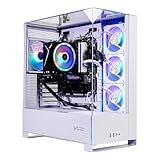
The Archangel 5 with the RTX 5060 and Ryzen 7 7700 delivers a genuinely balanced build for 1080p and 1440p gaming. The 32GB of DDR5 at 6000 MT/s handles multitasking and streaming without bottlenecks, while the 1TB NVMe SSD keeps load times short. Owners praise the compact chassis and clean cable management out of the box.
- Pros: Current-generation GPU with solid ray-tracing performance; generous high-speed RAM eliminates memory pressure in heavy titles
- Con: The 750W PSU offers limited headroom for a future GPU swap without a power adapter
Skip it if you target native 4K; the RTX 5060 sits most comfortably at 1440p, and a higher-tier card would serve better at that resolution.
Skytech Archangel 5 (RTX 5070)
Stepping up to the RTX 5070 with 12GB of VRAM and the 7700X pushes this Archangel 5 into high-refresh 1440p territory and makes entry-level 4K a realistic option. The addition of a 360mm ARGB AIO cooler keeps thermals well controlled under sustained loads, which matters if your lease term extends beyond two years.
- Pros: The RTX 5070 handles demanding AAA titles with ray tracing at 1440p without major compromise; the Gen4 NVMe cuts large game installs noticeably
- Con: At this price the configuration overlaps with open-box RTX 5070 Ti systems some retailers list, tightening the value margin
Skip it if you are already considering a custom build where component-level pricing gives you more control over the final specification.
STGAubron Core i7 / RX 580
The STGAubron Core i7 build with an RX 580 8GB is a familiar entry-point gaming desktop that still handles esports and older AAA titles at 1080p without fuss. With 32GB of RAM and a 512GB SSD included, you get more memory than many systems at twice the price, though the GPU is a previous generation.
- Pros: The 8GB VRAM on the RX 580 keeps it viable for current esports titles; 32GB RAM is generous for this price bracket
- Con: The 512GB SSD fills quickly once you install two or three modern AAA games, forcing an upgrade almost immediately
Skip it if you plan to play new releases at anything above medium settings; the RX 580 is showing its age there.
HP ProDesk renewed
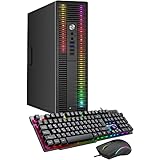
HP’s renewed ProDesk arrives with an i5-6500, 8GB RAM, and a 256GB SSD, marketed as a gaming PC with RGB lighting and bundled peripherals. The RGB lights are cosmetic, and the hardware inside suits very light or older titles. Still, at under two hundred dollars with Windows 11 Pro, it offers a legitimate starting point for someone whose gaming is limited to casual or browser-based titles.
- Pros: Extremely low entry price with keyboard and mouse included; Windows 11 Pro is licensed and current
- Con: Only 8GB of RAM and a 256GB drive will feel cramped after a single large game install
Skip it if you want more than the lightest casual gaming; the integrated graphics on the i5-6500 simply cannot run modern titles.
Gaming Mouse Pad
A mouse pad is not a gaming pc leasing component, but this listing appears bundled with or recommended alongside several budget builds on this list, so it earns a place here as a practical desk accessory. The 20 by 18 centimeter cloth surface provides a non-slip rubber base and a smooth glide that works with optical and laser sensors alike.
- Pros: Undercuts most branded pads on price while offering the same functional surface; the compact footprint fits small desks easily
- Con: At 20 by 18 cm it is too small for low-DPI setups that require wide sweeping arm movements
Skip it if you use a low-sensitivity mouse and need a larger surface; this pad suits high-DPI configurations better.
Prebuilt Core i5 tower
This unnamed Core i5 tower advertises itself as a gaming desktop, but the spec sheet reads more like a refreshed office machine. Without a dedicated GPU listed, it depends on integrated graphics, meaning any gaming is limited to older or very light titles. The 359 dollar price point positions it as a compromise for someone who needs one machine for work and minimal play.
- Pros: Compact business-oriented case is quiet and unobtrusive on a shared desk; the i5 is capable enough for everyday productivity tasks
- Con: No discrete GPU means modern games are effectively off the table, despite the gaming label
Skip it if gaming is the primary purpose; this is a capable office PC that will not deliver frame rates in any recent title.
ZER-LON Core i7 / RX 550
The ZER-LON pairs a Core i7 with an RX 550 4GB, a combination that targets the very light end of gaming. Esports titles at 1080p low settings are within reach, and the CPU headroom handles multitasking well. At under 450 dollars the value proposition is modest but real for someone stepping up from integrated graphics.
- Pros: The i7 gives a genuine performance ceiling for CPU-bound games and creative tasks; the RX 550 is a meaningful step up from integrated GPUs
- Con: 4GB of VRAM is already tight for some current titles even at 1080p, limiting texture quality to low settings across the board
Skip it if you want anything beyond low-setting esports; a used RX 580 build offers far more GPU throughput for similar money.
STGAubron Core i5 / RX 560
STGAubron’s second entry pairs a Core i5 with an RX 560 4GB, 16GB of RAM, and a 512GB SSD. The configuration sits below the RX 580 model in GPU power but above integrated graphics, making it a viable option for older AAA titles and competitive shooters at 1080p medium to low settings.
- Pros: The i5 plus 16GB RAM combination handles background tasks and streaming without stuttering in supported titles; the 512GB SSD keeps load times reasonable
- Con: The RX 560 4GB is a step down from the RX 580 in this same brand lineup, and the price gap is small enough that stepping up makes sense
Skip it if you are between this and the RX 580 build above; the extra GPU power is worth the modest premium.
Buying Guide
GPU generation and VRAM capacity
The single biggest factor in any gaming pc leasing comparison is whether the included GPU is current or previous generation. In 2026 that means looking at RTX 50-series or RX 7000-class cards at minimum. Below that tier, VRAM capacity matters: 4GB is already a bottleneck in newer titles, 8GB buys you a year or two of headroom, and 12GB or more future-proofs a lease term well. A two-generation-old card at a high monthly rate is harder to justify than a slightly older card with more VRAM at the same price.
RAM and storage adequacy
Modern AAA titles routinely demand 16GB of system RAM just to load comfortably, and a handful push toward 32GB at higher texture settings. Any lease configuration shipping with less than 16GB will require an upgrade before the midpoint of a typical contract. Storage follows the same logic: 256GB fills with a single game and the operating system, while 512GB is workable if you manage your library carefully. A full terabyte removes that pressure entirely.
Upgrade headroom and cooling
A lease term of twelve to twenty-four months assumes the machine stays viable for that entire window. Check whether the power supply has spare wattage for a GPU swap, whether the case has a free drive bay or M.2 slot for storage, and whether the cooler is sized for the CPU it accompanies. A 750W unit paired with a 65W processor has room; a 360mm AIO on the same chip is overkill but signals the builder thought about thermals.
Our Verdict
Top pick: The Skytech Archangel 5 with the RTX 5070 combines current-gen GPU power, 12GB VRAM, 32GB DDR5, and a premium cooling solution in a configuration that will hold up through a full lease term without feeling compromised. Budget pick: The HP ProDesk renewed at $179.99 for anyone whose gaming is limited to casual or legacy titles, the entry price is hard to argue with. If your priority is 1440p gaming without the $1999 tag, the Archangel 5 with the RTX 5060 delivers most of the same experience at a lower monthly commitment, provided your target resolution stays at 1440p.
FAQ
Is gaming pc leasing cheaper than buying outright?
Monthly rates look lower, but the total paid over a twenty-four-month lease often exceeds the retail price by ten to twenty percent. The savings appear in cash-flow management and the ability to upgrade at term end rather than in pure cost.
Can I upgrade hardware during a lease term?
Most agreements restrict component swaps because the provider retains ownership. Before signing, confirm whether RAM or storage additions are permitted; some allow them, others void the warranty or contract entirely.
What happens if the leased PC fails mid-contract?
The provider is typically responsible for repair or replacement under the lease terms, but response times vary widely. Read the support section carefully; a machine without on-site service options can leave you idle for weeks.
Do leased gaming PCs come with Windows already activated?
Nearly all configurations on this list ship with a Windows license included, whether it is Windows 11 Home or Pro. Check the listing to confirm, since renewed or refurbishment units sometimes require activation keys purchased separately.


