
A budget gaming mouse is one of those purchases where the gap between “surprisingly good” and “regretfully returned” comes down to three things: sensor consistency at your actual sensitivity settings, a shape that survives two-hour sessions without fatigue, and software that does not fight you when remapping a side button. Nobody needs a $150 peripheral to play well. The right sub-$40 mouse delivers 90 percent of what enthusiasts pay premium prices for, and the rest is marketing.
The problem is that cheap mice fail in ways that are invisible on spec sheets. An 8000 DPI number means nothing if the sensor smears at the tracking speed you actually use. A wireless claim matters less if latency ruins competitive aim. And a mouse can look perfectly shaped in product photos while pinching your pinky after twenty minutes. This roundup compares the best budget gaming mice available in 2026 by matching published specs against the owner feedback that consistently surfaces these real-world failure points, so you can skip the trial-and-error cycle and buy the right one for your grip style and game genre.
As an Amazon Associate we earn from qualifying purchases at no extra cost to you. Product prices and availability are accurate as of the date shown and are subject to change.




![Redragon M602 Gaming Mouse, Ergonomic RGB Gaming Mouse Wired with 7200 Adjustable DPI, 9 Programmable Buttons, Professional Software for Gamer Office [Black]](https://m.media-amazon.com/images/I/4189L2UBl9L._SL160_.jpg)
Top 3 picks at a glance
Quick Picks
| Product | Best for | Price |
|---|---|---|
| Redragon M612 | Maximum DPI under $20 | $16.99 |
| Logitech G305 Wireless (Black) | Wireless on a tight budget | $29.99 |
| Razer Basilisk V3 | Ergonomic comfort with full customization | $34.98 |
| Razer DeathAdder Essential | Proven shape at the lowest price | $20.98 |
| Logitech G203 | Clean sensor performance for FPS | $25.99 |
| Logitech G502 Hero | Heavy-mouse lovers and MMO versatility | $37.99 |
| Logitech G305 Wireless (Blue) | Wireless with a color statement | $34.99 |
| Redragon M602 | Button-rich ergonomics under $17 | $16.99 |
How We Picked
We filtered these mice on four criteria that consistently separate a worthwhile budget pick from a disappointing one. First, sensor reliability at moderate DPI settings — the numbers that most gamers actually play at — backed by owner reports of consistent tracking rather than spec-sheet max values. Second, shape and weight distribution, because an ergonomic or ambidextrous form factor that does not match your grip style will cause fatigue regardless of how good the internals are. Third, software quality and remapping flexibility, since budget mice often ship with clunky drivers that make customization painful. Fourth, value relative to price: we asked whether each mouse delivers something a cheaper option on this list cannot.
The 8 Best Budget Gaming Mice in 2026
Redragon M612 Wired RGB Optical Gaming Mouse
This is the mouse for someone who wants the highest published DPI figure possible under twenty dollars and does not care about brand pedigree. The M612’s 8000 DPI optical sensor and remappable keys give you a level of sensitivity control that no other sub-$17 mouse matches on paper. Owner feedback consistently praises the RGB lighting for the price and notes that the shape works for medium-to-large hands.
- Pro: 8000 DPI is the highest spec on this entire list, giving extreme sensitivity headroom.
- Pro: Remapping keys let you customize button functions without third-party software workarounds.
- Con: Redragon software is less polished than Logitech or Razer alternatives, and some owners report occasional tracking issues at very high DPI that may require lowering sensitivity for consistency.
Skip this if you play competitive shooters where sensor consistency at 800-1600 DPI matters more than a headline maximum number.
Logitech G305 Lightspeed Wireless Gaming Mouse (Black)
The G305 is the definitive answer to “I want wireless without spending more than thirty dollars.” It is lightweight, uses Logitech Lightspeed technology for latency that competitive players accept, and has a simple six-button layout that keeps the shape clean. Owners repeatedly highlight the battery life as a genuine advantage over rechargeable budget mice that die mid-session. The black finish is understated and professional enough for an office setup.
- Pro: Lightspeed wireless removes cable drag while keeping input latency competitive-grade.
- Pro: Extremely lightweight for a mouse at this price, ideal for flick-heavy FPS aiming.
- Con: Only six programmable buttons, which limits its usefulness for MMO or productivity tasks that benefit from extra inputs.
Skip this if you need more than a handful of side buttons or prefer a heavier mouse for stability.
Razer Basilisk V3
The Basilisk V3 sits at the top of this list price-wise and delivers accordingly. It is an ergonomic wired mouse with customizable RGB and a generous button count, built for players who want their mouse to feel like a cockpit control panel. The shape is designed around right-handed palm grips, and the thumb rest guides the hand into a natural position for long sessions. Owners praise the scroll wheel options and the overall build quality, noting it feels closer to a $60 mouse than a $35 one.
- Pro: Ergonomic shape with a dedicated thumb rest reduces wrist strain during extended use.
- Pro: Customizable RGB and multiple scroll modes add functional versatility beyond lighting.
- Con: At $34.98 it is the most expensive on this list, and the larger body can feel bulky for smaller hands or claw grips.
Skip this if you have small hands or prefer a minimalist button layout over full customization.
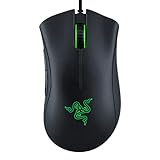
Razer DeathAdder Essential
The DeathAdder Essential is the budget version of one of gaming’s most recognizable silhouettes. It takes the ergonomic shape that defined a generation of FPS and MOBA play and strips away premium extras to hit an aggressive price point. Owners who have upgraded from older DeathAdder models report that the shape feels immediately familiar and comfortable. At $20.98 it is the cheapest way to get a proven ergonomic form factor from a major brand.
- Pro: The iconic DeathAdder ergonomic shape has decades of proven comfort feedback behind it.
- Pro: Lowest price from a major gaming peripheral brand on this list.
- Con: Lacks advanced features like high DPI, extra buttons, or customizable lighting — this is purely a shape and reliability purchase.
Skip this if you need programmable buttons beyond the basics or care about RGB aesthetics.
Logitech G203 Wired Gaming Mouse
The G203 is Logitech’s entry-level wired mouse and functions as a no-nonsense sensor platform. Its ambidextrous-friendly symmetrical shape suits palm and claw grips alike, and the sensor is tuned for consistent tracking rather than chasing maximum DPI numbers. Owners consistently describe it as the “safe choice” — nothing flashy, but it does not lose count or spin out during normal play. The RGB is tasteful rather than aggressive.
- Pro: Symmetrical shape works for a wide range of hand sizes and grip styles without forcing one.
- Pro: Logitech G Hub software is stable and well-supported, making DPI and button remapping straightforward.
- Con: Cable is fixed and not detachable, which limits portability and creates some drag during fast flicks.
Skip this if you need a left-handed shape with dedicated left-side buttons or wireless freedom.
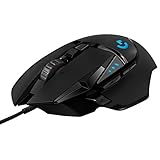
Logitech G502 Hero Wired Gaming Mouse
The G502 Hero is for the player who prefers a heavier mouse with many buttons and a pronounced ergonomic angle. It has accumulated a cult following because the weight and shape pair well with steady, controlled aiming in tactical shooters and MOBAs. The button count supports complex MMO or productivity workflows, and the shape cradles the palm firmly. Owners love the heft but also note the cable management is an ongoing consideration.
- Pro: High button count makes it one of the most versatile mice on this list for MMOs and work.
- Pro: The distinctive ergonomic angle and substantial weight suit players who want stability over speed.
- Con: Notoriously heavy for its price tier, and some owners find the cable stiffness requires a mouse bungee to avoid drag.
Skip this if you play fast-tracking FPS titles that reward quick flicks or if you have smaller hands.
Logitech G305 Lightspeed Wireless Gaming Mouse (Blue)
The blue G305 is functionally identical to the black model above — same sensor, same shape, same Lightspeed wireless technology. The $5 price difference reflects the color option rather than any hardware change. For someone who wants the exact same proven wireless budget mouse but prefers a blue aesthetic to match a themed desk setup, this is the straightforward choice. Owner feedback on the blue variant mirrors the black model’s praise for battery life and light weight.
- Pro: Identical Lightspeed wireless performance as the black model at only a slight color premium.
- Pro: Blue finish offers a distinctive look for themed setups without changing function.
- Con: The $5 markup over the black variant buys zero additional features, so value-conscious buyers should default to black unless the color genuinely matters.
Skip this if you are purely price-driven and the color is not important to your setup.
Redragon M602 Ergonomic RGB Gaming Mouse
The M602 targets a specific buyer: someone who wants nine programmable buttons, an ergonomic body, and adjustable DPI up to 7200 — all for under seventeen dollars. The “professional software” mention in its name signals that Redragon provides a driver with profile support, which is unusual at this price. Owners highlight the button layout as the main reason to buy, noting it handles both gaming macros and office shortcuts. The 7200 DPI ceiling is lower than the M612’s, but it covers every realistic sensitivity range.
- Pro: Nine programmable buttons rival mice twice the price, making it excellent for MMOs and productivity.
- Pro: Ergonomic shape and included software profile support add genuine long-session comfort and utility.
- Con: Build quality and sensor consistency trail behind Logitech and Razer options; some owners report the software occasionally fails to detect the mouse after driver updates.
Skip this if sensor consistency in competitive play is non-negotiable or if you dislike installing proprietary drivers.
Buying Guide
DPI Is a Maximum, Not a Recommendation
Every mouse on this list advertises a DPI number, but most gamers play between 400 and 1600 DPI at their actual sensitivity. A sensor that tracks cleanly at 1600 DPI is far more valuable than one that reaches 8000 DPI but smears or skips at the settings you use daily. Check owner feedback specifically for reports of “spin-outs” or “jitter” at your typical DPI rather than fixating on the headline number.
Shape Compatibility Is Non-Negotiable
A mouse can have the best sensor in its price tier and still be wrong for you if it does not match your grip style. Palm grips need length and a full back hump (think G502 or Basilisk). Claw grips prefer a shorter body with a pronounced rear curve (DeathAdder). Fingertip grips suit lighter, smaller shells (G305). Before buying, identify your grip and match it to the shape language of the mouse rather than its brand name.
Wired Versus Wireless Changes the Tradeoffs
Wireless eliminates cable drag and desk clutter, which matters for fast flicks and clean setups. The tradeoff at budget prices is weight distribution (battery placement) and the assumption of single-use AA batteries rather than rechargeable cells. Wired mice at this price tend to offer more buttons and lower entry cost, but a stiff cable without a bungee can noticeably slow your movements. Decide which constraint bothers you more: pulling cable drag or battery compartment weight.
Our Verdict
Best overall budget gaming mouse: the Logitech G305 Lightspeed Wireless in black at $29.99, because it solves the most buyer problems simultaneously — wireless freedom, light weight, proven sensor reliability, and Logitech software stability — without forcing compromise on any single axis.
Best pure value: the Redragon M612 at $16.99, if you want the most specifications per dollar and your play style tolerates a less refined sensor.
Condition where another wins: if you play MMOs or need extensive macro programming on a budget, the Redragon M602’s nine programmable buttons at $16.99 make it the obvious pick over everything else on this list.
FAQ
Is wireless better than wired for gaming?
Modern Lightspeed and comparable wireless technologies introduce latency that is indistinguishable from wired in blind tests, so the real tradeoff is convenience and weight versus button count and price. For most casual and intermediate gamers, wireless is preferable because it removes cable management frustration entirely.
Do I need 8000 DPI for gaming?
Almost certainly not. The vast majority of professional and enthusiast players run between 400 and 1600 DPI and adjust sensitivity in-game. A higher maximum is only useful if you play on ultra-high-resolution multi-monitor setups that genuinely require extreme cursor travel with small hand movements.
Is optical or laser tracking better for gaming?
Optical sensors are the standard for gaming because they do not suffer from the lift-off distance issues and surface sensitivity quirks of older laser sensors. The Redragon M612 is explicitly listed as optical, which is a positive sign for consistency.
What is the difference between the Logitech G305 black and blue?
They are the same mouse with different shell colors. The blue version costs $5 more purely for the aesthetic option, with no hardware or software differences. Choose whichever matches your setup preference.


