A car phone charger looks like the simplest purchase in electronics, until a phone shows “charging slowly” on the dashboard while navigation drains the battery faster than the socket refills it. The real decision is how much power the lighter socket must hand out, to how many devices, and through which ports. A single phone on a short commute and a family road trip with four passengers need very different adapters, and the listing wattage alone will not tell you which one you are buying.
This guide is for drivers who want one adapter that keeps a modern phone topped up under GPS load, and for those who share the socket with a passenger, a tablet, or a second phone. Every pick below was judged from the wattage, port count, and cable details stated in its listing, so you can match the numbers to your own devices and your own vehicle in 2026.
Our Top Picks


Top 3 picks at a glance
Quick Picks
As an Amazon Associate we earn from qualifying purchases at no extra cost to you.




| Product | Best for | Key spec from the title |
|---|---|---|
| LISEN 84W Retractable | Tangle-free cabling | 84W, 4 in 1, retractable |
| 67W 3-Port Type C | Mid-range multi-device | 67W, 3 ports |
| 2-Pack 70W USB C | Two cars or a spare | 2 pack, 70W, PD/QC |
| 4-Port 90W | Full back seat | 90W, dual 45W USB-C plus USB-A |
| 48W with Built-In Cable | Android drivers, no loose cord | 48W, 30W built-in Type C cable |
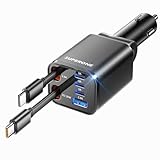
| SUPERONE 99W Retractable | Cable-free cabin | 99W, 6 in 1, dual cables |
| 130W 3-Port | Power users | 130W, voltage display |
| 5-Pack 38W | Fleets and gifts | 5 pack, 38W USB-C plus USB-A |
| LISEN 69W 2-Pack | Value pairs | 69W, 2 pack |
How to Choose
Match wattage to the fastest device you charge
Phones using USB Power Delivery usually negotiate somewhere between 20W and 45W, so an adapter that offers around 30W on a single port already covers most handsets. Tablets and small laptops want 45W or more. Total output matters less than per-port output: a 90W adapter that splits across four ports may give each device far less than the headline figure suggests, so read the port breakdown in the listing before trusting the big number.
Count ports and check the mix
Look for at least one USB-C port with PD for a current iPhone or Galaxy, plus a USB-A port for older accessories such as a dash cam or a Bluetooth earpiece. Three or four ports suit shared rides. If every passenger carries a USB-C device, a model with two USB-C outputs avoids a pile of dongles, while a USB-A-heavy adapter is the better match for older phones.
Decide between bare adapters and built-in cables
Retractable and built-in cable designs remove the loose-cord problem and suit rental cars or shared vehicles. The trade-off is that a worn cable can be harder to replace than a standalone lead. Bare adapters keep your own cable, which is easy to swap and easy to match to the wattage you need, but it also means one more thing to remember when you leave the house.
Ignore the marketing words, watch the standards
Terms like “super fast” are decoration; PD and QC 3.0 are actual protocols you can verify against your phone. Voltage displays are handy for spotting a weak battery or a failing socket, but they add nothing to charging speed. Budget models cut corners on heat control and socket fit, and an adapter that sits loose can drop its connection whenever the road gets rough.
The 9 Best Options
LISEN 84W Retractable Car Charger
This 4-in-1 design suits commuters who hate cable tangles and want a cord that tucks away when the car is empty. The listing states 84W with USB-C fast charge and a cigarette lighter fit, so a phone and a second device can share it without squabbling over the single socket. It is a sensible choice for a daily driver who wants the cabin to look uncluttered.
- Strength: retractable cabling keeps the cabin tidy.
- Strength: 84W total headroom for two devices.
- Trade-off: a built-in cable is harder to replace if it frays.
Skip it if you prefer using your own premium cable.
67W 3-Port Super Fast Type C Car Charger
A straightforward three-port adapter aimed at Samsung S-series and recent iPhone owners. At 67W it sits between the basic and heavy-duty classes, which fits a driver plus a passenger and still leaves a port free for a small accessory. Because the listing names Type C output, it is a natural match for current flagship phones and their charging cables.
- Strength: three ports cover phone, passenger phone, and accessory.
- Strength: Type C output suits current flagship phones.
- Trade-off: the 67W is shared, so full speed on all three at once is unlikely.
Skip it if you need a single device to receive very high wattage.
2-Pack 70W USB C Car Charger
Two adapters in one box, each listed at 70W with three ports and PD/QC support. A good fit for households with two cars, or drivers who want a spare in the glovebox for the day the first one goes missing. The protocol coverage means both iPhone and Android owners can use it without worrying about which fast-charge standard their phone speaks.
- Strength: two units cost less per adapter than buying singles.
- Strength: PD and QC cover both iPhone and Android fast charging.
- Trade-off: no built-in cable, so you supply your own.
Skip it if you only own one vehicle and want a premium single unit.
4-Port 90W Car Charger
The title names dual 45W USB-C ports plus USB-A, which makes it suited to a back seat where a tablet and a phone are both charging. Four ports are rare at this level, and the 45W USB-C pair is the detail that matters, since it is the figure a tablet or a larger phone actually uses. It is the natural pick for a minivan or a carpool.
- Strength: two 45W USB-C ports serve tablets and phones.
- Strength: USB-A keeps older gear working.
- Trade-off: running every port at once will split the 90W budget.
Skip it if your socket is shared with a dash cam that already draws power.
48W Car Charger with Built-In Type C Cable
Aimed at Android drivers, this unit lists a 30W built-in Type C cable alongside its 48W total. It removes the need to carry any cord at all, which makes it popular for a second vehicle or a work van. Navigation plus music streaming is exactly the load a 30W lead handles comfortably.
- Strength: an attached cable means nothing to forget.
- Strength: 30W on the built-in lead suits recent Galaxy phones.
- Trade-off: lower total than the multiport rivals.
Skip it if iPhones or older Lightning cables are in your household.
SUPERONE 99W Retractable Car Charger
A 6-in-1 build with dual cables, so one passenger can plug in without hunting for a lead. The 99W figure gives it the top total among the retractable models listed, and the two cables mean driver and passenger charge simultaneously. It suits couples who share a car and never agree on whose cable is in the door pocket.
- Strength: dual retractable cables serve two phones.
- Strength: 99W total is generous for a cable-equipped adapter.
- Trade-off: more moving parts than a fixed adapter.
Skip it if you want the simplest possible hardware.
130W 3-Port USB C Car Charger
The most powerful unit on this list at 130W, with a voltage display. It targets drivers who charge a phone, a tablet, and possibly a laptop on long trips, such as sales reps and traveling contractors. The display doubles as a quick check on the vehicle battery, which is a useful bonus in older cars.
- Strength: 130W leaves room for a laptop-class device.
- Strength: voltage display shows battery and socket health.
- Trade-off: overkill for one phone.
Skip it if your vehicle socket is fused for modest loads.
5-Pack 38W USB-C and USB-A Car Charger
Bulk packaging with USB-C plus USB-A in each unit and PD/QC 3.0 support. It suits fleets, ride-share drivers, or anyone outfitting several cars on a tight budget. Five identical units also make handy stocking gifts or spares for the family driveway.
- Strength: five units cover an entire fleet.
- Strength: PD/QC 3.0 gives wide device compatibility.
- Trade-off: 38W is the lowest per-unit output here.
Skip it if you want laptop-class charging.
LISEN 69W Car Charger 2-Pack
Two 69W adapters from a brand that also appears in the retractable class. It is a simple, value-oriented pair for two vehicles, and the 69W per unit is comfortable for a phone plus a tablet. Think of it as the no-fuss option when you just want two reliable adapters and already own good cables.
- Strength: 69W per unit handles a phone plus a tablet.
- Strength: pairing lets one stay in each car.
- Trade-off: no retractable cable.
Skip it if cable management is your priority.
Which One Fits Your Situation
Solo commuter with one phone
The 48W model with a built-in cable keeps the setup minimal, and 30W is plenty for navigation while charging. Nothing to plug in except the adapter itself.
Family road trip
The 4-Port 90W gives each passenger a socket, and the dual 45W USB-C ports cover a tablet in the back seat.
Remote worker on the road
The 130W 3-Port has the headroom for a phone plus a laptop, and its voltage display helps spot a weak socket before a long drive.
Two cars or a fleet
The 2-Pack 70W suits two vehicles, while the 5-Pack 38W covers larger numbers with modest per-unit power. Ride-share drivers in particular benefit from keeping a spare in each vehicle, because a dead adapter mid-shift means a passenger with a dying phone and a lower rating at the end of the night. Anyone renting cars should prefer the LISEN 84W Retractable, since its cord stays attached and nothing gets left behind at the counter.
Common Mistakes
- Buying on total wattage without checking how it divides across ports.
- Pairing a high-watt adapter with a cable not rated for that power.
- Forgetting that older phones may only use USB-A speeds.
- Choosing a retractable design and then never checking the cable for wear.
- Leaving a charger plugged in when the socket stays powered after the engine stops.
Related guides
- Gaming Chair Cushions And Lumbar Supports
- Business Laptops With Long Battery Life
- Travel Backpack With Laptop Compartment
Frequently Asked Questions
How many watts do I need for a phone?
Most phones charge well at 20W to 45W. Anything beyond that matters only if you also charge tablets or laptops from the same adapter.
Do retractable chargers charge slower?
Not by design. The spec sheet shows total wattage, so compare that number rather than the form factor. Thin built-in cables can limit current, though, so look for the per-cable rating.
Is a voltage display useful?
It helps you spot a weak car battery or a failing socket. It does not speed up charging, so treat it as a diagnostic extra.
Can a car charger drain the battery?
If the socket stays live with the engine off, a plugged-in adapter draws a small current. Unplug it for long parking stretches, especially in older vehicles.
Related guides
More from Amazon
Programs that pair well with the guide above. Offers and eligibility are set by Amazon and may change.
Free shipping on eligible items, Prime Video and more. Eligible new members can start with a free trial.
Start a Prime free trialAd-free music streaming. Eligible new subscribers can start with a free trial.
Try Music Unlimited freeA Prime membership for ages 18-24 with a trial period. Eligibility is set by Amazon.
See Prime for Young AdultsAudiobooks and podcasts to listen to on the go. Eligible new members can start with a free trial.
Try Audible freeAs an Amazon Associate we earn from qualifying purchases.