
Most gamers spend more time arguing about RAM than actually understanding it. The classic mistakes: buying 32GB of blazing-fast memory for a CPU that can’t run it at its rated speed, mixing a four-stick kit into two empty slots and wondering why stability fell apart, or paying a premium for CL28 timings that deliver two frames per second over a CL30 kit. Others chase 7200MT/s numbers on an AMD build, where the sweet spot sits far lower. RAM speed and latency matter, but only within a narrow, well-understood window — and this guide shows you exactly where that window is and what to pay for it.
Top 3 picks at a glance
Decide These 3 Things First
1. Your platform dictates everything. DDR4 and DDR5 are physically incompatible — the notch position differs, so a DDR5 stick will not seat in a DDR4 board. Intel’s 12th through 15th gen CPUs and AMD’s AM5 platform (Ryzen 7000/9000) use DDR5; older AM4 and Intel 10th/11th gen boards use DDR4. If you’re on AM4, your decision is largely made: DDR4-3600 CL16 is the proven ceiling.
As an Amazon Associate we earn from qualifying purchases at no extra cost to you. Product prices and availability are accurate as of the date shown and are subject to change.


2. Check your motherboard’s QVL. Every board has a Qualified Vendor List of tested memory kits. A kit not on the QVL usually still works, but if you plan to run high speeds, stick to listed kits or at least verified ICs (Hynix A-die for DDR5, Samsung B-die for DDR4).
3. Know your realistic budget tier. RAM is one of the few components where diminishing returns arrive brutally fast. Decide now whether you’re a $60–$100 buyer, a $100–$160 buyer, or a $160+ RGB enthusiast — the performance difference between the first and last is often under 5% in games.
Capacity First: 16GB Is the Floor, 32GB Is the Answer
Capacity affects gaming more than any timing number. Modern AAA titles plus a browser and Discord routinely push past 16GB. Buy:
- 16GB (2x8GB): Acceptable for esports-only builds (CS2, Valorant, League). Around $45–$70 for DDR5.
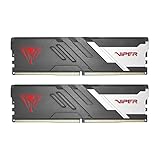
- 32GB (2x16GB): The standard for any new build. Expect $90–$160 for DDR5-6000 depending on timings and RGB. This is where the Patriot Viper Venom 32GB kit and G.SKILL Flare X5 32GB kit sit — both two-stick configurations.
- 48GB or 64GB: Only for streaming, heavy multitasking, or productivity work. Games gain nothing.
Always buy a two-stick kit, not four sticks. Dual-channel is required for acceptable performance — single-channel can cost 10–20% in CPU-bound games. Four sticks stress the memory controller and usually forces lower speeds.
Speed (MT/s): The Number That Depends on Your CPU
Speed matters differently by platform:
- AMD AM5 (Ryzen 7000/9000): The sweet spot is 6000MT/s. This matches the memory controller’s ideal 1:1 ratio with the FCLK. Going to 6400+ often requires decoupling, which can actually lose performance. kits like the Viper Venom and Flare X5 at 6000MT/s hit the mark.
- Intel 12th–15th gen: Memory controllers are more tolerant. 6400–7200MT/s yields small but real gains, especially in X3D-less, cache-limited scenarios. But 6000–6400 remains the value point.
- DDR4 builds: 3600MT/s CL16 is the target. Beyond that, returns evaporate on AM4.
Important: a kit rated 6000MT/s only runs at 6000MT/s after you enable XMP or EXPO in BIOS. Out of the box, DDR5 runs at a base 4800MT/s (DDR4 at 2133). Enabling the profile takes two minutes in BIOS — do it, or you’ve paid for speed you’re not using.
Latency (CL): What CL30 Actually Means
CAS latency is the delay in clock cycles between a request and the data arriving. Lower is better, but raw CL is misleading across speeds — compare first word latency in nanoseconds: (CL ÷ MT/s) × 2000.
- DDR5-6000 CL30 = 10ns — excellent
- DDR5-6000 CL36 = 12ns — good
- DDR4-3600 CL16 = 8.9ns — still competitive
In real gaming, moving from CL36 to CL30 at the same speed typically buys 2–5% in CPU-bound titles and near-zero in GPU-bound ones. Pay for tighter timings only if the price gap is small. On AM5, CL30 at 6000MT/s is the enthusiast standard; CL36 kits (like the G.SKILL Flare X5 listed) cost noticeably less for nearly identical frame rates.
Voltage, Cooling, and Overhead
Standard DDR5 XMP/EXPO profiles run at 1.25V–1.35V; extreme kits push 1.4V+. Anything at or below 1.35V is safe for daily use and kind to the integrated memory controller. Kits at 1.4V+ need decent airflow and offer no gaming benefit worth the heat.
Heatspreaders are effectively universal now — thin aluminum bars on even budget kits. Low-profile sticks (under 35mm tall) matter if you use a large tower air cooler; tall RGB heat spreaders can reach 45–55mm and clash with front-flow coolers like the Noctua NH-D15. Check clearance before buying RGB kits.
Hardware overheat protection: DDR5 modules include on-die temperature sensing, and JEDEC spec allows up to 85°C operation. Passive heatspreaders plus case airflow handle anything at 1.35V.
Price Tiers: What Your Money Buys
- Budget ($50–$90 for DDR5, $40–$70 for DDR4): 32GB at 5600–6000MT/s with CL36–CL40, no RGB, basic heatspreader. Loses perhaps 3% to premium kits in games.
- Mid ($90–$150): 32GB DDR5-6000 CL30–CL36 with EXPO/XMP, low-profile or mid-height heatspreaders. This is the smart buy for most builders — the PUSKILL-style DDR4-3200 CL16 kits occupy the equivalent DDR4 tier.
- Premium ($150–$280+): Tighter binned Hynix A-die, CL28–CL30 timings, RGB, 6800–7200MT/s bins. Buy this tier for aesthetics or Intel high-speed builds, not for measurable framerate gains on AM5.
A note on listings: prices fluctuate weekly with the memory market. A kit listed near $480 may have been $110 months earlier — compare against historical pricing tools before buying, and never pay a scalper premium for RAM.
Warranty and Brand Support
Memory fails rarely, but when it does, support matters. Look for:
- Lifetime warranty: Standard from Corsair, G.SKILL, Patriot, Kingston, Crucial, and TeamGroup. This is table stakes — skip any kit without it.
- Actual warranty length in writing: “Limited lifetime” typically means the life of the product line, not your life. Read the terms for major brands.
- RMA process: Corsair and Kingston have the smoothest replacement pipelines; smaller brands may require shipping to overseas depots.
Compatibility, Delivery, and Installation Notes
RAM is one of the easiest components to install: open the latches, align the notch, press until they click — no tools, no thermal paste, about 60 seconds per stick. Standard U-DIMM sticks are 133.35mm long and about 31–45mm tall depending on the heatspreader; SFF cases occasionally limit height to 35mm, so verify.
Install in slots A2 and B2 (check your manual — usually the second and fourth slots from the CPU). Wrong slots can disable dual-channel. SODIMM laptop memory will not fit desktop boards; verify “UDIMM” or “Desktop” in the listing.
Spec Checklist
| Spec | Budget | Mid | Premium |
|---|---|---|---|
| Capacity | 16–32GB (2 sticks) | 32GB (2x16GB) | 32–64GB (2 sticks) |
| Type | DDR4-3200 or DDR5-5600 | DDR5-6000 | DDR5-6400 to 7200 |
| Latency | CL16 (DDR4) / CL36–40 (DDR5) | CL30–CL36 | CL28–CL30 |
| First word latency | ~10–14ns | ~10–12ns | ~9–10ns |
| Voltage | 1.25–1.35V | 1.35V | 1.35–1.45V |
| Profiles | XMP 3.0 or EXPO | XMP 3.0 + EXPO | XMP 3.0 + EXPO |
| Price range | $40–$90 | $90–$150 | $150–$280 |
Red Flags
- Unbranded kits with no IC manufacturer listed — no way to verify bin quality, poor resale value.
- Prices wildly above market — the example listings hovering near $480–$500 for 32GB DDR5 are 3–4x typical street price; the same silicon sells around $90–$150 normally.
- “Gaming RAM” at inflated prices with only RGB as the difference — lighting adds zero frames.
- Single-stick 16GB kits — halves your bandwidth for a small saving.
- Kits advertised above 6400MT/s for AM5 builds without clear stability caveats.
- No lifetime warranty or vague “1-year seller warranty.”
- Listing photos showing four sticks while the price covers two — always confirm stick count.
FAQ
Does faster RAM actually increase FPS?
Yes, but modestly and unevenly. In GPU-bound games at 1440p or 4K, expect 0–2% difference between DDR5-5600 and DDR5-6000. In CPU-bound scenarios — competitive shooters at low settings, high refresh rates, or sims — the gap between slow and well-tuned memory can reach 10–15%. That’s why the sweet spot matters more than the maximum.
Is CL30 worth paying extra over CL36?
Only if the price difference is under roughly $20–$30. Real-world gaming gain is 2–5% at most, concentrated in CPU-limited titles. If you’re on AM5, CL30 6000MT/s is the known-good enthusiast config, but CL36 kits deliver nearly identical experiences for less.
Can I mix RAM kits or add sticks later?
You can try, but it’s a gamble. Mixed kits may fail to train, force lower speeds, or cause random crashes. Buy the total capacity you want in a single matched kit from day one. If you must add later, use identical model and revision numbers.
DDR4 or DDR5 for a new build in 2026?
DDR5, unless you’re upgrading an existing DDR4 platform. DDR5-6000 is now priced close to DDR4-3600, current CPUs and boards are mature on DDR5, and DDR4 locks you out of modern platforms. The only reason to buy DDR4 today is a budget AM4 or LGA1200/1151 refresh.
The bottom line: For most builders, 32GB (2x16GB) of DDR5-6000 CL30–CL36 with EXPO support — around $90–$150 at fair market pricing — is the correct purchase. Enable XMP/EXPO in BIOS, populate slots A2/B2, and spend the savings on a better GPU, where frames actually come from.


