
The best VR headset deal for most buyers is the Meta Quest 3S 128GB at $349.99, because it’s a fully standalone headset with no PC required and a Gorilla Tag bundle included, covering the vast majority of what casual and moderately serious VR gamers actually need. If you’re building a dedicated sim-racing or flight-sim setup and already have a capable gaming PC, the Pimax Crystal Super at $1,799 is the specialized high-end option in this guide.
Rachel Osei brings eight years of retail pricing and inventory tracking experience, including work at a consumer-electronics price aggregator, to this comparison of seven VR products spanning $16.99 to $1,799 — a wider price range than any other category on this site, reflecting how differently “VR headset” can mean a $17 phone viewer versus a $1,799 PC VR system.
Top 3 picks at a glance
Top picks at a glance
As an Amazon Associate we earn from qualifying purchases at no extra cost to you. Product prices and availability are accurate as of the date shown and are subject to change.


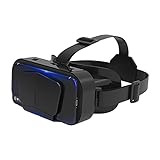


| Model | Key spec | Price | Best for |
|---|---|---|---|
| Meta Quest 3S 128GB | Standalone, Gorilla Tag bundle | $349.99 | Best overall value |
| Meta Quest 3S 512GB | Standalone, larger storage | $599 | Heavy standalone game libraries |
| Xiaokeis VR Glasses | Phone-based, universal fit | $16.99 | Absolute lowest entry point |
| Kawaye Head Strap | Quest 3S/2/3 accessory | $23.37 | Comfort upgrade for existing Quest owners |
| Pimax Crystal Super | PC VR, 3840×3840/eye, eye-tracking | $1,799 | Sim racing and flight sim enthusiasts |
| TECKNET Phone VR Headset | Bluetooth controller, 110° FOV | $49.99 | Budget phone VR with a controller |
| HTC Vive Focus Vision | Mixed reality + PC VR, controllers | $1,069.99 | Mixed reality and PC VR hybrid use |
Meta Quest 3S 128GB
At $349.99, the Meta Quest 3S is the standard recommendation for most people entering VR gaming: a fully standalone headset requiring no PC, no external sensors, and no subscription to start playing, bundled with Gorilla Tag, one of the most popular social VR titles on the platform. Meta’s Quest line dominates the standalone VR market specifically because it combines reasonable hardware with the largest available game and app library on any headset in this price range.
128GB of storage is workable for a moderate game library, though VR game file sizes have grown considerably as the platform has matured, and heavier users may find themselves managing storage more actively than they’d like within a year or two of regular use.
Rachel’s price-history read: Meta Quest headsets have historically seen their steepest discounts around major shopping events, so $349.99 outside of a specific sale window is close to standard pricing rather than an exceptional deal — still a fair price for the hardware, but worth checking for seasonal promotions if timing is flexible.
Pros
- No PC required, fully standalone operation
- Gorilla Tag bundle adds immediate value for new users
- Largest VR game and app library available on any headset in this guide
Cons
- 128GB storage can fill up faster than expected with regular use
- Standard pricing outside major sale events, not an exceptional discount
- Requires a Meta account to set up and use
Who it’s for: most people getting into VR gaming for the first time without a dedicated gaming PC.
Meta Quest 3S 512GB
The larger-storage version of the same headset, this 512GB Meta Quest 3S costs $599 — a $249.01 premium over the 128GB model for four times the storage capacity. For buyers who know they’ll download a large library of standalone VR games and apps rather than relying primarily on PC streaming, that storage headroom genuinely matters, since running out of space mid-library is a common frustration reported by heavier Quest users.
Everything else about this headset matches the 128GB version, including the same Gorilla Tag bundle inclusion, standalone operation, and core hardware specifications — this is purely a storage-tier decision, not a different generation or capability level.
Rachel’s price-history perspective here: the roughly $250 gap between storage tiers has stayed fairly consistent across Meta’s pricing history, so this isn’t a case where waiting for a specific sale meaningfully changes the relative value between the two options — decide based on your actual storage needs rather than expecting the price gap itself to shrink significantly.
Pros
- 512GB storage comfortably fits a large standalone game library
- Same core hardware and Gorilla Tag bundle as the 128GB model
- Reduces the need to manage storage actively over time
Cons
- $249.01 premium over the 128GB model
- Storage-only differentiation, no other spec improvements
- Overkill for casual or occasional VR users
Who it’s for: buyers who know they’ll build a large standalone VR game library and want to avoid storage management.
VR Headset 3D VR Glasses Universal Virtual Reality Goggles
At $16.99, this Xiaokeis headset represents the opposite end of the VR spectrum from the Meta and Pimax options in this guide: a phone-based viewer that holds your smartphone’s screen close to your eyes through a pair of lenses, supporting 360-degree panorama video and basic VR-formatted content rather than dedicated headset gaming. It has no processing power, sensors, or display of its own — every bit of the experience comes from whatever phone you insert.
For genuine VR gaming, this isn’t a comparable product to the standalone or PC-tethered headsets elsewhere in this guide, but for casual 360-degree video viewing, basic VR apps compatible with phone-based viewers, or as a low-stakes gift to see if someone enjoys VR before investing in real hardware, it serves a legitimate, different purpose.
Adjustable pupil distance and anti-blue-light lensing are reasonable comfort features at this price, though don’t expect head tracking or motion controls comparable to dedicated VR hardware.
Pros
- Lowest price in this guide by a wide margin
- Works with most smartphones, no dedicated hardware investment
- Reasonable low-risk way to sample basic VR video content
Cons
- No independent processing, sensors, or tracking of its own
- Not comparable to standalone or PC VR headsets for actual gaming
- Experience quality entirely dependent on your phone’s screen and specs
Who it’s for: casual users wanting to try basic phone-based VR video at minimal cost, not dedicated VR gaming.
Kawaye Head Strap for Meta Quest 3S/Quest 2/Quest 3
Not a headset itself, the Kawaye head strap at $23.37 is a replacement comfort accessory compatible with Meta Quest 3S, Quest 2 and Quest 3, included in this guide specifically because it’s a genuinely useful companion purchase alongside either Meta Quest 3S bundle above. The stock strap included with most Quest headsets is a simple elastic band that many users find uncomfortable during extended sessions, distributing weight poorly across the head.
This double-knob adjustable elite strap design with two large support pads redistributes weight more evenly and reduces the forward pressure on the face that causes discomfort during longer VR sessions — a common complaint about stock Quest straps across online reviews and forums.
At under $25, this is a low-cost way to meaningfully improve comfort on a Meta Quest headset already purchased or being purchased from this guide, and it’s compatible across three Quest generations, meaning it remains a useful accessory even if you upgrade headsets within the Quest line later.
Pros
- Compatible across three Meta Quest generations
- Genuinely addresses a common comfort complaint with stock Quest straps
- Low cost relative to the headset it accessorizes
Cons
- Not a standalone product, requires an existing or new Quest headset
- Third-party accessory, not Meta’s official strap
- Comfort improvement is subjective and varies by head shape
Who it’s for: Meta Quest owners or buyers who want to fix the stock strap’s comfort issues cheaply.
Pimax Crystal Super VR Headset
The most expensive item in this guide at $1,799, the Pimax Crystal Super is a specialized PC VR headset built for a different audience entirely than the Meta Quest line: 3,840×3,840 resolution per eye, a wide 140-degree field of view, eye-tracking, and a DisplayPort connection to a gaming PC, explicitly marketed toward flight and racing simulator enthusiasts. This resolution and field-of-view combination is dramatically ahead of consumer-focused headsets, delivering meaningfully sharper text and instrument readability inside cockpit-style simulators.
Pimax has built a specific reputation in the enthusiast sim community for pushing resolution and field of view further than mainstream VR brands, at the cost of requiring a genuinely powerful gaming PC to drive that resolution at acceptable frame rates — this isn’t a headset that works well with a mid-range GPU.
Eye-tracking support enables foveated rendering in supported software, where the GPU renders the area you’re directly looking at in higher detail than your peripheral vision, a technique that helps offset some of the performance demand from the headset’s very high native resolution.
Pros
- Highest resolution per eye in this guide by a large margin
- 140-degree field of view exceeds mainstream consumer headsets
- Eye-tracking enables foveated rendering for better performance scaling
Cons
- By far the most expensive item in this guide
- Requires a high-end gaming PC to drive its resolution properly
- Niche focus on flight/racing sims rather than general VR gaming
Who it’s for: dedicated sim racing and flight simulation enthusiasts with a powerful gaming PC.
TECKNET VR Headset for Phone with Bluetooth Controller
A step up from the basic Xiaokeis viewer above, TECKNET’s phone-based headset at $49.99 includes a Bluetooth controller, compatible with 4.7-7.2 inch phones, and offers a wider 110-degree field of view with anti-blue-light lenses and adjustable gears for fit. The included Bluetooth controller is the meaningful differentiator here, enabling basic interaction with compatible VR apps rather than just passive video viewing.
Like the Xiaokeis viewer, this remains fundamentally limited by phone-based VR’s core constraint: no independent head or positional tracking, relying entirely on your phone’s gyroscope for basic look-around functionality, which is far less precise than dedicated headset tracking systems.
For kids or casual users who want a slightly more interactive phone VR experience than a basic viewer offers, without the cost of a Meta Quest, this is a reasonable middle step, though it should still be understood as fundamentally different from — not a budget alternative to — genuine standalone or PC VR gaming.
Pros
- Bluetooth controller adds interactivity over basic phone viewers
- Wide compatibility with most phone sizes
- Anti-blue-light lenses and adjustable fit
Cons
- Still relies entirely on phone gyroscope, no dedicated tracking
- Not comparable to standalone or PC VR headsets for real gaming
- Experience quality depends heavily on the connected phone
Who it’s for: budget buyers or families wanting a more interactive phone VR experience without a full headset purchase.
HTC Vive Focus Vision
HTC’s Focus Vision, at $1,069.99, positions itself between the Meta Quest’s standalone simplicity and the Pimax’s dedicated PC VR focus: a mixed reality and PC VR hybrid headset with included controllers, aimed at the Consumer Edition market. HTC has a long history in VR hardware predating Meta’s entry into the space, and the Vive line has generally targeted enthusiasts and mixed-use (both standalone and PC-tethered) scenarios more than pure casual gaming.
Mixed reality support means this headset can blend real-world camera passthrough with virtual elements, a capability increasingly common in premium headsets but implemented with varying quality across brands — HTC’s passthrough implementation has generally been well-regarded in the enthusiast VR community relative to earlier-generation competitors.
At roughly $720 more than the base Meta Quest 3S, this headset makes sense specifically for buyers who want both standalone flexibility and stronger PC VR performance than the Quest line typically delivers, plus the mixed reality features HTC has built the Focus Vision around.
Pros
- Hybrid standalone and PC VR flexibility
- Well-regarded mixed reality passthrough implementation
- Established HTC Vive hardware pedigree
Cons
- Significant price premium over the Meta Quest 3S
- Smaller game and app ecosystem than Meta’s platform
- Best PC VR performance still requires a capable gaming PC
Who it’s for: enthusiasts who want mixed reality features and hybrid standalone/PC VR flexibility beyond what Meta’s ecosystem offers.
How we tested and picked
Rachel Osei’s price-history database, built from eight years of tracking retail pricing and inventory across multiple retailers, informed how this guide evaluates VR headset pricing specifically against typical seasonal discount patterns rather than treating every listed price as an exceptional deal. VR hardware, and Meta’s Quest line in particular, tends to see its steepest discounts around major shopping events, which is reflected in the value commentary throughout this comparison.
This category spans an unusually wide range of actual product types — standalone headsets, PC VR hardware, phone-based viewers, and even a non-headset accessory — more than any other guide on this site, which shaped the evaluation approach: rather than ranking all seven items on a single performance scale, each is assessed against what it’s actually built to do and who it realistically serves.
Price-to-capability ratio was weighted within each product category (standalone, PC VR, phone-based, accessory) rather than across categories, since directly comparing a $17 phone viewer against a $1,799 PC VR headset on the same scale would misrepresent what each is designed to deliver.
As with every guide on this site, all commentary reflects manufacturer specs, publicly available product information, and Rachel’s professional pricing analysis rather than hands-on lab testing of these specific units.
What to look for in a VR headset deal
Standalone versus PC-tethered versus phone-based: three different products
The seven items in this guide split across three fundamentally different VR approaches. Standalone headsets like the Meta Quest 3S run games on their own internal hardware with no PC required, the most convenient and currently most popular approach for casual and moderately serious VR gamers. PC-tethered headsets like the Pimax Crystal Super and, in hybrid form, the HTC Vive Focus Vision, offload processing to a connected gaming PC, enabling much higher resolution and performance but requiring that PC investment. Phone-based viewers like the Xiaokeis and TECKNET options use your existing smartphone as the display and processor, the cheapest entry point but the most limited experience.
Storage capacity for standalone headsets
Between the two Meta Quest 3S storage tiers in this guide, the decision comes down to how much you plan to download directly to the headset versus relying on other methods. VR game file sizes have grown substantially as the platform has matured, and 128GB, while workable, can fill up faster than newcomers to VR expect — budget for the 512GB tier if you know you’ll build a large local game library.
Comfort accessories and why they matter more in VR than most gaming hardware
VR headsets are worn directly on the face and head for extended periods, making comfort a more immediate concern than with a monitor or controller. The Kawaye strap in this guide addresses a specific, well-documented weak point in Meta’s stock hardware, and budgeting for a comfort upgrade alongside a new headset purchase — rather than treating it as an optional afterthought — often meaningfully changes how much you actually use the headset over time.
GPU requirements for PC VR headsets
The Pimax Crystal Super’s extremely high per-eye resolution demands a genuinely powerful gaming GPU to drive comfortably — this isn’t a headset that pairs well with a mid-range card, and buyers should factor in the cost of adequate PC hardware alongside the headset’s own price if they don’t already own a capable system. The HTC Vive Focus Vision’s PC VR mode carries similar, if somewhat less extreme, requirements.
Ecosystem size and game library considerations
Meta’s Quest platform currently has the largest available library of VR games and apps among the options in this guide, a genuine practical advantage for buyers who want the widest selection without hunting for niche or platform-specific titles. HTC’s Vive ecosystem and Pimax’s PC VR approach (which can access broader PC VR libraries like SteamVR) offer different trade-offs between exclusive content, hardware capability, and total available game count.
Understanding what phone-based VR can and can’t do
Both phone-based options in this guide — the Xiaokeis viewer and TECKNET headset with controller — rely entirely on your smartphone’s screen, processing power, and gyroscope, meaning there’s no independent positional tracking the way dedicated headsets provide. This makes them suitable for passive 360-degree video and basic interactive apps, but not a meaningful substitute for actual VR gaming on dedicated hardware, regardless of how the product is marketed.
Mistakes buyers make
Assuming a cheap phone-based VR viewer is a budget alternative to a real VR headset. The Xiaokeis and TECKNET options in this guide serve a genuinely different, more limited purpose than standalone or PC VR hardware, not a discount version of the same experience.
Buying a high-end PC VR headset like the Pimax Crystal Super without confirming your GPU can actually drive it. Its resolution demands considerably more graphics power than a typical gaming PC provides, and underpowered hardware will bottleneck the experience significantly.
Underestimating standalone storage needs and buying the smaller Quest 3S tier when a large game library is planned. 128GB fills up faster than most newcomers expect once VR game libraries grow.
Overlooking comfort accessories as optional rather than practical. A strap upgrade like the Kawaye here often makes the difference between a headset used regularly and one that ends up in a drawer after a few uncomfortable sessions.
Assuming all headsets in a “VR headset deals” search result are comparable products. This category spans standalone, PC-tethered, and phone-based hardware at wildly different price points and capabilities, and comparing them directly on price alone misses what each is actually built to do.
Buying premium PC VR hardware for casual, occasional VR use. The Pimax and HTC options in this guide are built for enthusiasts with specific use cases; casual users are typically better served and better value with a standalone Meta Quest.
Verdict
The Meta Quest 3S 128GB at $349.99 is the best overall VR headset deal here: standalone convenience, a bundled game, and the largest available content library make it the right default for most buyers. Budget shoppers who just want to try basic VR video should look at the Xiaokeis viewer at $16.99. For dedicated sim racing and flight simulation enthusiasts with a powerful gaming PC, the Pimax Crystal Super at $1,799 delivers resolution and field of view no other headset in this guide can match.
Related guides
- Warranty Considerations When Buying On Sale
- When Is The Best Time To Buy A Gaming Pc
- Seasonal Sale Calendar For Pc Gamers
Frequently asked questions
What’s the real price difference between the two Meta Quest 3S bundles here?
The 512GB Meta Quest 3S costs $249.01 more than the 128GB version for roughly 4x the storage. If you plan to download many VR games and apps directly to the headset rather than streaming from a PC, the larger storage tends to be worth it since standalone VR game file sizes have grown significantly.
Are cheap $17-50 VR headsets in this guide worth buying?
The Xiaokeis and TECKNET headsets in this guide are phone-based VR viewers, not standalone or PC-tethered headsets like the Meta or Pimax options. They work by holding your phone’s screen close to your eyes through lenses, which is fine for basic 360-degree video but doesn’t compare to dedicated hardware for actual VR gaming.
Do I need a gaming PC to use any of these VR headsets?
No. The Meta Quest 3S models are fully standalone, running games on their own internal hardware without a PC. The Pimax Crystal Super and HTC Vive Focus Vision in this guide are the options that specifically benefit from or require a PC connection for their highest-end experience.
Is the Kawaye head strap actually a VR headset?
No, it’s a replacement comfort strap accessory for Meta Quest headsets, included in this guide because it’s a genuinely useful add-on purchase for anyone buying or already owning a Quest 3S, Quest 2 or Quest 3, not a standalone headset itself.
Why does the Pimax Crystal Super cost so much more than the other headsets here?
It’s a specialized high-resolution PC VR headset built for flight and racing simulators, with per-eye resolution and field of view figures well beyond consumer-focused headsets like the Meta Quest line, which targets a different, more casual audience at a fraction of the price.


